
The Aperture as Curator
Architecture has always mediated between inside and outside, but the decision to install a single, uninterrupted pane of glass changes the relationship entirely. Where traditional fenestration parcels a view into digestible fragments, a picture window operates more like a museum vitrine, isolating and elevating the landscape beyond into something worth sustained contemplation. The device is deceptively simple: eliminate mullions, minimize the frame, maximize the glass. What results is not merely transparency but curation, a deliberate act of selection that asks occupants to regard their surroundings as composed, static, worthy of hanging on a wall.
At World Archi Design, we've been tracking how architects deploy this tectonic move across wildly different geographies and how the character of the view, in turn, reshapes the interior. A picture window facing an urban courtyard performs differently than one aimed at an alpine forest or a tidal flat. The former might emphasize geometry and enclosure; the latter invites seasonal change and weather into the spatial narrative. What unites them is intentionality: the architect has chosen what to see and, by extension, what to ignore.
Coastal Peripheries and the Horizontal Sublime
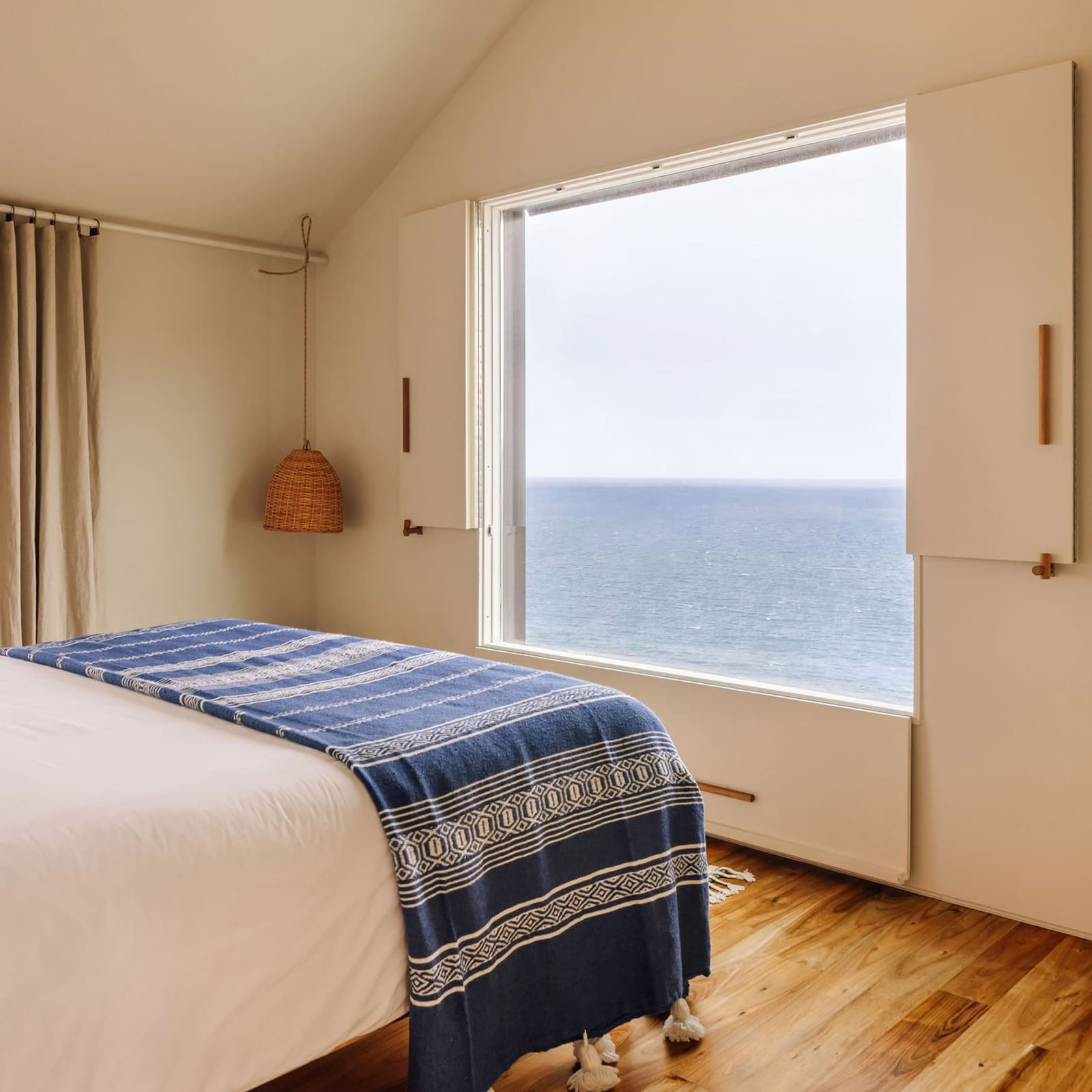
Atelier Backlar's Blue House, perched on a cliff in the Azores, offers a textbook example of how a picture window can distill vastness into something legible. The rectangular opening at the foot of the bedroom captures the Atlantic in its entirety, from the former whaling bay below to the horizon line that bisects sky and water. The white frame acts as a hard boundary, refusing to blend with the deep blue cladding that wraps the exterior. Inside, the bed is oriented perpendicular to the window, which means the view becomes the first and last thing occupants encounter each day. The seascape is not incidental; it is the room's primary furnishing.
A similar logic governs the Redshank artist's studio in Essex, though here the subject matter is more intimate. Lisa Shell designed the cork-clad structure to cantilever over salt marshes, positioning a large picture window in the living area to capture the restless choreography of tidal channels and seabirds. Unlike the static grandeur of the Atlantic, this view is in constant flux, responding to lunar cycles and weather patterns. The window does not frame a singular moment but a temporal sequence, turning the interior into an observation post. The choice of cork, a material typically associated with warmth and absorption, contrasts with the cool, reflective quality of the glass, grounding the viewer even as the landscape outside refuses to settle.
On the Pacific coast of California, Fuse Architects positioned a picture window in the Pajaro Dunes house to capture a more composed tableau: Adirondack chairs arranged on the sand, tall dune grass swaying in the breeze, the ocean beyond. The scene reads almost like a staged photograph, which raises an interesting question about the picture window's role in residential design. Is the architect framing what already exists, or are they creating the conditions for a scene to emerge? In this case, the furniture placement outside feels deliberate, as if the window's presence demands a corresponding visual anchor. The glass does not simply reveal; it organizes.
Interiors That Echo Their Frames
At the Amangiri villa in Utah, the picture window in the bedroom captures the stratified reds and ochres of the desert escarpment, a view so chromatically rich that the interior palette, rendered in browns, beiges, and khakis, feels almost redundant. Yet the repetition is precisely the point. Masastudio's design does not attempt to compete with the landscape; instead, it mirrors it, creating a tonal continuum between inside and outside. The rock face beyond also provides privacy, a secondary function of the picture window that often goes unacknowledged. By framing a natural barrier, the architects eliminate the need for curtains or blinds, allowing the glass to remain unobstructed.
In Suffolk, Mole Architects brought the geometric order of arable farmland into the living room of Alde Valley Barn through a series of white-framed picture windows. The ploughed furrows outside create parallel lines that echo the striations in the rug, the grain of the wood tabletop, and the weave of the upholstery. This is landscape as pattern, a flattening of three-dimensional space into something closer to textile design. The windows do not offer depth so much as surface, a quality that aligns with the barn's own form, a low, horizontal volume that hugs the ground rather than rising above it.
The Nest, a cabin in Canada designed by Daria Sheina Studio, takes a different approach by stacking two black-framed picture windows in a double-height living space. The effect is gallery-like, with the upper window capturing tree canopies and the lower one focusing on trunks and underbrush. The vertical arrangement creates a bifurcated view, allowing occupants to read the forest in layers. Inside, the design reinforces this woodland narrative through whimsical touches: gnome-shaped side tables, a tree stump stool, green flooring that mimics moss. The windows anchor the space, but the interior refuses to remain neutral, actively participating in the conversation between built and natural environments.
Nested Views and the Question of Scale
Bricault Design's Whistler Hideaway in British Columbia demonstrates how picture windows can manipulate the perception of scale and enclosure. The bedroom, lined entirely in wood, features a large opening that frames the surrounding treetops, giving the space a nest-like intimacy despite its relatively generous dimensions. The window is positioned at a height that emphasizes the canopy rather than the ground, a decision that collapses the distance between interior and forest. The effect is immersive without being overwhelming, a careful calibration that depends on both the size of the glass and its placement within the room.
In contrast, the living area at House Grimstad in Norway, designed by Waelgaard Salim Arkitekter, opens onto a more domesticated landscape: a garden with fruit trees and mowed lawns. The spruce-lined walls create a warm, enclosing frame, while the picture window offers a view that feels deliberately picturesque, almost pastoral. The black tar-stained timber cladding on the exterior sharpens the contrast, ensuring that the interior remains a distinct realm even as the glass attempts to dissolve the boundary. This push-pull between enclosure and openness is central to the picture window's appeal; it promises connection while maintaining separation, allowing occupants to engage with the landscape on their own terms.
Precedents and the Modernist Lineage
The picture window as a residential typology has roots in mid-century modernism, where architects like Richard Neutra and Philip Johnson used large, uninterrupted panes to dissolve the boundary between architecture and site. Neutra's Kaufmann Desert House in Palm Springs, completed in 1946, deployed floor-to-ceiling glass to frame the San Jacinto Mountains, turning the living room into a viewing platform. Johnson's Glass House in New Canaan, finished in 1949, took the idea to its logical extreme, making the entire structure a transparent pavilion. Both projects understood that the picture window is not merely a functional element but a philosophical statement, a claim that architecture should defer to landscape rather than dominate it.
The contemporary examples examined here inherit this modernist ethos but apply it with greater nuance. Where Neutra and Johnson often pursued total transparency, today's architects are more selective, using the picture window as one tool among many rather than the defining gesture. The Blue House and the Pajaro Dunes residence embrace transparency, but they also employ solid walls, alcoves, and material contrasts to modulate the relationship between interior and exterior. The picture window becomes a moment of punctuation rather than a continuous condition, which allows it to retain its impact.
Material and Tectonic Considerations
The success of a picture window depends not only on what it frames but also on how it is constructed. Slim profiles and minimal hardware are essential; a thick frame or visible mullions would undermine the device's primary function, which is to appear as immaterial as possible. Advances in structural glazing have made it feasible to span larger distances without intermediate supports, but this comes with trade-offs. Thermal performance, acoustic insulation, and structural integrity all require careful engineering, particularly in climates with extreme temperatures or high wind loads.
The choice of frame material also matters. White-painted steel, as seen in the Blue House and Alde Valley Barn, creates a crisp, graphic boundary that heightens the contrast between interior and exterior. Black frames, used at The Nest and House Grimstad, tend to recede, making the glass itself more prominent. Wood frames, less common in the examples discussed here, offer warmth but can compete with the view if not carefully detailed. In every case, the frame must be substantial enough to support the glass but refined enough to avoid calling attention to itself.
The View as Primary Program
What these projects collectively suggest is that the picture window is not simply an architectural detail but a spatial organizing principle. The view becomes the room's primary program, dictating furniture arrangement, material choices, and even the occupants' daily routines. In the Blue House, the bed faces the ocean; in the Redshank studio, the desk is positioned to overlook the marshes; in the Whistler Hideaway, seating is oriented toward the forest canopy. The architecture does not merely accommodate these views; it choreographs them, ensuring that the act of looking remains central to the experience of inhabiting the space.
This approach has implications for how we think about residential design more broadly. If the view is the primary amenity, then the interior must remain subordinate, a neutral backdrop that does not compete for attention. Yet complete neutrality risks blandness, which is why the most successful examples here, such as The Nest and the Amangiri villa, find ways to echo or complement the landscape without mimicking it. The result is a delicate balance: the interior is distinct enough to feel inhabitable but restrained enough to let the view dominate.
Forward Implications
As urban density increases and access to open landscapes becomes more constrained, the picture window may take on new significance. In cities, where views are often limited to adjacent buildings or narrow sightlines, the device might be used to frame micro-landscapes: a single tree, a pocket garden, a sliver of sky. The principle remains the same, elevating the ordinary into something worth sustained attention through the act of framing.
There is also the question of how climate change will alter the landscapes these windows frame. Rising sea levels, shifting vegetation patterns, and more frequent extreme weather events will inevitably transform the views that architects currently take for granted. The picture window, in this context, becomes a document of change, a fixed aperture through which occupants can witness the gradual or sudden reshaping of their surroundings. Whether this adds poignancy or melancholy to the architectural gesture remains to be seen, but it underscores the fact that the picture window is never truly static. The frame may be fixed, but the view, like all landscapes, is always in motion.
Save this story. A free account keeps your reading list and the 07:00 email in one place.
CREATE FREE ACCOUNT →SIGN IN