
The Architect as Textile Designer
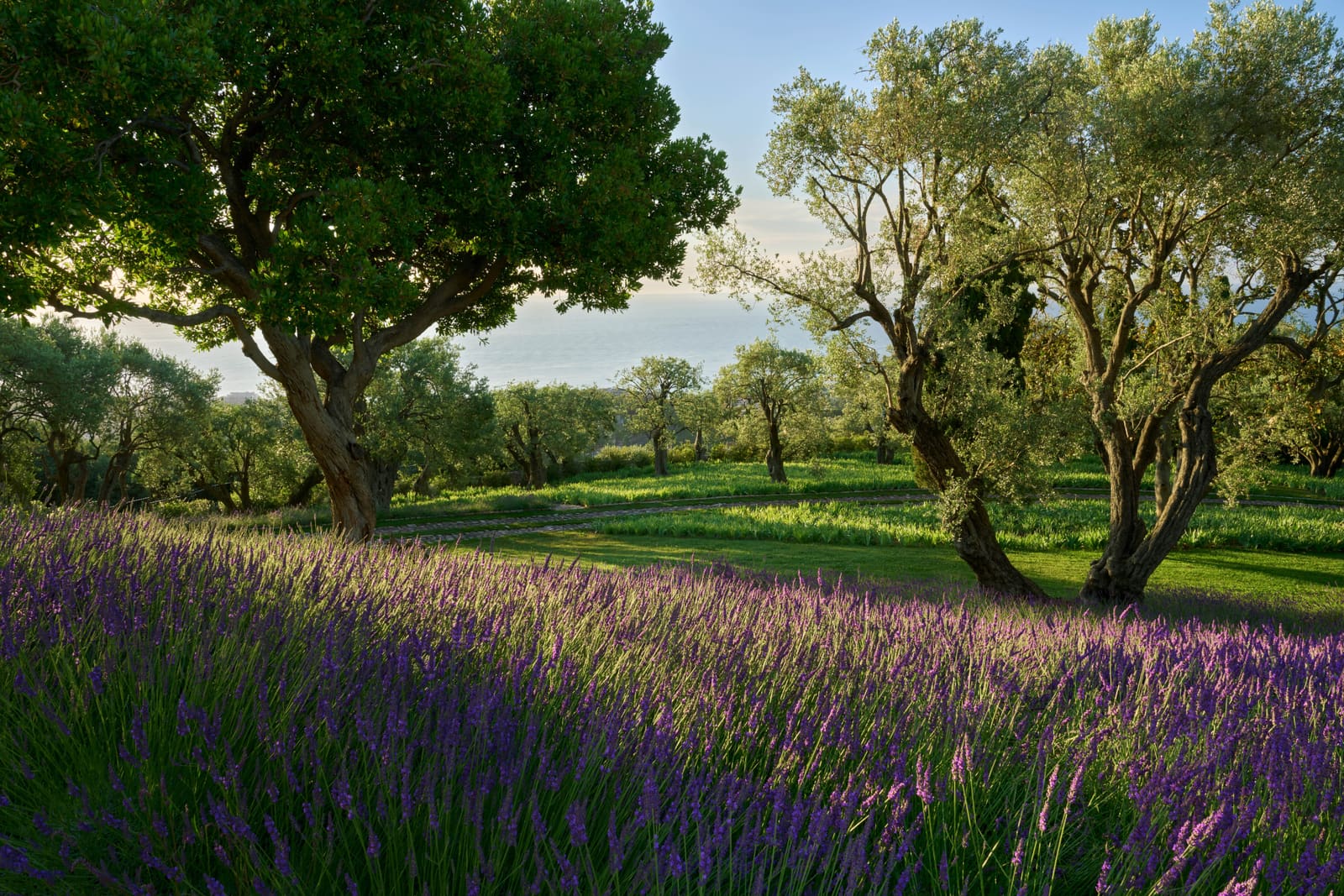
Landscape architecture rarely gets discussed in terms of texture, drape, or hand. Yet when Peter Marino set out to restore La Pausa, the hillside estate Gabrielle Chanel built overlooking the Mediterranean in 1928, he approached the grounds as if laying out bolts of cloth. Lavender cascades down slopes in what the French call a coulée, or flood. Iris beds color-block the terraced land. Wild grasses mix with clover, creating what Marino describes as a textured surface reminiscent of Chanel's signature tweeds. The parallel is not accidental. At World Archi Design, we have long argued that the best designers operate across scales with a consistent material logic. La Pausa offers rare evidence of that principle in reverse: a couturier whose domestic environment anticipated the tactile vocabulary of her fashion.
Chanel purchased the nearly ten-acre site in 1928 with proceeds from her revolutionary couture house and from No. 5, the perfume launched seven years earlier. Working with architect Robert Streitz, she built a sober stone residence partly inspired by the Aubazine convent where she had spent her childhood. The name La Pausa references a fifteenth-century chapel on adjacent land; local tradition holds that Mary Magdalene rested in the shade of Roquebrune's olive trees en route to Marseille. Chanel kept the estate until 1953, shortly before reopening her couture atelier after a nearly fifteen-year hiatus that began with the Second World War.
Precedent and Constraint
The house of Chanel reacquired La Pausa from the heirs of publisher Emery Reves in 2015. Marino, who has designed Chanel boutiques and offices for four decades, was tasked with returning both house and grounds to their 1930s condition. Working with the brand's heritage team, he identified 1935 as the reference year - the moment when Chanel's landscape intentions had fully materialized. The choice of date matters. The mid-1930s coincided with the Depression; austerity was not merely aesthetic but economic. Marino notes that the estate had to feel restrained, even modest, reflecting the broader cultural mood.
During the original construction in 1928 and 1929, Chanel instructed Streitz to preserve two ancient olive trees: one in the center of the entrance walkway, the other in a cloister-like courtyard. The architect designed the house around the courtyard specimen, a gesture that reveals Chanel's priorities. Indigenous vegetation took precedence over architectural symmetry. She retained the scrubby garrigue - wild lavender, iris, cacti, Holm oak - that thrives in the region's heat and aridity. The only non-native additions were a Magnolia grandiflora, whose dark, glossy leaves echo the camellia she favored in Paris but tolerate Mediterranean summers, and a collection of desert species including agave and potted succulents.
Removal as Design
Marino's first move was subtractive. Later owners had introduced palms and other ornamental species that obscured sightlines and diluted the estate's austere character. He removed these additions, reopening views toward Menton in the east and Monaco in the west. The gesture recalls the minimalist interventions of landscape architects like Dan Kiley, who understood that clarity often depends on what you take away.
With the ground cleared, Marino relocated some of the 250 existing olive trees to more advantageous positions, including one that returned to the entrance walk. Many of these specimens are centuries old; the most ancient is estimated at 800 years. To illuminate them, Marino embedded small LED spotlights in the branches, angled downward. The effect mimics moonlight filtering through foliage, casting dappled shadows on the ground even on overcast nights. The technique is simple but reveals an understanding of how artificial light can reinforce natural rhythms rather than compete with them.
Color-Blocking the Land
Once the site had settled, Marino planted broad swaths of lavender and iris across the terraced slopes. He describes the approach as color-blocking, a compositional strategy he associates with Kandinsky. The comparison is apt. Both painter and landscape architect work with fields of hue that shift in intensity depending on vantage point and season. On the front slope, lavender flows downhill in a coulée, a planting style that suggests liquid movement. Lawns were left to grow wild, grass mingling with whatever volunteer species emerged. The result is a variegated surface that changes texture as you move through it - a three-dimensional analog to the irregular weave of a bouclé jacket.
Marino's assertion that the garden reflects Chanel's fashion sensibilities is more than metaphor. Both systems rely on contrast between rough and refined, between indigenous material and deliberate composition. A tweed suit juxtaposes coarse yarn with precise tailoring. The La Pausa landscape juxtaposes wild garrigue with geometric beds of iris. In each case, the tension between control and spontaneity generates visual interest.
Sensory Sequence
The experience of approaching La Pausa unfolds as a sequence of scents. Jasmine vines cloak the stone walls along the cobblestone drive. An iris field releases a softer fragrance to the right. At the top, lavender saturates the air. Two of these three plants - jasmine and iris - are ingredients in Chanel No. 5, a detail that underscores the designer's integration of place, product, and identity. The estate was not simply a retreat but a kind of laboratory where olfactory and spatial ideas could develop in parallel.
The house itself is organized around the cloister courtyard, with its central olive tree. The great hall, living room, and dining room radiate from this open-air core. Chanel displayed plants in simple clay pots, a gesture that Marino has replicated. The choice of vessel matters. Terracotta is porous, inexpensive, and ubiquitous in Mediterranean vernacular architecture. It signals an anti-decorative stance, a refusal of the ornate planters that typified bourgeois interiors of the period.
Contemporary Use and Future Program
La Pausa remains private, hosting occasional company events and artist residencies. The inaugural residency in autumn 2025 accommodated writers; a second program for composers is planned for the following summer, culminating in a concert on the grounds. The choice of disciplines is telling. Both writing and composition are temporal arts that unfold over time, much like the seasonal cycles of a garden. Chanel's own circle included composer Erik Satie and pianist Misia Sert, who performed at the estate during her tenure. Marino's programming honors that legacy while adapting it to contemporary practice.
In spring 2026, Matthieu Blazy, Chanel's creative director, selected La Pausa as the setting for the advertising campaign accompanying his first ready-to-wear collection. Models climbed the courtyard olive tree, recreating photographs of Chanel herself from nearly a century earlier. The campaign literalizes the relationship between fashion and landscape, treating the estate not as backdrop but as co-author of the brand's visual language.
Material Intelligence Across Scales
What makes La Pausa architecturally significant is not its historical association with a famous designer but the consistency of material thinking it represents. Chanel applied the same principles to site planning that she brought to garment construction: respect for indigenous resources, restraint in ornament, and an understanding that texture can carry as much information as form. Marino's restoration succeeds because it recognizes this continuity. He does not attempt to freeze the estate in amber but instead identifies the design logic that animated Chanel's original decisions and extends it forward.
The comparison to tweed is instructive. A tweed fabric gains its character from irregularity - slubs, color variation, the interplay of warp and weft. A perfectly uniform surface would defeat the purpose. Similarly, the La Pausa landscape derives its interest from controlled wildness: grasses that grow as they will, ancient trees that dictate circulation, native scrub that asserts itself between cultivated beds. The designer's task is not to eliminate these variables but to compose with them, to establish a framework within which spontaneity can occur.
This approach has precedents in twentieth-century landscape practice. Roberto Burle Marx's Brazilian gardens combined indigenous flora with abstract geometries. Geoffrey Jellicoe's work at Sutton Place layered historical reference with modernist form. Yet Chanel's contribution predates both, emerging from a fashion designer's intuition rather than formal training in landscape architecture. That intuition was grounded in material: how things feel in the hand, how they weather, how they combine.
The Discipline of Restraint
Marino notes that the estate induces a particular mental state, a freedom from distraction that he finds rare. The observation points to a quality that eludes quantification but that any designer recognizes: the capacity of a well-resolved environment to quiet the mind. That quality does not result from picturesque beauty or dramatic views - though La Pausa offers both - but from coherence. Every element, from the LED spotlights angled downward in the olive branches to the terracotta pots in the cloister, reinforces the same set of values. Nothing is extraneous. Nothing competes for attention.
This discipline of restraint is what connects Chanel's fashion work to her landscape work. A well-cut jacket eliminates visual noise, allowing the wearer's form to read clearly. A well-composed garden eliminates botanical clutter, allowing the site's essential character to emerge. In both cases, the designer's intelligence manifests not in what is added but in what is withheld.
As climate pressures intensify and resources contract, the La Pausa model gains relevance. Indigenous planting reduces water demand. Passive lighting strategies minimize energy consumption. Durable materials like stone and terracotta age gracefully, requiring little maintenance. These are not incidental virtues but core principles of the project, principles that Chanel articulated nearly a century ago and that Marino has translated into contemporary practice. The estate demonstrates that sustainability need not be austere in the pejorative sense - that restraint, when guided by material intelligence, can yield environments of enduring richness.
Save this story. A free account keeps your reading list and the 07:00 email in one place.
CREATE FREE ACCOUNT →SIGN IN