
A Name Restored, a Discipline Challenged
In architectural historiography, certain names command immediate recognition while others remain stubbornly marginal, their contributions folded into the achievements of better-known collaborators. Lilly Reich belongs to the latter category, though not for lack of significance. Her work alongside Ludwig Mies van der Rohe on projects ranging from exhibition design to the iconic Barcelona Pavilion has been extensively documented, yet her independent voice and theoretical contributions have only recently begun receiving sustained scholarly attention. That we now have a grant bearing her name, administered by the foundation honoring her most famous collaborator, signals something more than symbolic redress. It represents an institutional acknowledgment that architectural history has been incompletely told.
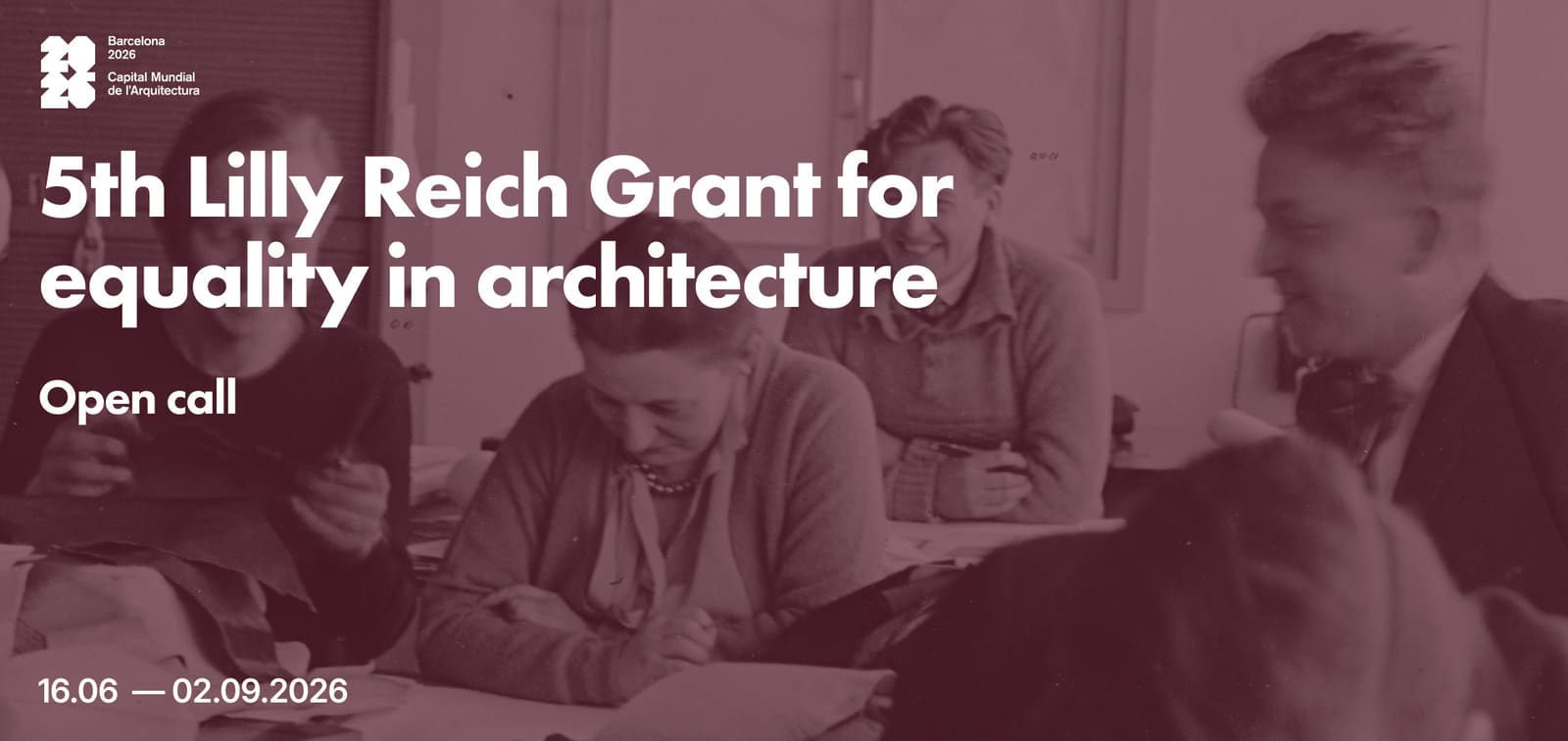
The Fundació Mies van der Rohe has opened submissions for the fifth iteration of the Lilly Reich Grant, an initiative that funds research examining equality, diversity, and inclusion across the discipline. While previous cycles invited proposals spanning any aspect of these themes, this year's call places particular emphasis on Reich herself: her design philosophy, professional trajectory, pedagogical methods, and the cultural conditions that shaped her career. Researchers are encouraged to investigate her legacy through contemporary lenses, though the foundation makes clear that projects addressing other historical periods, geographies, or theoretical frameworks remain welcome.
Rewriting Modernism's Authorship Problem
Architectural modernism has long been narrated as a story of heroic individuals, most of them men, working in splendid isolation or leading hierarchical ateliers. The canon celebrates singular genius, an approach that obscures the collaborative, interdisciplinary nature of much twentieth-century design work. Reich's case exemplifies this erasure. She managed Mies van der Rohe's Berlin studio, led interior design courses at the Bauhaus, and contributed material sensibility and spatial intelligence to projects that bear only his name. Her expertise in textiles, furniture, and exhibition architecture brought a tactile, human scale to Mies's often austere formal vocabulary, yet credit rarely followed.
At World Archi Design, we have tracked a growing body of scholarship that interrogates these attribution imbalances. Historians like Beatriz Colomina and Despina Stratigakos have demonstrated how gender shaped not only who designed buildings but also how those buildings were documented, published, and remembered. Reich's restoration to the historical record is part of a broader project to recover the work of Charlotte Perriand, Aino Aalto, Denise Scott Brown, and countless others whose contributions were minimized or erased. The grant named in her honor extends this work, funding research that can deepen our understanding of how modernism was actually produced, not how it was mythologized.
Scope and Ambition: Beyond Biographical Correction
While the fifth edition foregrounds Reich, the grant's mandate extends well beyond biographical recuperation. Applicants may propose research on any dimension of equality in architecture, encompassing gender, race, class, disability, and other axes of identity that have structured access to education, professional advancement, and historical recognition. This capacious definition reflects a discipline-wide shift toward more inclusive narratives, one that recognizes architecture as a social practice shaped by power relations, not merely a sequence of formal innovations.
Proposals might examine how building codes and zoning regulations have perpetuated segregation, how design education reproduces exclusionary norms, or how contemporary practices are experimenting with cooperative ownership and participatory design. They might investigate the spatial politics of accessibility, the environmental racism embedded in infrastructural planning, or the ways Indigenous building traditions have been marginalized by Eurocentric historiography. The grant's flexibility allows researchers to pursue questions that traditional funding mechanisms often neglect, prioritizing work that challenges disciplinary orthodoxies rather than reinforcing them.
Institutional Context: The Foundation's Evolving Mission
The Fundació Mies van der Rohe has, over recent decades, expanded its role from custodian of a single canonical structure to a platform for critical engagement with modernism's legacies. The foundation administers the European Union Prize for Contemporary Architecture, co-organizes exhibitions and symposia, and maintains the Barcelona Pavilion as both monument and pedagogical tool. Establishing a grant focused on equality represents a logical extension of this mission, aligning the foundation with broader conversations about whom architecture serves and whose voices shape its future.
This institutional evolution mirrors shifts across the discipline. Architecture schools are revising curricula to include non-Western traditions and marginalized practitioners. Professional organizations are implementing diversity initiatives, however imperfectly. Journals and conferences increasingly feature scholarship on topics that would have been considered peripheral a generation ago. The Lilly Reich Grant participates in this transformation, providing material support for research that might otherwise struggle to secure funding from more conservative institutions.
Methodological Possibilities: Archives, Oral Histories, and Spatial Analysis
Research on equality in architecture demands methodological creativity. Traditional archives often contain few traces of figures like Reich, whose work was frequently credited to others or simply not preserved. Scholars must therefore employ alternative strategies: oral histories with practitioners whose experiences have not been documented, spatial analysis of buildings to reveal how design encodes social hierarchies, or comparative studies that foreground non-canonical geographies.
Some of the most compelling recent scholarship has emerged from these approaches. Researchers have used building permit records to reconstruct the contributions of women and minority-owned firms, analyzed the spatial layouts of domestic architecture to understand changing gender roles, or traced networks of influence among designers working outside major metropolitan centers. The grant's emphasis on generating debate as well as research suggests that successful proposals will not merely recover lost histories but also articulate their contemporary relevance, connecting past erasures to present inequalities.
The Reich Effect: Material Intelligence and Spatial Intimacy
Reich's own practice offers instructive precedents for contemporary designers grappling with sustainability and human-scaled design. Her background in textile and fashion design informed a material sensibility that prioritized tactility, color, and flexible spatial arrangements. In exhibition projects for the Deutscher Werkbund and later commercial clients, she developed modular systems that could adapt to different contexts and user needs. This approach, collaborative and responsive rather than authorial and fixed, suggests alternative models for architectural practice that remain relevant today.
Her pedagogical work at the Bauhaus further underscores her emphasis on material experimentation and interdisciplinary thinking. Students in her interior design courses worked across media, exploring how fabrics, furniture, and lighting could transform spatial experience. This holistic approach anticipated later developments in environmental design and biophilic architecture, fields that reject the separation of structure from surface, form from atmosphere. Recovering Reich's methods might therefore yield not only historical insight but also practical strategies for designers seeking to move beyond the formal preoccupations that have dominated much modernist and post-modernist practice.
Regional Resonances: Equality Agendas Across Contexts
While the grant originates from a European institution and foregrounds a German designer, its thematic concerns resonate globally. Architecture's gender and diversity gaps are not unique to any single region, though they manifest differently across cultural contexts. In many parts of Asia, Africa, and Latin America, women and minority practitioners face barriers that mirror those Reich encountered, compounded by postcolonial legacies and economic inequalities. Research examining these regional specificities can enrich the global conversation, revealing how local conditions shape both exclusion and resistance.
We have seen, for instance, how women architects in India have navigated caste and gender hierarchies to establish independent practices, or how Black architects in the United States have used design as a tool for community empowerment and spatial justice. These stories, often marginalized in Eurocentric accounts, demonstrate the diversity of architectural practice and the myriad ways designers have challenged inequitable systems. The Lilly Reich Grant, by welcoming proposals from any geography, creates space for these narratives to enter the institutional record and inform pedagogy and practice worldwide.
What This Funding Model Signals
Grants like this one represent more than financial support. They signal institutional priorities, legitimize certain forms of inquiry, and create networks of scholars working on related questions. By naming the grant after Reich and centering it on equality, the Fundació Mies van der Rohe asserts that these concerns are central to understanding modern and contemporary architecture, not peripheral or supplementary. This framing matters, particularly for early-career researchers whose work might otherwise be dismissed as niche or ideologically motivated.
The grant also models a form of institutional self-reflection. The foundation, built around the legacy of a canonical male architect, acknowledges that legacy's incompleteness and actively funds research to complicate and enrich it. This approach contrasts with institutions that treat their founding figures as untouchable icons, resisting any scholarship that might reveal their limitations or dependencies. By embracing complexity, the foundation positions itself as a site of ongoing inquiry rather than static commemoration.
Looking Forward: Research as Catalyst
The deadline for submissions will bring proposals from across the discipline, each articulating a vision of what architectural equality might mean and how research can advance it. Some will focus narrowly on Reich, mining archives for overlooked correspondence or re-evaluating specific projects. Others will take her career as a point of departure for broader investigations into gender, collaboration, and historiography. Still others will pursue entirely different lines of inquiry, connected to Reich only thematically, through shared concerns with inclusion and justice.
What unites these diverse projects is a conviction that architecture's past has been selectively remembered and that correcting this selectivity requires more than adding names to existing narratives. It demands new frameworks for understanding how buildings come into being, who benefits from their construction, and whose knowledge and labor make them possible. The Lilly Reich Grant funds this work not as an act of charity but as an investment in the discipline's intellectual future, recognizing that architecture cannot address contemporary challenges without first reckoning with its exclusionary histories.
As the fifth cycle opens, the grant continues to expand the field's sense of what counts as architectural knowledge and who gets to produce it. In doing so, it honors Reich not through hagiography but through the kind of rigorous, critical inquiry her own practice exemplified: attentive to material realities, responsive to human needs, and committed to finding new solutions within existing constraints.
Save this story. A free account keeps your reading list and the 07:00 email in one place.
CREATE FREE ACCOUNT →SIGN IN