
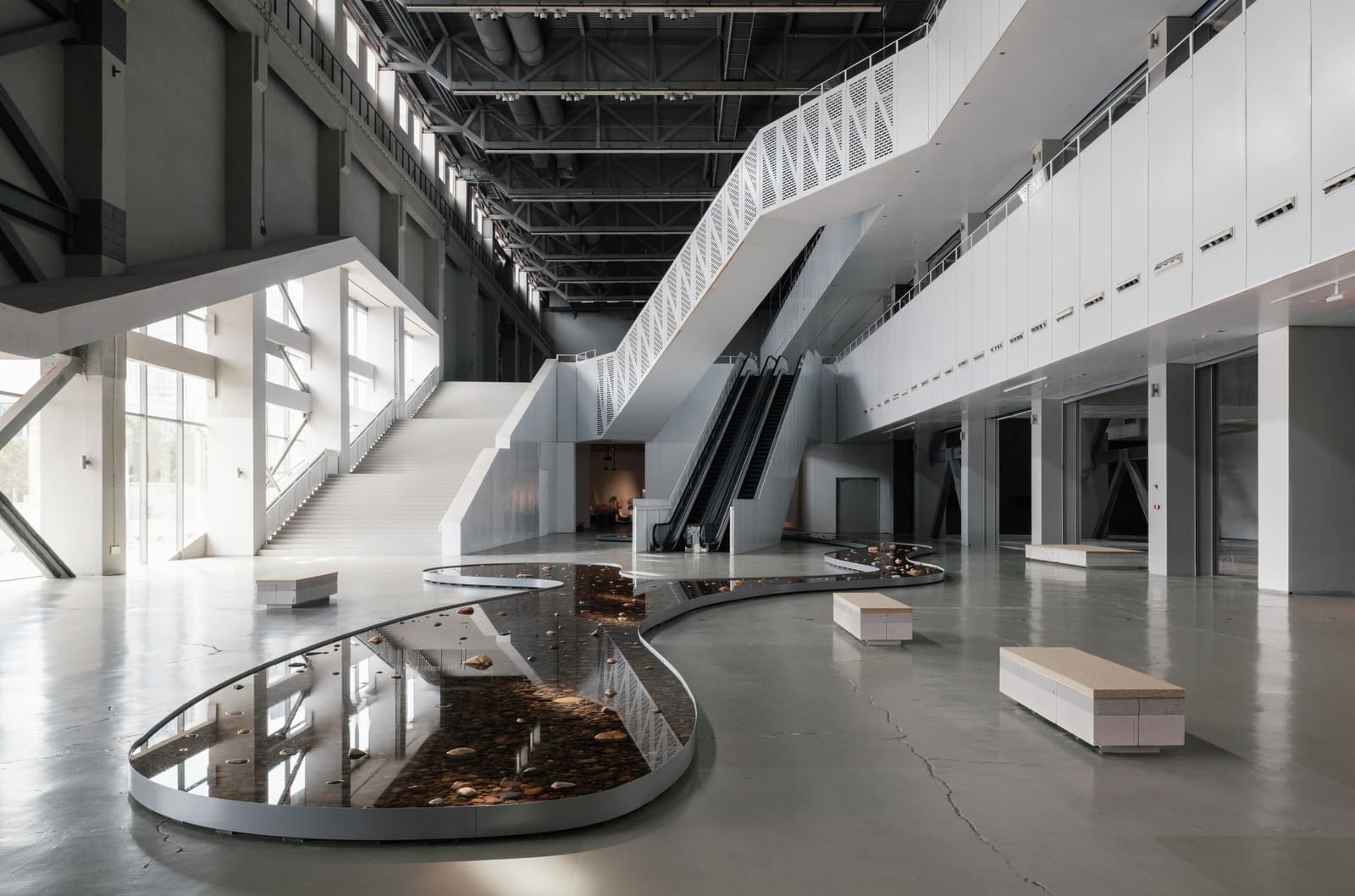
A Pond That Travels Continents
The first thing visitors encounter at the Power Station of Art in Shanghai is water. Not a fountain, not a reflecting pool in the conventional sense, but a replica of an interior element from SESC Pompéia that embodies something much larger: the São Francisco River threading through Brazil. Reproduced at its original scale yet lifted slightly above ground, the installation appears to hover, its surface animated by four ceiling-mounted outlets that drip steadily, compensating for evaporation while creating ripples that catch and scatter light. Pebbles of varying dimensions line the bottom, a textured memory of riverbeds and geological time.
This threshold gesture sets the tone for what unfolds beyond. Running through 25 October 2026, "The Poetics of Survival" marks the first exhibition in China dedicated to Lina Bo Bardi, the Italian-born architect whose practice became inseparable from mid-century Brazilian culture and society. Curated by Renato Anelli and occupying 2,300 square meters within the Huangpu district museum, the show deliberately resists the retrospective label. Instead, it frames itself as an encounter with a designer whose work functioned as a survival mechanism during periods of historical rupture and political turbulence.
Material as Narrative Device
OPEN Architecture, responsible for the exhibition design, approached the 2,300-square-meter ground-floor gallery as a problem in spatial storytelling. The solution: a single continuous curve constructed from natural linen that meanders through the rectangular volume, defining nine interconnected zones without rigid compartmentalization. The fabric acts as both divider and screen, soft enough to receive projections yet substantial enough to anchor a sequence of thematic territories.
The choice of linen was deliberate. Lightweight, reusable, and carrying an earthy tactility, the material echoes qualities central to Bo Bardi's own design language: modesty, adaptability, and an economy of means. Exhibition texts are silkscreen-printed directly onto the cloth, eliminating the need for separate didactic panels. Openings between sections are positioned at the center of each enclosure, with the linen gently lifted to create passageways that visitors move through like curtains, heightening the sense of transition from one aspect of Bo Bardi's multifaceted practice to another.
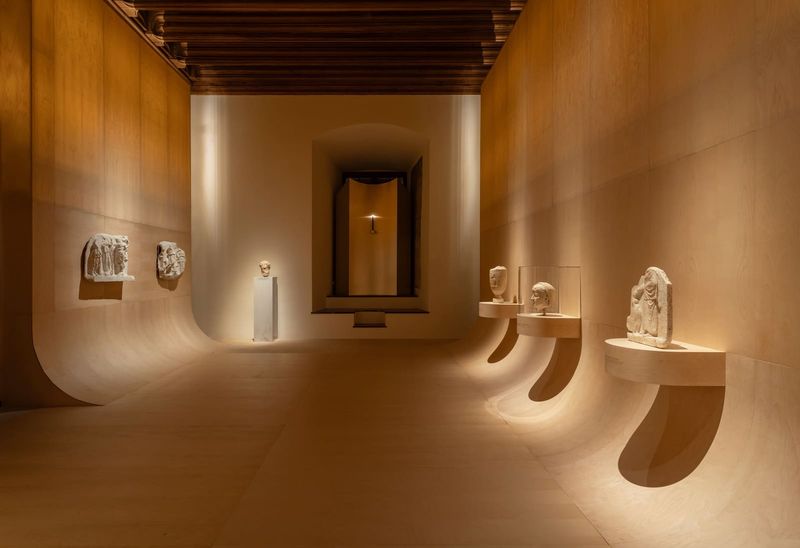
Architectural models and artifacts occupy the gallery as freestanding islands, distributed across the floor rather than fixed to walls. Overhead and wall-washing fixtures cast warm illumination on the objects themselves while keeping supporting structures in shadow, lending the displayed work a quality of suspension. The strategy recalls Bo Bardi's own exhibition designs, which frequently blurred the line between display and inhabitation.
Furniture, Rebars, and the Language of Assemblage
OPEN's intervention extends to custom elements designed specifically for the show. The Beam Bench and display cabinets were conceived to support the exhibition's material logic. A divider separating the ticketed zone in the museum lobby combines Bo Bardi's signature concrete base for glass panels with red wood latticework borrowed from SESC Pompéia. Rocks from the pond installation double as weights anchoring the linen fabric. Plywood strips are assembled into platforms for models and furniture. Rebars, typically hidden within concrete, are folded into brackets that replace conventional museum distance barriers.
This approach to exhibition infrastructure reflects a broader alignment with Bo Bardi's design ethos. She worked across scales and media with a fluidity that contemporary practice often struggles to achieve: architecture, furniture, set design, folk art, and writing were not separate disciplines but overlapping modes of engagement. The Shanghai exhibition attempts to mirror that multiplicity, weaving together drawings, sketches, models, photographs, and video projections within a single spatial continuum.
The Poetics of Survival as Design Principle
The exhibition's title borrows from a late-20th-century concept describing how creative production becomes a tool for enduring trauma, whether historical oppression, political violence, or systemic crisis. In Bo Bardi's case, the framework addresses a practice shaped by her move from postwar Italy to Brazil, her navigation of military dictatorship, and her deep investment in the social fabric of her adopted country. Her work was not simply responsive to context; it was constituted by it, absorbing and transforming the lived experiences of a particular time and place.
This is most evident in projects like SESC Pompéia, a cultural center carved from an abandoned factory in São Paulo, where Bo Bardi preserved the industrial character of the existing structure while inserting new programs and spatial logics. The indoor pond, now recreated in Shanghai, was part of that larger gesture: an invocation of Brazil's geography within an urban leisure complex, a reminder that architecture can hold multiple scales of meaning simultaneously.
At World Archi Design, we have noted a growing interest in architects whose work resists easy categorization, practitioners whose output spans furniture, exhibition design, and built form with equal commitment. Bo Bardi remains a touchstone in this regard, her practice offering a model for how design can engage culture without collapsing into mere aestheticization.
Contextualizing the Encounter
Presenting Bo Bardi's work in China introduces a productive friction. Her architecture emerged from a specific set of conditions: postwar reconstruction, the aspirations of Brazilian modernism, the tensions between industrialization and vernacular tradition. Transplanting that legacy into a contemporary Shanghai art institution raises questions about how design ideas travel, what gets lost or amplified in translation, and whether spatial empathy can bridge vastly different cultural and political landscapes.
OPEN Architecture's design acknowledges this gap by foregrounding materiality and phenomenology over didactic explication. The linen curtains, the hovering pond, the suspended objects, all work to create an atmospheric field rather than a linear narrative. Visitors move through the exhibition not as passive consumers of information but as participants in a spatial choreography that mirrors the improvisational, socially embedded quality of Bo Bardi's own projects.
The exhibition also arrives at a moment when Chinese architecture is grappling with questions of cultural identity, the legacy of rapid urbanization, and the role of design in addressing social inequity. Bo Bardi's example, rooted in a different geography but animated by similar concerns, offers a comparative lens. Her insistence on dissolving boundaries between high and low culture, her attention to craft and local materials, her refusal to treat architecture as a purely formal exercise, these positions resonate beyond their original context.
Precedents and Parallels
Bo Bardi's approach to exhibition design itself constitutes a body of work worth examining. Her 1968 installation for "A Mão do Povo Brasileiro" (The Hand of the Brazilian People) at MASP featured artifacts suspended on glass panels, creating a floating display that rejected hierarchical distinctions between fine art and folk craft. That sensibility, privileging the object's presence over its categorization, informs the Shanghai exhibition's spatial strategy.
Comparisons might also be drawn to Carlo Scarpa's museum interventions, where architecture and curation merge into a single act of spatial editing. But where Scarpa often worked with precision-cut stone and intricate joinery, Bo Bardi favored rougher textures, exposed construction, and materials that bore the marks of their making. The linen curtains in Shanghai, with their creases and translucency, align more closely with this latter tradition.
The Exhibition as Archive and Argument
Beyond its role as a display mechanism, "The Poetics of Survival" functions as an argument about how we remember and transmit architectural knowledge. The decision to organize the exhibition around a continuous curve rather than discrete rooms or chronological sections suggests that Bo Bardi's practice cannot be easily segmented. Her furniture designs inform her architectural thinking; her writing shapes her spatial interventions; her engagement with Brazilian folk traditions feeds back into her modernist vocabulary.
This integrative approach challenges the disciplinary boundaries that still structure much architectural discourse. Schools and publications tend to separate practice into categories: residential, institutional, commercial, temporary installations. Bo Bardi's work resists that taxonomy, and the Shanghai exhibition design attempts to honor that resistance by creating a spatial experience that is similarly porous and multi-scalar.
The exhibition also raises questions about the role of replication and reproduction in architectural exhibitions. The pond from SESC Pompéia is not the original but a full-scale recreation, built with the same dimensions yet inevitably transformed by its new context. Is this a faithful homage or a kind of spatial translation? Does the meaning shift when an element designed for a São Paulo cultural center appears in a Shanghai art museum? These are not questions the exhibition answers directly, but they hover at its edges, implicit in the decision to stage such an encounter in the first place.
Looking Forward
As the exhibition continues through October, it joins a broader conversation about how institutions outside the West engage with modernist legacies. The show coincides with other international exhibitions examining architecture's relationship to political independence, urban transformation, and cultural memory. Each of these projects grapples with similar challenges: how to present historical work without flattening its complexity, how to make space for multiple readings, how to avoid reducing architecture to a series of aesthetic gestures divorced from their social and political contexts.
For visitors unfamiliar with Bo Bardi's work, the Shanghai exhibition offers an entry point into a practice that defies easy summary. For those already versed in her projects, it provides an opportunity to see familiar work through a different spatial and cultural lens. Either way, the exhibition succeeds in staging what OPEN Architecture describes as an encounter, not with a fixed historical figure but with a set of ideas and approaches that remain urgent and unresolved.
Save this story. A free account keeps your reading list and the 07:00 email in one place.
CREATE FREE ACCOUNT →SIGN IN