
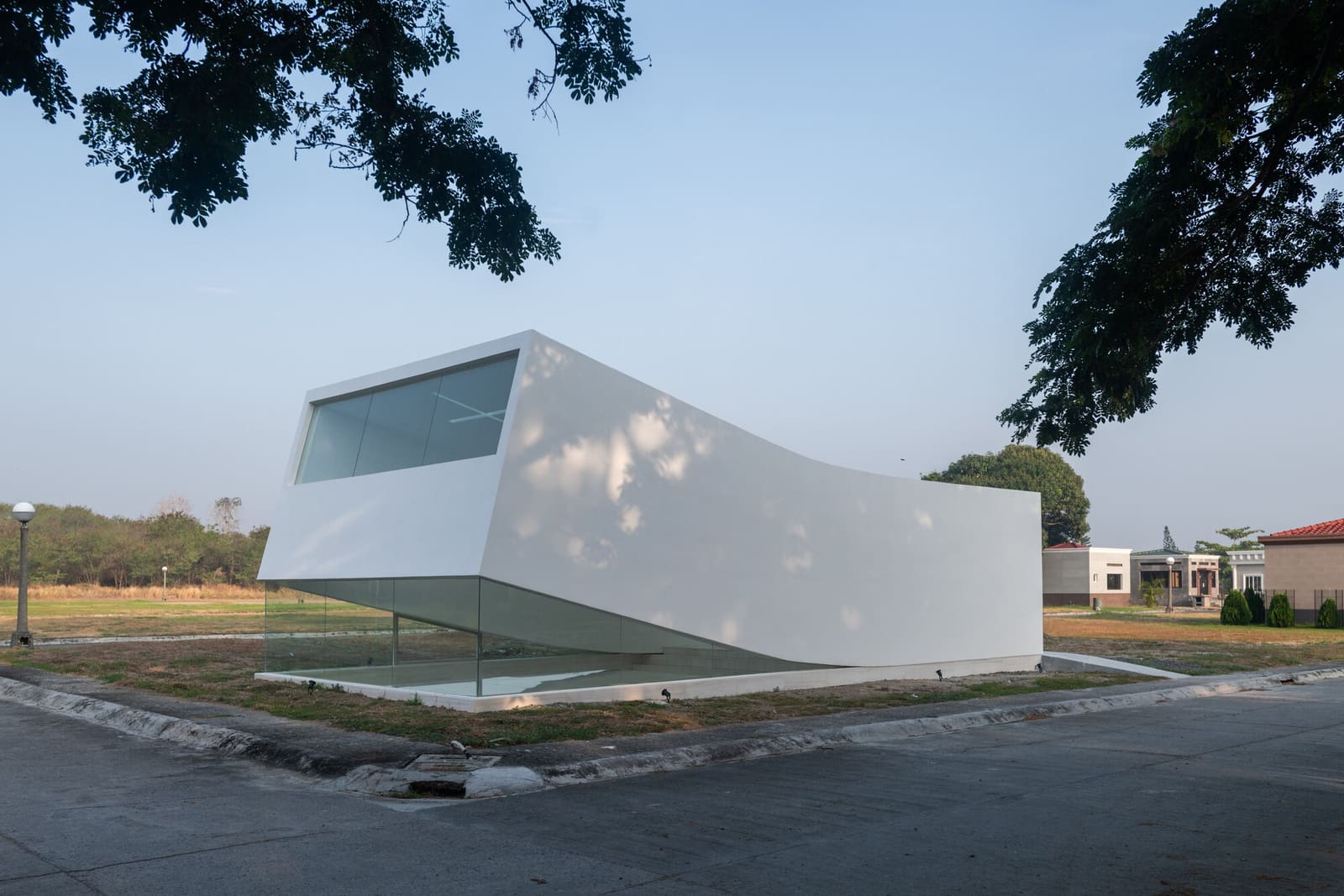
The Architecture of Grief, Redirected
Funerary architecture has, for centuries, directed our attention earthward. Tombs are subterranean. Crypts descend. Even the language we use to describe death suggests a downward trajectory: we speak of the departed as "laid to rest," of bodies "interred" beneath the soil. Jim Caumeron's Exalt mausoleum, completed in 2026 on an 88-square-meter site in Muntinlupa, Philippines, proposes a different spatial logic altogether. Here, the architecture asks visitors to lift their eyes.
The project was commissioned under unusual circumstances. The family patriarch who requested the mausoleum was still living at the time of design, a detail that fundamentally shaped the brief. Rather than a memorial to a concluded life, the structure became something more ambiguous: a space for contemplating mortality while still inhabiting it. This temporal dislocation, between the living and the eventual dead, demanded an architectural response that could hold both states without collapsing into morbidity.
A Reversal of Typology
At World Archi Design, we've observed a persistent tendency in contemporary funerary projects to soften death through landscape integration or material warmth. Exalt takes a different path. Rather than making death more palatable, Caumeron inverts the architectural conventions that have long shaped how we encounter it. Where traditional mausoleums emphasize weight, enclosure, and the pull of the earth, this project explores verticality and openness.
The spatial organization resists the crypt's typical inward collapse. Instead of guiding mourners into progressively darker, more compressed chambers, the mausoleum establishes a vertical axis that draws the eye skyward. This is not merely a formal gesture; it reconfigures the phenomenology of the visit. The act of mourning, traditionally associated with introspection and a kind of psychological descent, is here reframed as an opportunity for elevation, both literal and metaphorical.
Material and Tectonic Decisions
Caumeron worked with A.I.A. Construction and structural consultants Arriesgado Engineering to realize a design that could support this vertical ambition without overwhelming the modest footprint. At 88 square meters, the mausoleum operates within tight spatial constraints, demanding precision in every tectonic decision. The structure's envelope balances solidity with permeability, allowing controlled light penetration that shifts throughout the day.
The choice of materials reinforces the project's conceptual framework. Rather than the heavy stone or sealed concrete typical of funerary architecture, the palette here includes elements that admit light and air. This is not transparency for its own sake, but a deliberate strategy to counter the hermetic quality that so often defines spaces for the dead. Kohler fixtures contribute to the material vocabulary, integrating functional elements with the overall spatial composition.
Structural engineer Arriesgado Engineering's contribution was critical in achieving the vertical emphasis without sacrificing stability. The massing reads as grounded yet aspirational, a balance that echoes the project's conceptual duality: a place rooted in the earth but oriented toward the sky.
Precedent and Context
Exalt invites comparison with other architects who have challenged funerary typology. Carlo Scarpa's Brion Cemetery in San Vito d'Altivole remains a touchstone for anyone rethinking memorial space, its layered geometries and water elements transforming a graveyard into a meditative landscape. More recently, David Chipperfield's Cemetery and Funeral Complex in Inagawa, Japan, employed austere concrete volumes to create a contemplative procession through grief. Both projects share with Exalt a refusal to sentimentalize death, opting instead for spatial rigor.
Yet where Scarpa and Chipperfield worked at the scale of the cemetery, embedding individual tombs within larger landscapes or complexes, Caumeron's project is singular and private. This intimacy changes the stakes. There is no collective ritual to structure the experience, no procession of mourners to animate the space. The mausoleum must function for an audience of one or two, in moments of solitary reflection. The upward orientation becomes, in this context, a way of breaking the isolation that private grief can impose.
The Living Client and the Architecture of Anticipation
The fact that the patriarch commissioned the mausoleum while alive introduces a peculiar temporal dimension. The building exists, for now, as a kind of rehearsal space, an architecture inhabited not by memory but by anticipation. This is rare in funerary design, where the architect typically responds to a loss already sustained. Here, the client's agency persists throughout the design process, shaping decisions in real time.
This dynamic raises questions about how we design for future absence. The mausoleum must serve two temporalities: the present, in which the patriarch might visit and contemplate his own mortality, and the future, in which surviving family members will come to mourn. Caumeron's solution, to orient the space upward, offers a gesture that can accommodate both. For the living client, the upward gaze suggests possibility, continuation, perhaps even transcendence. For future mourners, it offers a counterpoint to grief's gravitational pull.
Reframing Memorial Space
Exalt's contribution to contemporary funerary architecture lies not in formal invention but in conceptual reorientation. The project demonstrates that the language of death in architecture need not be fixed or universal. By questioning the downward gaze, Caumeron opens space for other readings: mourning as elevation, remembrance as aspiration, the tomb as a site of preparation rather than conclusion.
In a discipline where precedent often dictates form, projects like Exalt remind us that even the most tradition-bound typologies remain open to reinterpretation. The mausoleum's modest scale and private program might limit its influence, but its conceptual gesture, the simple act of asking visitors to look up rather than down, suggests possibilities for how architecture can hold the complexities of mortality without collapsing into convention.
Save this story. A free account keeps your reading list and the 07:00 email in one place.
CREATE FREE ACCOUNT →SIGN IN