
The Brief That Shouldn't Exist
When an embodied intelligence company asks its architects for a "low-tech feel," something interesting is happening beneath the surface of the request. Bothaus, a 300-square-metre reception and exhibition space designed by HCCH Studio for Sudo Technology, occupies the lower floor of a Shanghai tower along the Yangpu waterfront. The brief itself reads like a provocation: create a space for robotics demonstrations and client meetings that refuses the visual language technology companies have spent decades perfecting.
At World Archi Design, we've tracked the evolution of tech-office interiors from the server-room aesthetic of the early 2000s through the obligatory exposed ceilings and neon signage of the 2010s. Bothaus suggests a different trajectory altogether. The project sits below Sudo's offices and robotics laboratory, functioning as both café and demonstration environment for invited users. Yet the design language eschews the glossy futurism one might expect. Instead, HCCH Studio interpreted the client's counterintuitive directive as an argument about ubiquity: when technology becomes genuinely embedded in daily experience, it stops announcing itself.
Material Restraint as Spatial Argument
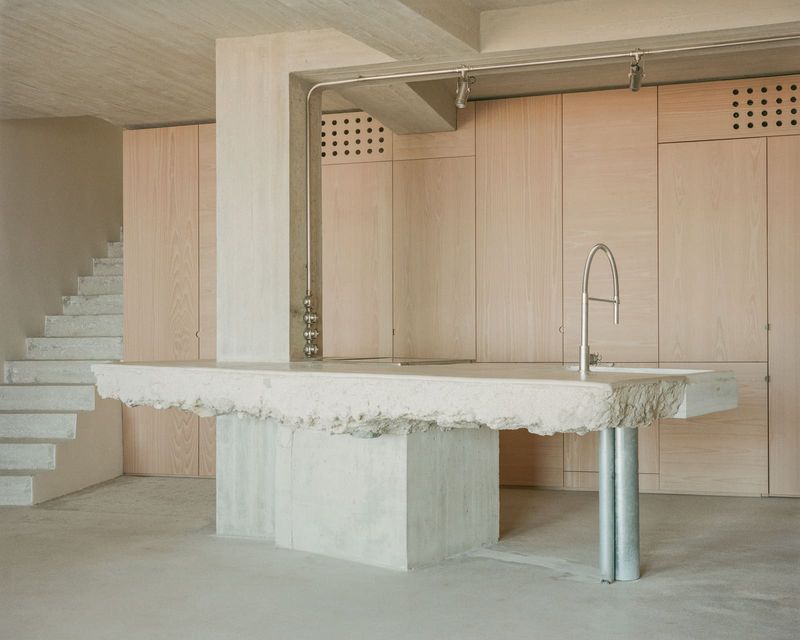
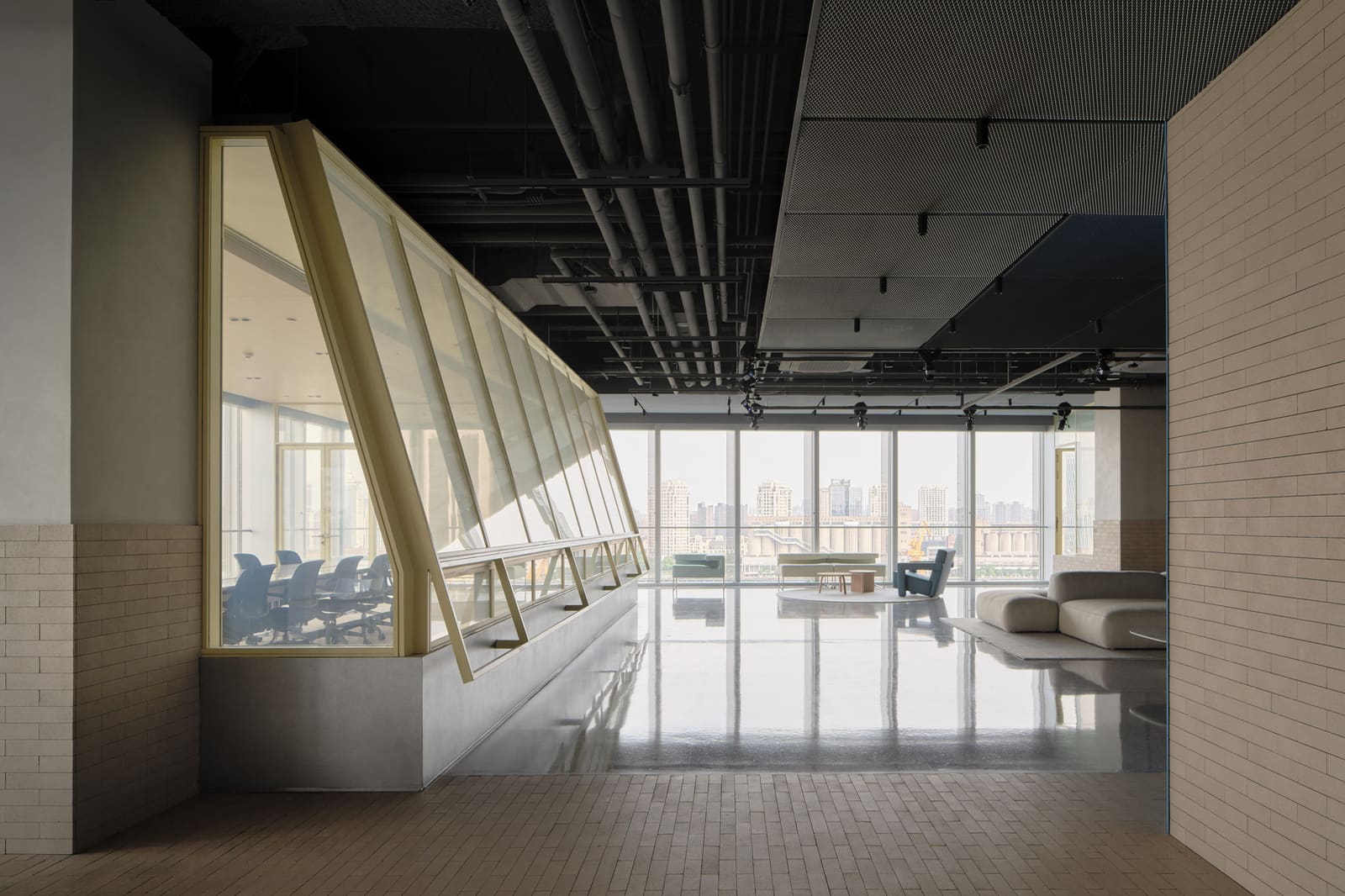
The 300-square-metre footprint unfolds through a sequence of zones unified by restrained materiality. HCCH Studio employed timber, concrete, and steel in their most straightforward expressions. Timber framing defines the primary seating areas without attempting decorative complexity; concrete surfaces remain largely untreated; steel elements appear as structural necessities rather than sculptural gestures. This is not minimalism for its own sake but rather an active suppression of technological signifiers.
The design team, led by Hao Chen and Chenchen Hu with contributions from Qisen Yang, Puchun Zhang, and Yazhou Ding, appears to have studied the problem of how physical space can accommodate advanced technology without becoming subservient to it. Fenestration along the waterfront elevation admits natural light across work surfaces and seating platforms, establishing a rhythm that privileges human occupation over equipment display. The ceiling plane remains legible, avoiding the false complexity of exposed services that has become shorthand for innovation districts worldwide.
Programme as Hybrid Typology
Bothaus functions simultaneously as coffee shop, reception area, and robotics demonstration space. This programmatic overlap creates specific spatial demands. The architecture must accommodate casual social interaction, formal client presentations, and the operational requirements of embodied AI systems, all within a modest floor area. HCCH Studio's response avoids compartmentalisation. Rather than carving the space into discrete zones for each function, the design establishes a continuous ground plane with furniture elements and partial-height screens that suggest territory without enforcing separation.
This strategy recalls earlier experiments in flexible workspace design, particularly the post-war open-plan offices of the Bürolandschaft movement, though here applied to a fundamentally different programmatic challenge. Where mid-century designers sought to democratise corporate hierarchy through spatial fluidity, Bothaus uses openness to normalise the presence of robotic systems. The implication is that embodied intelligence should inhabit space as furniture does, available but not dominating.
Context and Waterfront Urbanism
The Yangpu waterfront has undergone significant transformation over the past decade, transitioning from industrial port infrastructure to mixed-use development anchored by technology and creative enterprises. Sudo Technology's tower participates in this broader urban recalibration. Bothaus, positioned at the building's lower level, mediates between the corporate floors above and the public waterfront beyond.
The project does not attempt monumental engagement with its context. Instead, HCCH Studio calibrated the interior to frame selective views outward while maintaining a degree of enclosure suited to client meetings and product demonstrations. This calibration reflects a pragmatic understanding of how technology companies operate: they require both visibility for brand positioning and discretion for proprietary work. The architecture accommodates both without favouring either.
The Aesthetics of Disappearance
The "low-tech feel" Sudo Technology requested can be understood as an aesthetic strategy aligned with what design theorist Bruce Sterling once termed "the internet of things that have internalized the internet." When computational capacity becomes sufficiently distributed and miniaturised, the visual codes developed to signify technological sophistication, such as exposed circuitry, LED accent lighting, or glossy black surfaces, begin to feel anachronistic. They announce what should by now be assumed.
HCCH Studio's design for Bothaus operates within this logic. Timber surfaces and concrete floors do not signal technological absence but rather technological confidence. The space trusts that robotics and AI systems will demonstrate their capabilities through operation, not through architectural scenography. This represents a notable shift from the approach taken by earlier tech-office projects, where architecture often worked to amplify the perceived innovation of the tenant through formal and material excess.
Precedent and Divergence
Comparing Bothaus to other recent technology-sector interiors clarifies its specific contribution. Herzog & de Meuron's VitraHaus employs stacked gabled volumes to create domestic-scaled exhibition spaces, but retains strong formal expression. David Chipperfield's Amorepacific headquarters in Seoul integrates workspace with public amenities through a porous ground plane, yet maintains monumental massing. Bothaus shares programmatic hybridity with both precedents but pursues material understatement more rigorously.
Closer parallels might be found in Japanese practice, particularly in studios such as Suppose Design Office or Yusuke Seki, where material restraint serves philosophical rather than budgetary motivations. HCCH Studio's work here suggests familiarity with that lineage, adapted to the specific demands of a robotics client operating within Shanghai's competitive technology sector.
Spatial Performance and User Experience
The success of Bothaus as a typological experiment depends on how effectively the space accommodates its dual functions: everyday social use and periodic demonstration of robotic systems. The open plan allows for flexible furniture arrangements, while the material palette provides a neutral backdrop that neither competes with nor fetishises the technology on display. Early occupancy suggests the strategy holds. Users report the space feels approachable rather than intimidating, an important quality for a company whose products are intended to integrate into non-specialist environments.
This user experience dimension connects to broader questions about how design can shape public understanding of emerging technologies. Architecture that presents robotics and AI within familiar, comfortable spatial contexts may help demystify these systems, making them legible as tools rather than spectacles. HCCH Studio's restraint in formal and material expression supports this goal, even if it risks appearing unremarkable at first glance.
Forward Implications
Bothaus poses a question relevant beyond its immediate context: as computational intelligence becomes ubiquitous, what role should architecture play in either highlighting or naturalising that presence? The project suggests one possible answer, prioritising integration over display. Whether this approach scales to larger commissions or influences other technology-sector clients remains to be seen. But the underlying logic, that advanced technology might be best served by undemonstrative architecture, challenges conventions that have guided tech-office design for decades.
HCCH Studio's work for Sudo Technology may mark an early instance of a broader aesthetic shift. If so, we should expect to see more projects that refuse the visual tropes of innovation in favour of spatial strategies that assume technology's presence rather than announce it. The "low-tech feel" might, paradoxically, become the new language of high-tech confidence.
Save this story. A free account keeps your reading list and the 07:00 email in one place.
CREATE FREE ACCOUNT →SIGN IN