
The Architecture as Instructor
How does one design within a monument without competing against it? For Matteo Thun, the answer lay in listening. His recent completion of 72 residential units across the upper floors of Milan's Torre Velasca represents not an imposition of contemporary taste onto a mid-century icon, but a careful dialogue with the building's existing material language. The tower, completed in 1958 by the studio BBPR (Banfi, Belgiojoso, Peressutti and Rogers), has long divided opinion with its muscular, top-heavy silhouette, a deliberate echo of medieval Lombard fortifications rendered in reinforced concrete. Thun's intervention acknowledges that such a building does not require reinvention; it requires translation into domestic terms.
The project encompasses suites through to duplex penthouses, yet maintains a consistent methodological rigour. Rather than overlay a signature aesthetic, Thun's studio extracted the tower's inherent chromatic and material DNA, then amplified it through contemporary furnishing and spatial composition. The result reads less as interior design in the conventional sense and more as an act of adaptive curation, one that accepts the building's tectonic authority as the project's governing logic.
A Palette Derived from Plaster and Tile
Torre Velasca's facade employs a specially formulated pink plaster, developed and patented for the structure during its construction. This dusky, slightly weathered tone became the anchor for Thun's colour strategy. In the living areas, walls receive custom velvet coverings produced by the Milanese textile house Dedar, calibrated to echo the facade's pale rose hue. The choice of velvet introduces tactility and acoustic softness, qualities absent from the tower's austere concrete frame, yet the chromatic fidelity ensures continuity rather than contrast.
Blue and green floor tiles, original to the tower's loggias and internal circulation spaces, provided secondary chromatic cues. Thun's team developed deeper, more saturated iterations of these tones for entrance zones and bedrooms, a move that delineates functional thresholds while maintaining chromatic kinship with BBPR's original material selections. The effect is one of graduated intensity: public spaces remain lighter, private zones darken subtly, guiding inhabitation through colour as much as through plan.
This approach recalls the colour theories of Carlo Scarpa, whose interventions in historic Venetian structures similarly privileged material conversation over novelty. Where Scarpa often introduced contrasting materials to articulate new insertions, Thun opts for tonal modulation within a restricted palette, a strategy that privileges coherence over commentary.
Preservation and the Edited Interior
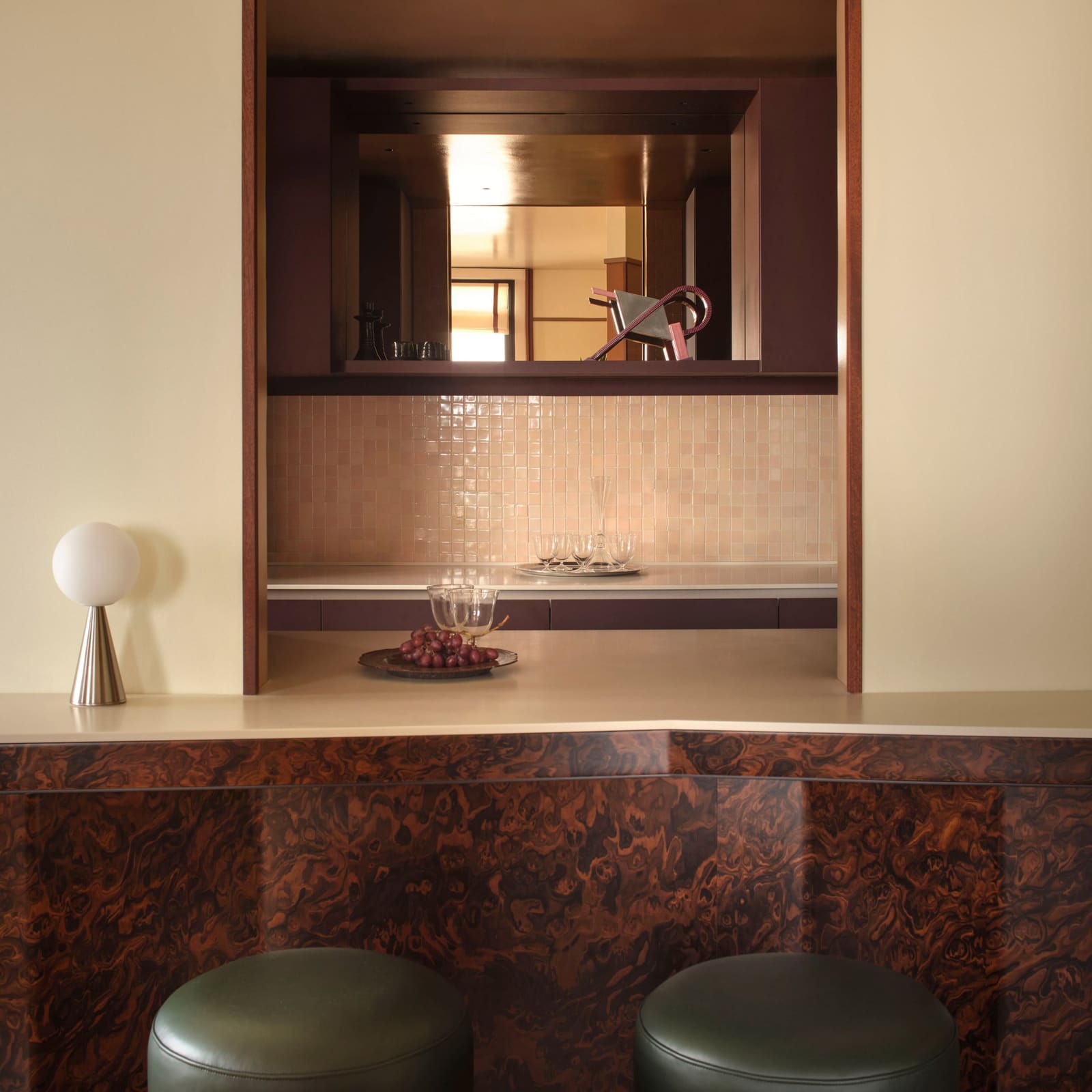
Thun retained original architectural elements throughout: doors, window frames, loggias, and the bathrooms' and kitchens' tilework remain intact. These fixed components establish a datum against which movable furnishings are arranged. The furniture selection spans decades, incorporating pieces from the 1950s through the 1980s alongside new designs from Thun's own studio. Several iconic pieces were reissued in custom colourways through collaboration with historic Milanese manufacturers, a process that required negotiation between archival authenticity and chromatic integration.
This editorial approach sidesteps the pitfall of period pastiche. Rather than recreate a 1950s interior whole cloth, Thun assembles a temporal collage in which mid-century classics coexist with contemporary production, unified by material quality and chromatic discipline. The loggias, with their original tiles and concrete balustrades, frame views of Milan's roofscape while providing a literal threshold between the tower's exterior language and the softer, textile-rich interiors.
The ground-floor reception, lobby and corridors received similar treatment. Here, the challenge was one of scale and public legibility: these spaces must communicate the building's residential transformation while respecting its civic presence in Milan's urban fabric. Thun's solution employs the same chromatic vocabulary established in the apartments, extending the material narrative from private threshold to public approach.
Reinterpretation as Architectural Practice
Thun characterises the commission as pedagogical, describing it as an exercise in architectural thinking rather than decorative application. The distinction is instructive. Working within a structure as formally assertive as Torre Velasca demands spatial and material decisions that engage directly with the building's parti and tectonic expression. The tower's cantilevered upper floors, its deep-set windows, its relationship to Milan's historic centre, all these exert pressure on any interior intervention.
The project's restraint reflects an understanding that BBPR's architecture already articulates spatial hierarchy, light modulation and material expression. Thun's role becomes one of amplification and inhabitation, finding moments where contemporary domesticity can nestle within a framework designed for a different era's residential expectations. The preservation of original elements is not sentimental but strategic: these components carry information about proportion, craft standards and material durability that contemporary fabrication often struggles to replicate.
This mode of working finds precedent in the adaptive reuse projects of Swiss architects such as Miller & Maranta, whose interventions in mid-century structures similarly balance preservation with functional updating. Yet where Miller & Maranta often employ stark material contrasts to articulate new from old, Thun pursues chromatic and textural continuity, a choice that reflects Torre Velasca's particular status in Milan's architectural consciousness.
Living Within the Monument
The conversion of Torre Velasca's upper floors to residential use raises broader questions about the inhabitation of monuments. The tower has long functioned as a vertical landmark, a visual terminus and orientation device within Milan's fabric. Its transformation into private dwellings shifts its role from civic symbol to lived environment, a transition that requires careful negotiation between public identity and domestic privacy.
Thun's interiors facilitate this negotiation through spatial and material strategies that acknowledge both scales of inhabitation. The pale pink walls and preserved loggias maintain visual and material continuity with the tower's exterior, ensuring that the building's public identity remains legible. Yet the introduction of velvet, custom furnishings and modulated lighting creates zones of domestic intimacy within the concrete frame, spaces calibrated for individual habitation rather than institutional function.
The project suggests a model for adaptive reuse that privileges material continuity over formal novelty, one in which the existing architecture's vocabulary becomes the basis for contemporary intervention rather than a constraint to overcome. This approach demands close reading of the original structure, an understanding of its material logic and spatial organisation sufficient to guide new insertions without overwhelming the existing framework. For architects navigating the growing field of mid-century adaptive reuse, Thun's Torre Velasca interiors offer a case study in respectful amplification, demonstrating that listening to a building can yield more compelling results than speaking over it.
Save this story. A free account keeps your reading list and the 07:00 email in one place.
CREATE FREE ACCOUNT →SIGN IN