
The Question of Where Design Stops
What happens when a designer borrows not just inspiration but actual manufacturing techniques from the food industry? Or when a speaker's form matters as much as its acoustics? These questions ran through the eighth Contemporary Design Selections exhibition at Lake Como Design Festival, where curator Giovanna Massoni assembled 57 projects that refuse to stay neatly within disciplinary lines. The theme, "Borders," invited participants to examine the edges of their practice, whether material, conceptual, or social, and the resulting work ranged from furniture that moves like bodies to textiles that narrate seasonal shifts.
Held across ten rooms and outdoor areas of Villa Saporiti, a neoclassical structure opening to the public for the first time in this capacity, the show drew designers and studios from 30 countries. We visited the exhibition in mid-September 2026 and identified seven projects that demonstrate how contemporary practitioners are dismantling the distinctions between function, craft, and art.
Rethinking Stability Through Motion
Studio Bjorn Verlinde, based in Belgium, presented the Fur collection, a series that challenges conventional seating typologies. The centrepiece is a backless rocking chair constructed from a curved aluminium base paired with a brown leather seat. The absence of a backrest forces the sitter into an active relationship with the object; rather than settling into passive comfort, the user engages core muscles and subtle shifts in weight to maintain balance. The accompanying side table mirrors the chair's curved language, creating a formal dialogue within the collection.
This approach reflects a broader interest in furniture that accommodates restlessness rather than suppressing it. The aluminium base's curvature allows gentle backward lean without tipping, a tectonic detail that transforms instability into controlled movement. It is a small but meaningful departure from the static postures most seating enforces.
Fragility as Structural Logic
Milan-based artist and designer Massimo Rigaglia contributed Lights in Tension, a lighting series built from flexible bamboo strips held taut by leather cords. The resulting forms are lightweight, curved, and anchored by brass bases. Rigaglia describes the work as embracing fragility as an aesthetic value, a stance that runs counter to the durability-focused rhetoric common in product design.
The bamboo's flexibility is not incidental; it is the structural premise. The strips bend into arcs determined by the tension of the leather, creating forms that appear provisional yet stable. This method recalls tensile structures in architecture, where cables and membranes replace rigid frames, but scales the logic down to domestic objects. The brass base provides visual and physical weight, grounding the otherwise ephemeral assembly.
Brutalism Meets Translucency
Basel-based Studio Alessandra Hofmann's BR Collection applies brutalist massing principles to coffee tables, using travertine blocks intersected by handmade cast glass slabs. The tables feature two distinct surface levels, with the glass cutting through the stone at right angles. Hofmann's process is deliberately experimental: she accepts and incorporates material reactions, such as air bubbles trapped in the glass and the open pores characteristic of travertine.
This approach positions imperfection as a design asset rather than a flaw to be corrected. The glass, cast by hand, retains irregularities that industrial production would eliminate, while the travertine's porosity contrasts with the glass's density. The result is a conversation between opacity and translucency, mass and void. Brutalist architecture often privileges raw concrete and exposed structure; here, that ethos is translated into domestic scale, with travertine standing in for concrete and glass introducing a transparency brutalism typically avoids.
Spatial Acoustics and Material Metaphor
ArmoniusLab, founded by designer Elia Dusi, introduced Saturnia, a floor-standing speaker system where the audio unit sits within a ring of acid-treated iron. The metal ring, visually reminiscent of planetary rings, is not purely decorative; it influences how sound disperses. The speaker tilts upward, directing audio toward the ceiling and walls rather than straight at the listener. This design creates a diffused listening experience, filling the room rather than focusing on a single point.
The iron undergoes acid treatment to achieve its textured surface, a finishing process that adds visual depth and tactile interest. By embedding the speaker within a sculptural form, Dusi collapses the boundary between audio equipment and furniture, a move that reflects broader trends in high-end consumer electronics where form is expected to carry as much weight as function.
When Food Technology Becomes Furniture
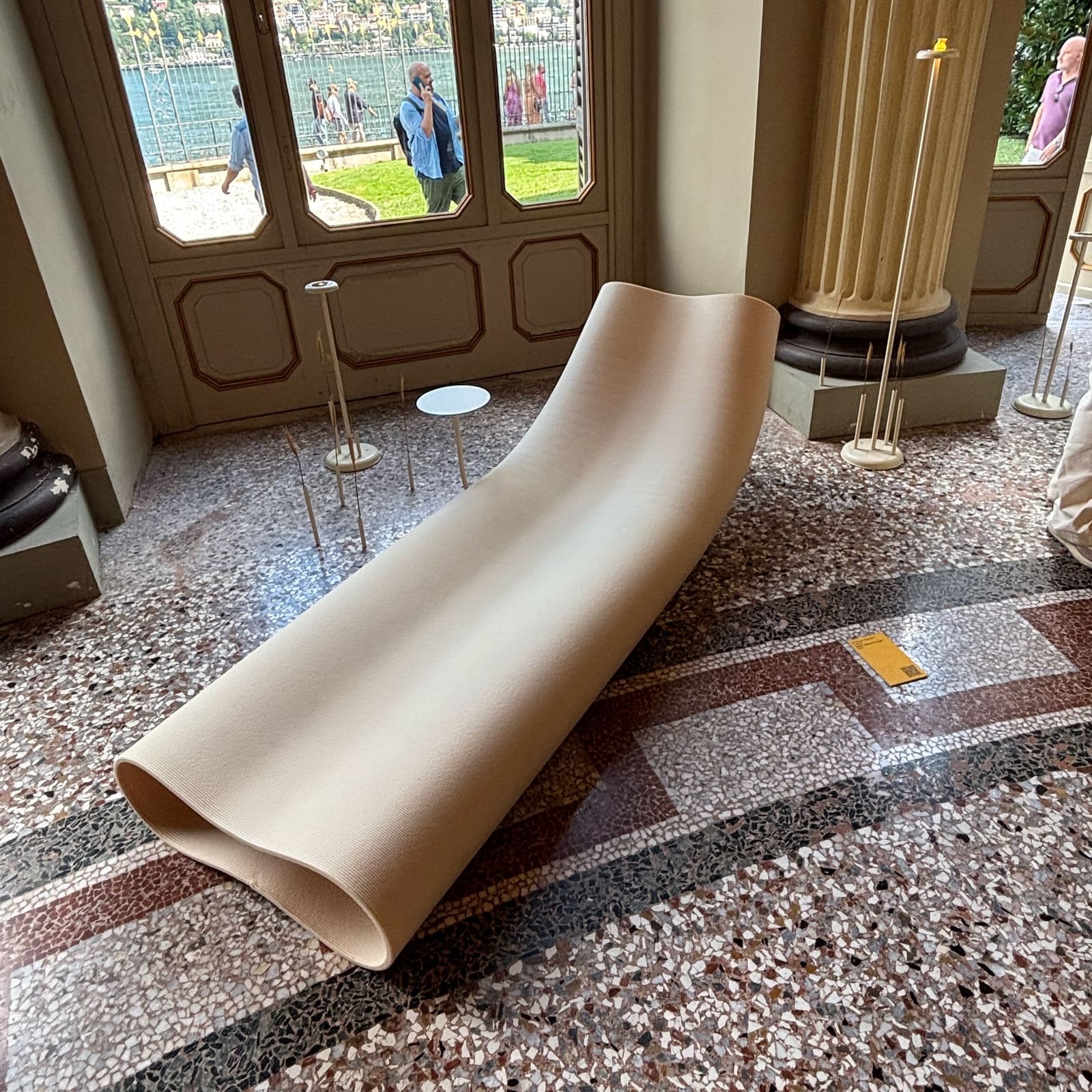
Studio YellowDot collaborated with Barilla's Artisia project, which explores 3D-printed pasta, to produce Tattile, a daybed printed in a single piece from wood fibre and bioplastic composite. The surface is ribbed, directly referencing pasta shapes, and the entire form is hollow, a structural efficiency borrowed from food production. The project explicitly addresses the "Borders" theme by situating itself at the intersection of culinary technology and furniture design.
Three-dimensional printing in furniture is not new, but the material composition here, derived from food-grade processes, is less common. The wood fibre-bioplastic blend offers a renewable alternative to petroleum-based polymers, and the single-piece construction eliminates joints and fasteners. The ribbed surface, beyond its visual reference, increases structural rigidity without adding mass, a principle familiar in corrugated materials. Tattile is less a functional daybed than a provocation about where manufacturing expertise can migrate.
Narrative Woven into Pattern
The Happy Few, a textile studio, created The Long Take, a ten-metre wool rug designed to evoke the experience of walking through an urban environment. Rectangular woven blocks mimic street tiles, and the colour palette transitions from grey and blue to brown and green, suggesting seasonal progression. The rug functions as both floor covering and narrative device, encoding a temporal journey into its structure.
Textile design has long been a medium for storytelling, but The Long Take's scale and sequential logic push it toward cinematic territory. The title itself references the long take in film, an unbroken shot that unfolds in real time. Here, the viewer's movement along the rug substitutes for the camera's tracking shot, with colour shifts marking narrative beats. It is an example of how textile work can operate beyond decoration, engaging spatial and temporal dimensions more often associated with installation art.
Transparency as Spatial Intervention
Bucharest and Zurich-based Whats Wrong Duo contributed Claustra, a room divider made from aluminium and ceramic components. The studio developed custom glazes for the clay, achieving brown, purple, cream, and grey tones. The divider's design draws on soft lines and transparency found in natural forms, creating a partition that defines space without fully enclosing it.
The term "claustra" historically refers to lattice screens in Romanesque and Byzantine architecture, used to separate sacred and secular zones while maintaining visual and acoustic porosity. Whats Wrong Duo's contemporary interpretation retains that porosity, allowing sightlines and light to pass through while still marking a boundary. The combination of aluminium and ceramic, materials with different thermal and tactile properties, adds complexity to the object's presence. The studio positions Claustra as occupying the space between functional divider and artistic expression, a framing that reflects the exhibition's broader interest in disciplinary ambiguity.
The Politics of Material Choice
Across these projects, material selection functions as both aesthetic and ethical decision. Rigaglia's bamboo, Hofmann's travertine, YellowDot's bioplastic composite, and The Happy Few's wool all carry associations beyond their physical properties: sustainability, locality, renewability, craft tradition. The exhibition's theme, "Borders," was framed not only as a formal or functional question but also as a social and political one. Material choice is where those dimensions converge most directly in design practice.
Contemporary Design Selections ran from 12 to 20 September 2026 at Villa Saporiti, marking both the festival's continued expansion and the villa's entry into public programming. The decision to stage the exhibition in a neoclassical building, with its ornate mouldings and hierarchical room sequences, created a productive friction with the work on display. Where the villa's architecture insists on symmetry and historical reference, the exhibited objects pursue asymmetry, hybridity, and material experimentation. That tension, between container and content, underscored the exhibition's central question: not where borders lie, but what happens when we choose to cross them.
Save this story. A free account keeps your reading list and the 07:00 email in one place.
CREATE FREE ACCOUNT →SIGN IN