
The Challenge of Contemporary Sacred Space
How does a mosque built in 2026 speak to fourteen centuries of Islamic architectural tradition without becoming a pastiche? It is a question that confronts every architect working within the typology today, particularly in regions where historical precedent runs deep. At World Archi Design, we have seen many contemporary mosques veer toward either nostalgic revivalism or a sterile minimalism that strips away cultural resonance. The Plage des Nations Mosque, designed by OUALALOU+CHOI and completed this year on Morocco's Atlantic coastline, attempts a third path: an architecture of distillation rather than mimicry.
The 1,578-square-metre project, led by Tarik Oualalou and Linna Choi, occupies a coastal site where the Atlantic horizon provides both context and constraint. Unlike the dense urban fabric of Fez or Marrakech, where mosques negotiate narrow streets and layered courtyards, this building addresses open sky and shifting light. The design response is correspondingly uncluttered, prioritising volume and luminosity over applied decoration.
Materiality and Tectonic Expression
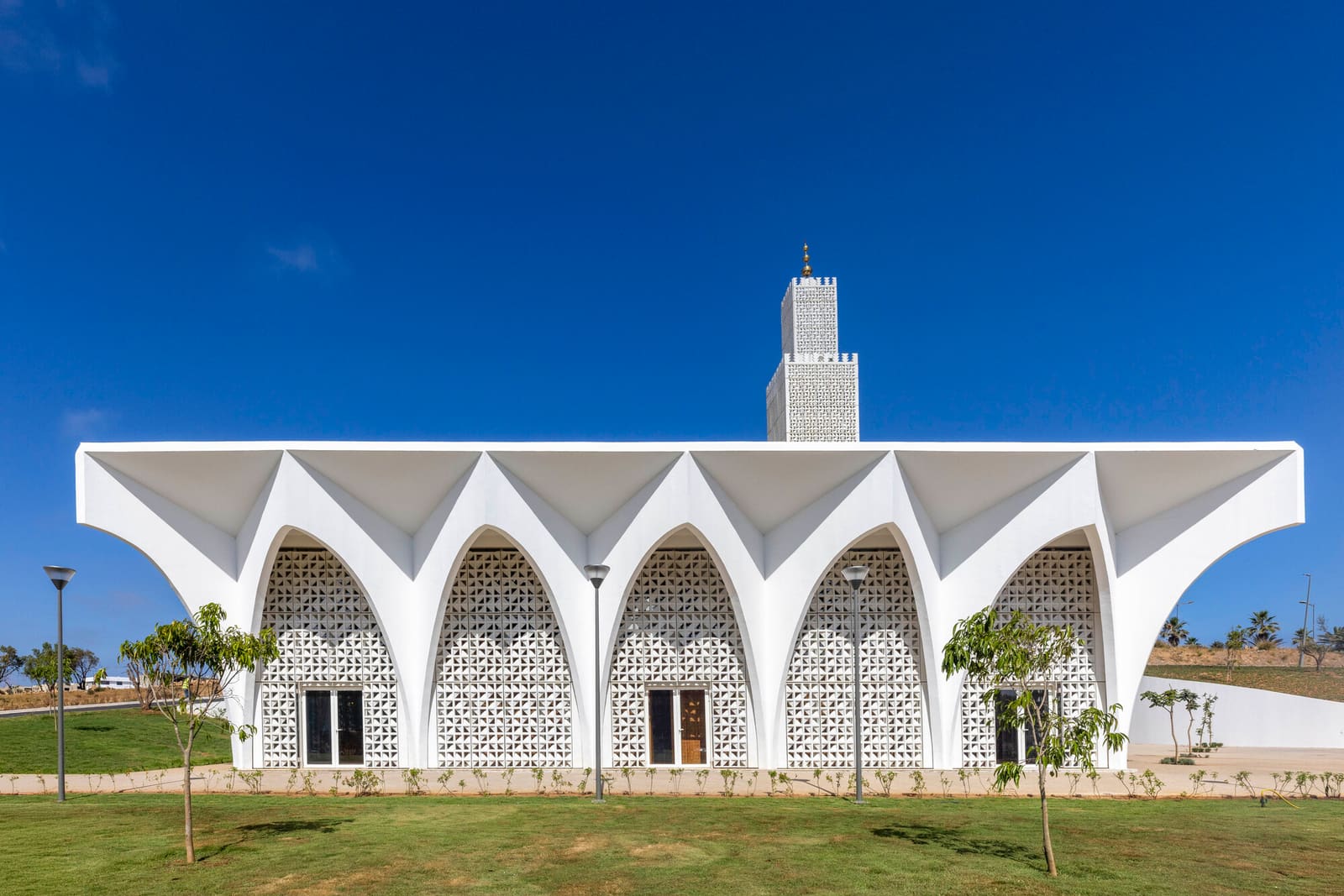
OUALALOU+CHOI's approach to materiality here is restrained. The envelope employs pale masonry that reads almost as a single plane in certain light conditions, an effect that recalls the whitewashed vernacular of coastal Moroccan settlements. Yet the surface is punctuated by deep-set apertures, creating a rhythm of solid and void that modulates both daylight and shadow throughout the day.
This fenestration strategy departs from the intricate mashrabiya screens common in historic Moroccan architecture. Rather than filtering light through geometric latticework, the mosque uses the depth of the wall itself as a mediating device. The thick section slows the ingress of daylight, creating gradients of illumination that shift with solar angle. In this sense, the building's tectonic logic is closer to Louis Kahn's work at the Salk Institute or the Indian Institute of Management, where mass and void are choreographed to shape atmospheric conditions.
The choice of a monolithic material palette also sidesteps the polychrome tilework and carved plaster that characterise much of Morocco's architectural heritage. It is a deliberate omission, one that positions the building within a lineage of modernist sacred spaces, from Gottfried Böhm's pilgrimage churches to Tadao Ando's Church of the Light, where spiritual experience is constructed through spatial sequence and controlled illumination rather than iconographic detail.
Spatial Organisation and Ritual Sequence
The plan organises prayer space, ablution facilities, and ancillary functions within a compact footprint. The main prayer hall occupies the central volume, oriented towards Mecca, with supporting spaces arranged peripherally. This clarity of parti is not novel, yet the execution avoids the formulaic. Circulation is compressed, so that the transition from exterior to interior is abrupt, heightening the sensory shift from bright coastal environment to dim, cool enclosure.
Within the prayer hall, the ceiling treatment becomes the primary expressive element. Rather than a flat or vaulted surface, the design introduces a faceted geometry that catches and redistributes light entering from clerestory openings. The effect is kinetic; as the sun moves, planes of light sweep across the interior, marking the passage of time in a manner that aligns with the rhythmic structure of Islamic prayer.
This manipulation of overhead light has precedent in Hassan Fathy's work in Egypt, where vaulted ceilings and wind catchers shaped both thermal and luminous environments. OUALALOU+CHOI updates the strategy with contemporary fabrication techniques, allowing for more precise control over surface angle and aperture placement. The result is a space that feels both ancient and immediate, grounded in climatic logic but executed with modern precision.
Cultural Context and Coastal Typology
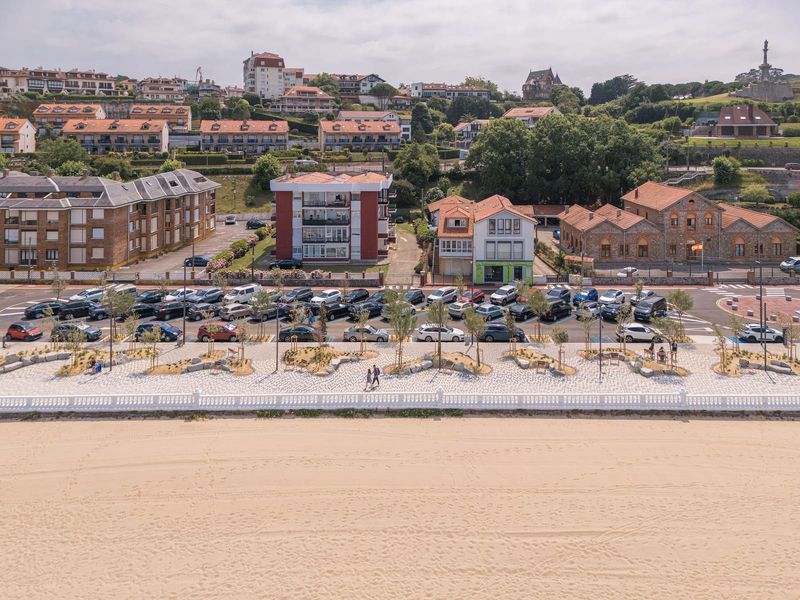
Plage des Nations, located north of Rabat, has seen rapid development over recent decades, transitioning from a quiet beach town to a growing suburban corridor. The mosque serves a relatively new community, one without the layered architectural fabric of older Moroccan cities. In this context, the building must establish rather than reinforce a sense of place.
The design responds by drawing on the broader vocabulary of Moroccan coastal architecture: thick walls for thermal mass, minimal openings to manage glare, and a cubic massing that resists the wind. Yet it refrains from direct quotation. There are no pointed arches, no tile-clad minarets, no ornamental stucco. Instead, the mosque borrows the tectonic principles underlying those forms, translating them into a contemporary language.
This approach aligns with the work of other architects who have sought to engage regional tradition through abstraction rather than replication. One thinks of Geoffrey Bawa's work in Sri Lanka, where verandas, courtyards, and deep eaves are reinterpreted within modernist spatial frameworks, or Balkrishna Doshi's institutions in Ahmedabad, where vaulted brick and carved openings echo Mughal precedent without copying it.
The Question of Symbolism
Religious architecture carries symbolic weight that secular typologies do not. A mosque must be recognisable as such, legible to a community accustomed to specific formal markers. OUALALOU+CHOI's design navigates this expectation carefully. The minaret, an essential element of the typology, is present but subdued, rising as a slender volume rather than an ornamental tower. The mihrab, marking the qibla wall, is articulated through subtle material differentiation rather than decorative carving.
This restraint risks being read as austerity, yet the building avoids coldness through its handling of light. The interior is not bright but luminous, a quality achieved through indirect illumination and reflective surfaces. The experience is contemplative rather than didactic, encouraging inward focus in a manner consistent with the function of the space.
Precedent and Departure
Across the projects we have covered this year, a recurring theme has emerged: the tension between continuity and innovation in regional architecture. Some designers resolve this by layering historical references into contemporary forms; others reject precedent altogether, pursuing a universal modernism. OUALALOU+CHOI's Plage des Nations Mosque occupies a middle ground, acknowledging tradition without being beholden to it.
The building's success lies not in novelty but in synthesis. It understands that heritage is not a fixed catalogue of forms but a set of spatial and climatic strategies developed over centuries. By isolating and reinterpreting those strategies - thick walls, controlled light, cubic massing - the design produces an architecture that feels both rooted and forward-looking.
Whether this approach will resonate beyond its immediate context remains to be seen. Morocco's architectural landscape is diverse, ranging from meticulously restored medinas to sprawling modernist housing estates. The Plage des Nations Mosque offers one possible trajectory: a contemporary sacred architecture that honours the past without being trapped by it, that engages materiality and light as primary expressive tools, and that trusts spatial experience over applied ornament. In a typology often dominated by nostalgia or generic modernism, that is no small achievement.
Save this story. A free account keeps your reading list and the 07:00 email in one place.
CREATE FREE ACCOUNT →SIGN IN