
Bringing Marble Home
For more than a hundred years, six allegorical sculptures carved from Carrara marble stood exposed to the elements in Argentina's northwestern province of Jujuy. Originally commissioned for the Argentine National Congress Palace in Buenos Aires in 1906, the works by sculptor Lola Mora were removed roughly fifteen years later and donated to the province, where they remained outdoors. Now, the Lola Mora Cultural Center in San Salvador de Jujuy provides a permanent, climate-controlled home for these pieces, reuniting The Lions, Liberty, Progress, Work, Peace, and Justice under one roof for the first time since their creation.
The project represents the final cultural commission led by the late César Pelli, completed by Pelli Clarke & Partners. It is the firm's first cultural building in South America and functions as both a conservation facility and a public institution dedicated to the life of Lola Mora, one of Argentina's earliest internationally recognized sculptors. The center's program extends beyond the marble works themselves, incorporating exhibition galleries, an interpretation center, a library, a restaurant, a gift shop, and dedicated spaces for temporary exhibitions and visiting artists.
Topography as Parti
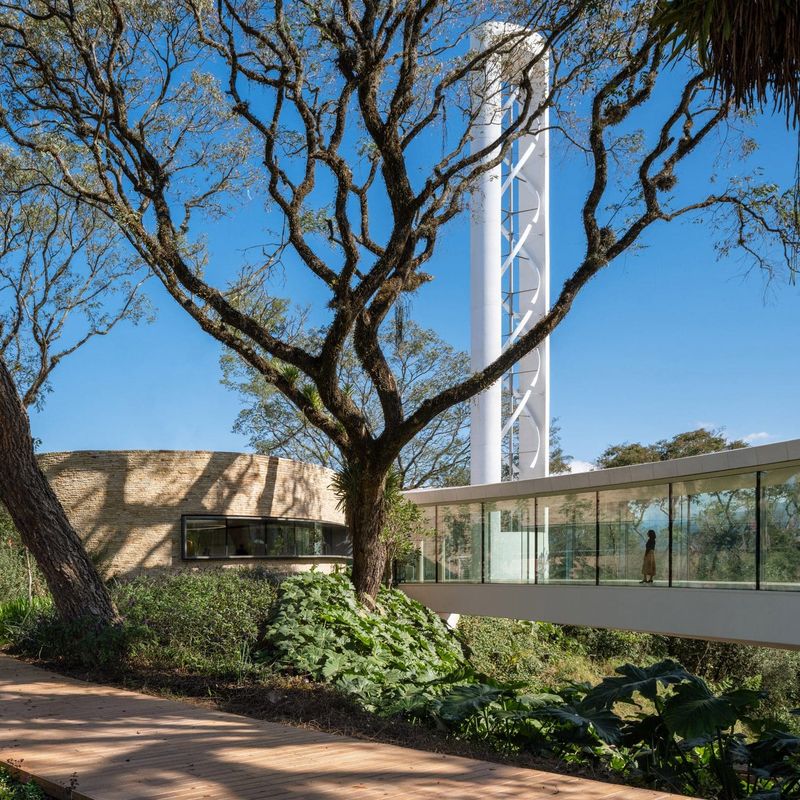
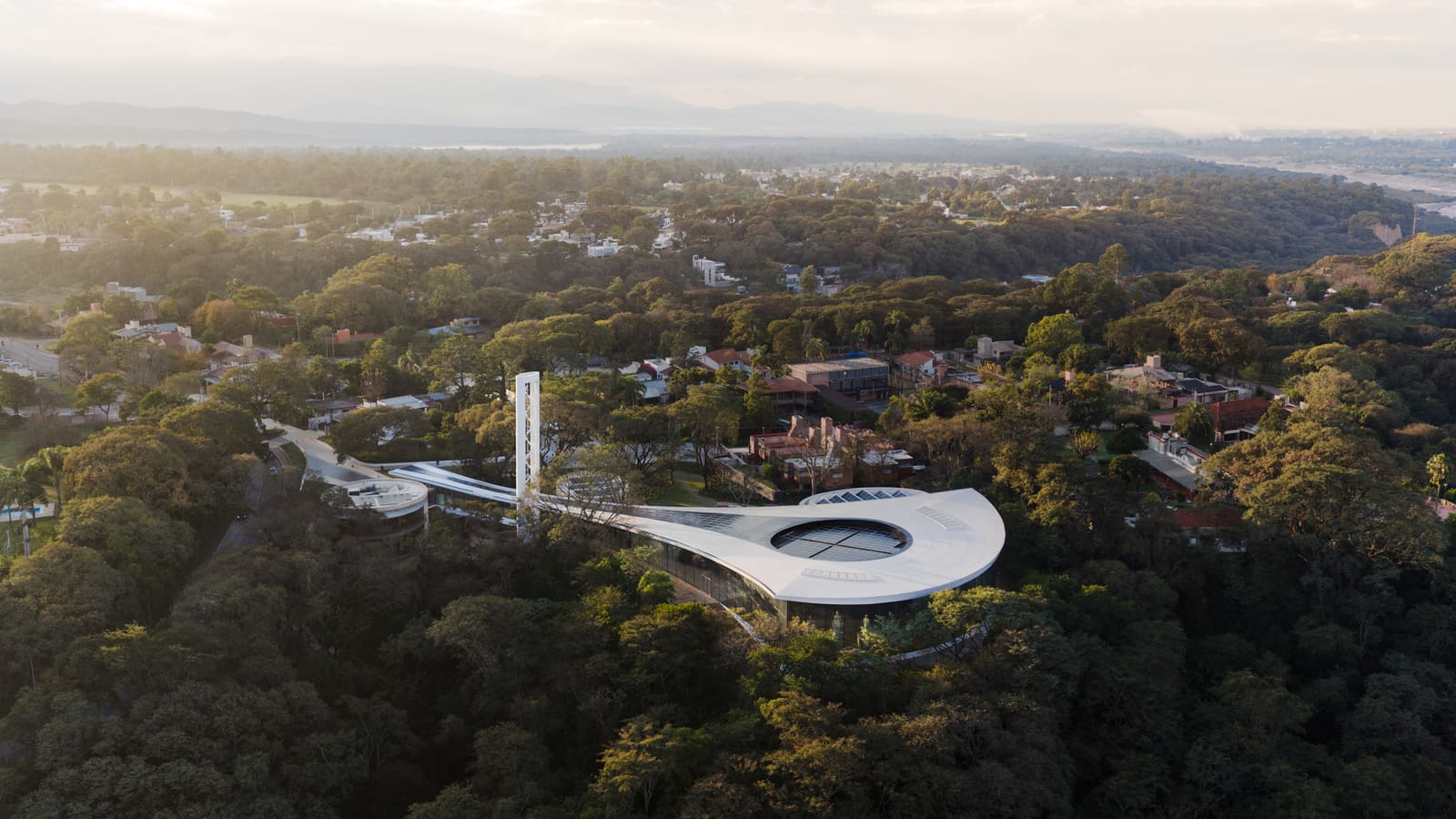
Sited on a hillside overlooking San Salvador de Jujuy, the building occupies a transitional zone at the edge of the Andes Mountains, surrounded by the subtropical Yunga forest. Rather than imposing a geometrically autonomous form, the design follows the site's natural contours. The building's curved plan wraps around existing native trees, preserving the forest canopy and minimizing site disturbance. A bridge spans a natural ravine to provide access to the main entrance, turning a topographic challenge into an experiential threshold.
This approach reflects a broader shift in contemporary cultural architecture toward landscape integration. Where earlier museum projects might have cleared hillsides to establish a monumental presence, the Lola Mora Cultural Center embeds itself within the existing terrain. The decision to preserve mature vegetation and adapt the building's footprint to accommodate individual trees echoes strategies seen in projects like Peter Zumthor's Bruder Klaus Field Chapel or Rick Joy's Desert Nomad House, where architecture negotiates rather than dominates its context.
Landscape design was developed by Balmori Associates, the practice founded by the late Diana Balmori, whose work consistently emphasized ecological performance alongside spatial experience. The collaboration between architecture and landscape extended to environmental systems as well: a series of small dams integrated into the ravine slow runoff and mitigate erosion, while rainwater harvesting supports landscape irrigation. These interventions address site-specific hydrological conditions without resorting to large-scale earthwork or imported drainage infrastructure.
Net-Zero Infrastructure in a Cultural Context
The center is designed to operate as a net-zero facility, generating as much energy as it consumes through a combination of renewable systems. A vertical tower housing five wind turbines serves as both a functional element and a visual landmark within the landscape. Photovoltaic panels and solar thermal collectors supplement the wind turbines, collectively meeting the building's operational energy needs. A high-performance envelope and efficient mechanical systems reduce baseline energy consumption, making the renewable generation targets more achievable.
The inclusion of wind turbines in a cultural building is relatively uncommon, particularly in a context where visual integration with natural surroundings is prioritized. The tower's vertical orientation addresses this tension by concentrating the renewable infrastructure into a single architectural element rather than distributing it across the roof or site. This strategy recalls the use of mechanical systems as expressive components in high-performance buildings, from Renzo Piano's California Academy of Sciences to Norman Foster's Reichstag dome, where environmental technology is made legible rather than concealed.
Material selection also contributed to the project's environmental strategy. Stone cladding sourced from regional quarries reduces transportation-related impacts and supports local supply chains. The use of locally available materials aligns with broader trends in sustainable design, where embodied carbon and supply chain transparency are increasingly scrutinized alongside operational energy performance. In a region with a strong tradition of stone construction, this choice also reinforces a connection to local building culture.
Conservation as Program
The center's primary function is the conservation and interpretation of Lola Mora's marble sculptures, which had deteriorated significantly during their century-long exposure to outdoor conditions. The decision to commission a purpose-built facility for these works reflects a growing recognition of the vulnerability of public sculpture, particularly when materials and environmental conditions are mismatched. Carrara marble, while durable, is susceptible to weathering, acid rain, and biological growth, all of which accelerate in humid subtropical climates.
Inside the galleries, controlled temperature, humidity, and light levels provide the stable environment necessary for long-term preservation. The building's high-performance envelope plays a dual role here: reducing energy consumption while maintaining the tight environmental tolerances required for marble conservation. This dual mandate, common in contemporary museum design, demands careful coordination between architectural envelope, mechanical systems, and curatorial requirements.
The interpretation center and library expand the institution's mission beyond the display of sculpture. By documenting Lola Mora's life and career, the center addresses a broader historical gap. Mora was among the first Latin American women to achieve international recognition in sculpture, yet her work has remained underrepresented in architectural and art historical discourse. The cultural center functions as both a repository for her major works and a platform for research and public engagement.
Regional Context and Institutional Ambition
San Salvador de Jujuy, with a metropolitan population of approximately 400,000, is not a typical location for a large-scale cultural institution. The decision to build the center in Jujuy rather than Buenos Aires reflects a deliberate effort to decentralize cultural infrastructure and anchor the sculptures in the province that has housed them for over a century. This approach parallels recent trends in cultural development, where new museums and cultural centers are increasingly sited in secondary cities or rural areas to stimulate regional tourism and economic development.
The project's scale and ambition also signal a shift in how cultural institutions in Latin America are conceived and funded. While the article does not detail the project's financing or governance structure, the commitment to net-zero operation and high-performance design suggests significant public or philanthropic investment. In recent years, several major cultural projects in the region, including the Museo Jumex in Mexico City and the Museo de Arte de Lima expansion, have demonstrated that world-class architecture and environmental performance are achievable outside traditional cultural capitals.
At World Archi Design, we have been tracking the expansion of cultural infrastructure in South America, particularly projects that integrate environmental performance with regionally specific design strategies. The Lola Mora Cultural Center joins a growing cohort of institutions that resist generic museum typologies in favor of site-responsive, ecologically engaged approaches. As climate considerations become non-negotiable in institutional architecture, the question is no longer whether cultural buildings can achieve net-zero operation, but how that achievement can be woven into the spatial and experiential fabric of the building itself.
Legacy and Continuity
As César Pelli's final cultural project, the Lola Mora Cultural Center carries particular weight within the firm's portfolio. Pelli's career, spanning from the Pacific Design Center in Los Angeles to the Petronas Towers in Kuala Lumpur, was defined by a consistent attention to context and a rejection of signature formalism. The Jujuy project, with its curved plan, landscape integration, and restrained material palette, reflects these priorities. The building does not announce itself as a monument to its architect; instead, it defers to the sculptures it houses and the landscape it inhabits.
This restraint is notable in an era when cultural buildings often compete for attention as much as they provide it. The center's curved form and stone cladding allow it to recede into the hillside, a strategy that prioritizes the visitor's experience of arrival, transition through the ravine, and eventual encounter with the marble sculptures. The architecture frames rather than dominates, a quality increasingly rare in contemporary museum design.
The project also raises questions about how we preserve and interpret the work of historically overlooked artists. Lola Mora's sculptures were removed from their original site and left outdoors for over a century, a sequence of decisions that reflects both the gendered dynamics of early twentieth-century art institutions and the practical challenges of conserving monumental sculpture. By providing a dedicated facility for her work, the cultural center does more than protect marble from the elements; it asserts the value of Mora's contribution to Argentine and Latin American art history. Whether the building can catalyze broader scholarly and public engagement with her work remains to be seen, but the infrastructure is now in place.
Save this story. A free account keeps your reading list and the 07:00 email in one place.
CREATE FREE ACCOUNT →SIGN IN