
Material as Narrative Device
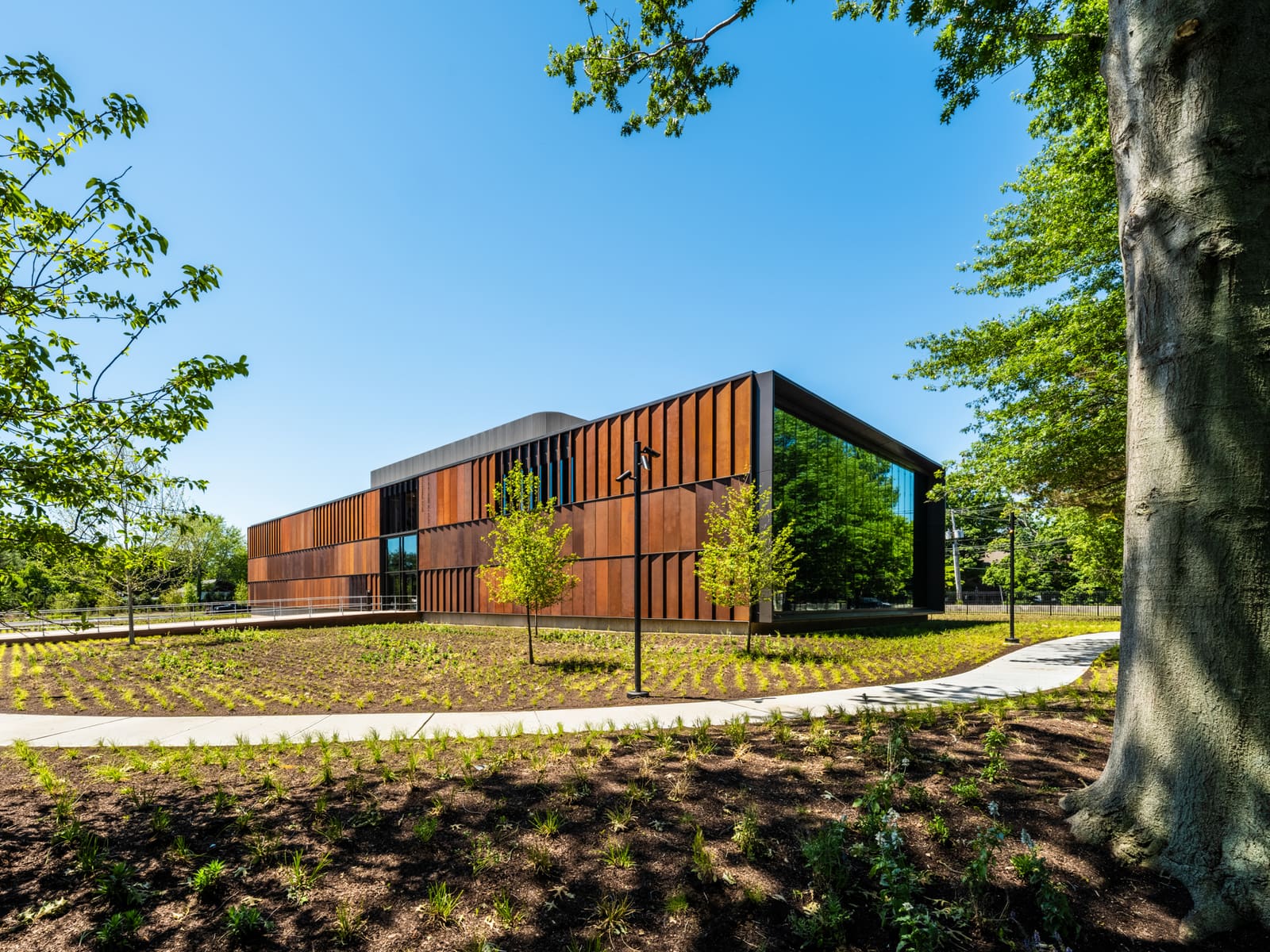
We've always been interested in buildings that do more than house programs - the ones that attempt to articulate something about the content they hold. COOKFOX's recently completed center at Monmouth University in Long Branch, New Jersey, operates in this register. The building, dedicated to American music and Bruce Springsteen's place within that lineage, employs two primary materials: weathering steel on the exterior and mass timber inside. Neither choice is decorative. Both are deliberate acts of storytelling.
The weathering steel cladding calls to mind the factories, shipyards, and railyards that populate not only New Jersey's industrial past but also the lyrical geography of Springsteen's songwriting. It's a material that ages visibly, accumulating patina over time - an architectural analogue to the working-class narratives embedded in the music itself. The facade doesn't attempt to be timeless; it accepts change as part of its identity.
Inside, the mass timber structure creates a counterpoint. Where the exterior reads as tough, weathered, and rooted in labor history, the interior is warm, tactile, and inviting. This duality - hardness and softness, myth and intimacy - mirrors the tension in Springsteen's work, which oscillates between sweeping American allegory and deeply personal storytelling.
Program and Spatial Hierarchy
The building spans approximately 30,000 square feet and organizes three distinct gallery zones: a 4,226-square-foot space dedicated to Springsteen, a 2,200-square-foot gallery focused on American music more broadly, and an equally sized temporary exhibition area. The dimensions - 206 feet long, 74 feet wide, and 30 feet tall - yield a horizontal, almost industrial proportion that reinforces the building's material language.
This is not a neutral container. The spatial hierarchy reflects a curatorial stance: Springsteen's work is understood as part of a larger American musical tradition, not isolated from it. The galleries flow into one another, encouraging visitors to draw connections between individual contribution and collective cultural production. The temporary space ensures the building can adapt to evolving narratives, a necessary flexibility in a cultural institution that aims to remain relevant beyond its opening moment.
The building also serves Monmouth University's educational mission, housing archival materials and supporting academic programming. This dual function - public-facing cultural space and institutional resource - requires careful calibration. COOKFOX's design avoids the common pitfall of making the building feel like a campus annex by centering the visitor experience and allowing the educational components to operate quietly in the background.
Tectonic Expression and Structural Clarity
Mass timber construction, engineered and built by Timberlab, is increasingly common in cultural projects, but its deployment here feels less about sustainability signaling and more about phenomenological effect. The exposed timber ceilings and structural members create a rhythm that organizes the interior without subdivision. Visitors read the building's structure as they move through it, a quality that fosters a sense of transparency and honesty.
This is a building that wants you to understand how it's made. The steel frame by Dissimilar Metal Design and the timber work together in a hybrid system that reflects contemporary trends in mid-scale construction, where neither material dominates but both contribute to the overall tectonic logic. The facade, designed with consulting support from DeSimone Consulting Engineering, wraps the structure without pretending to be load-bearing, a straightforward expression of cladding as skin rather than structure.
LaGuardia Design Group's landscape work extends the building's material vocabulary into the site, using hardy, low-maintenance plantings that echo the weathering steel's acceptance of time and exposure. The landscape doesn't compete with the architecture; it frames it, providing a buffer between the campus and the cultural institution without creating a barrier.
Cultural Placemaking and Architectural Precedent
Cultural centers dedicated to individual musicians are a tricky typology. They risk hagiography, turning architecture into a monument rather than a space for critical engagement. COOKFOX's approach sidesteps this by situating Springsteen within a broader musical context and by choosing materials that resist the polished, reverential quality of many museum projects.
There's a kinship here with Steven Holl's work at the EX of IN House in Rhinebeck, where weathering steel was used to root a building in its landscape and history, and with Michael Maltzan's Inner-City Arts campus in Los Angeles, where industrial materials were repurposed to serve cultural and educational functions. In both cases, the architecture resists preciousness, opting instead for durability, honesty, and a certain roughness that feels appropriate to the communities and narratives being served.
The decision to use weathering steel in an academic setting is also notable. University buildings often default to brick or limestone, materials that signal permanence and tradition. By choosing a material associated with infrastructure and industry, COOKFOX reframes what a cultural building on a campus can be. It's not trying to blend in; it's asserting a different set of values.
Acoustics, Light, and Visitor Experience
Trinity Consultants handled acoustic design, a critical consideration in a building dedicated to music. The galleries are designed to support audio installations and live performance without bleed between zones, a technical challenge in an open-plan structure. The mass timber contributes to this effort; wood absorbs and diffuses sound differently than concrete or steel, creating a warmer acoustic environment that feels less clinical.
ONELux's lighting design works with the building's natural daylighting strategy, which is necessarily constrained by conservation requirements for archival materials. The result is a space that feels neither too bright nor too dim, with carefully controlled illumination that highlights objects without overwhelming them. Exhibition design by C&G integrates signage and interpretive elements in a way that feels cohesive with the architecture, avoiding the common problem of exhibition design and architecture working at cross purposes.
Harvey Marshall Berling Associates contributed theater consulting, suggesting that the building accommodates performance as well as static display. This programming flexibility is essential for a music-focused institution; the architecture must support not just the history of music but its ongoing practice.
A Building That Ages Into Its Subject
At World Archi Design, we've been tracking how cultural institutions are increasingly turning to materials that age visibly, rejecting the modernist ideal of the unchanging object. The Springsteen Center is part of this shift. The weathering steel will darken and rust, the timber will patina, and the building will accumulate the marks of use and time. This is intentional.
Springsteen's music is full of characters who work with their hands, who live in landscapes shaped by industry, who navigate the gap between the American dream and American reality. A building dedicated to that music shouldn't look pristine. It should look like it belongs to the same world its subject sings about - a world where things are made, used, worn down, and occasionally, if we're lucky, endure.
Save this story. A free account keeps your reading list and the 07:00 email in one place.
CREATE FREE ACCOUNT →SIGN IN