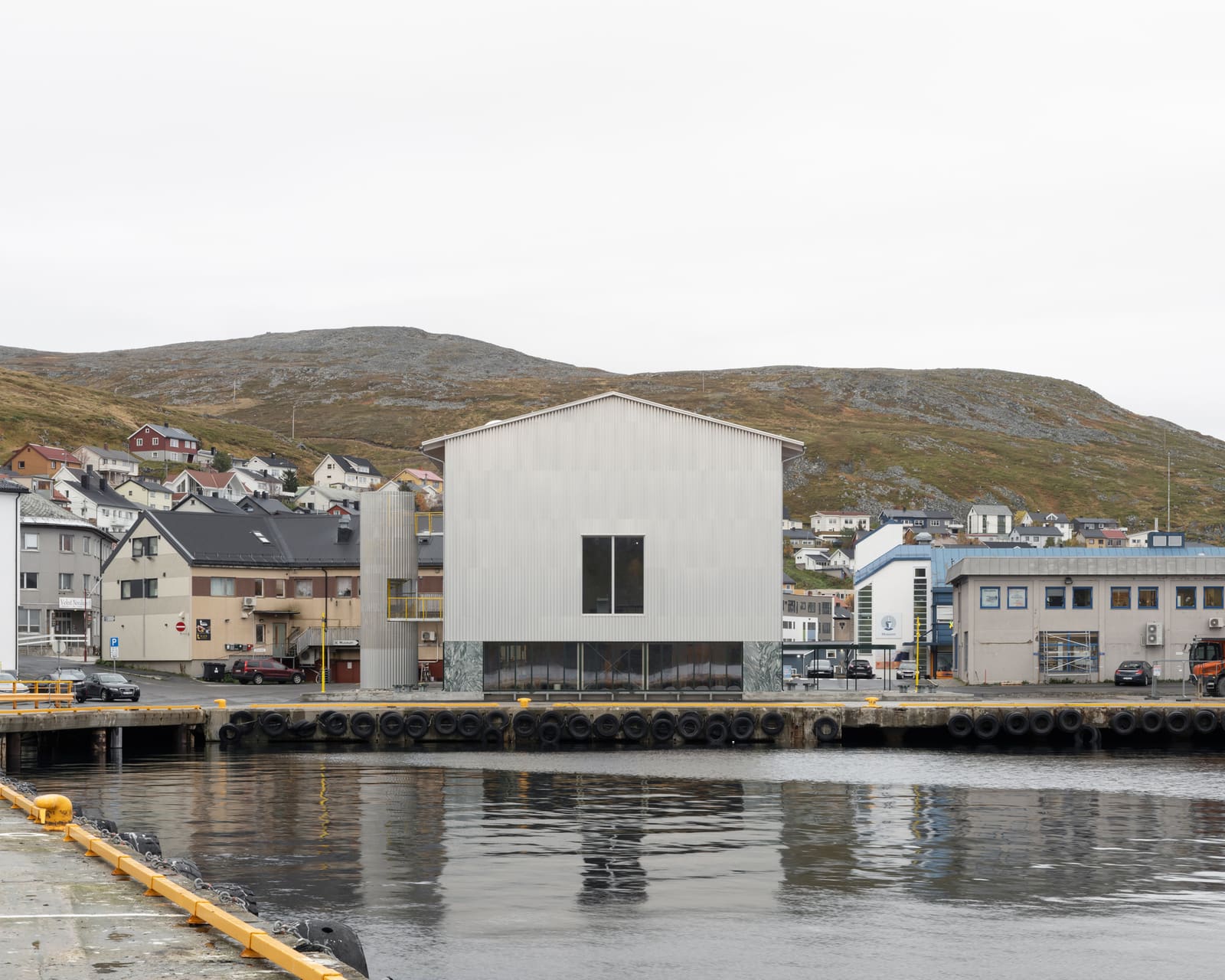
Building at the Edge of the World
Honningsvåg sits closer to the North Pole than to Oslo. At 70 degrees north, the town experiences polar night in winter and midnight sun in summer, conditions that shape not only daily life but also the architecture required to sustain it. When Transborder Studio accepted the commission from Grieg Seafood to design a museum dedicated to oceanic narratives, the practice faced a familiar Arctic challenge: how to create an interior environment that honors the elemental force of the landscape without resorting to mimicry.
The Ocean Stories Museum, completed in 2025, occupies 650 square meters in a region where building means negotiating extreme cold, high winds, and a cultural expectation that structures should be both durable and legible within their context. Lead architects Peter Skråvik Brekke and Øystein Rø chose a material palette that speaks to regional precedent while allowing for contemporary spatial flexibility. Wood, aluminum, and locally sourced stone form the primary tectonic vocabulary, each selected for performance as much as for symbolic resonance.
Material Decisions in an Unforgiving Climate
Wood dominates the interior, a choice rooted in Norwegian vernacular building but executed with contemporary detailing. The timber framing provides thermal mass and a tactile warmth that counters the museum's exhibition-focused program. Unlike many cultural institutions that prioritize neutrality, the Ocean Stories Museum allows material character to inflect the visitor experience. The grain patterns, joinery, and surface treatment become part of the narrative apparatus.
Aluminum cladding wraps portions of the exterior, a nod to the maritime and fishing industries that underpin the local economy. The metal's reflectivity shifts with the quality of Arctic light, a phenomenon that changes dramatically across seasons. In summer, the facade captures the low-angle sun; in winter, it reads as matte and recessive. This responsiveness to light is not ornamental but functional, a way of embedding the building within the diurnal and seasonal rhythms that define life in Honningsvåg.
Local stone anchors the structure, both literally and conceptually. Sourced from regional quarries, the stone ties the museum to its geological context. Transborder Studio has used the material sparingly, concentrating it at points of structural emphasis and at thresholds where the building meets the ground. The decision avoids the trap of overstating regionalism while maintaining a clear connection to place.
Exhibition Space as Environmental Framework
The museum's program centers on storytelling, but the design resists the white-cube model common to contemporary exhibition spaces. Instead, the interior is subdivided into zones that vary in scale, ceiling height, and lighting quality. This sectional variation allows curators to modulate the visitor's experience, moving between intimate displays and more expansive installations.
Nina Vuga curated the inaugural exhibition, working closely with the design team to ensure that spatial organization supported narrative flow. The collaboration between architect and curator is evident in the way circulation paths unfold. Rather than a single linear route, the museum offers multiple trajectories, encouraging visitors to construct their own understanding of the oceanic themes presented.
Structural engineering by Sweco and Bollinger+Grohmann enabled long spans that keep columns to a minimum, preserving visual continuity across the exhibition floor. The engineering strategy also addresses seismic and wind loads, critical considerations in a region prone to severe weather. BMBA Entreprenør AS served as general contractor, coordinating the complex material assembly required by the design.
Precedent and Contemporary Practice
Transborder Studio's approach recalls the work of Sverre Fehn, particularly his attention to how light and material can articulate a building's relationship to landscape. Fehn's Nordic Pavilion in Venice and his Hedmark Museum in Norway both demonstrate how restrained material choices can amplify spatial experience. The Ocean Stories Museum operates within this lineage but updates it for a program centered on environmental and industrial narratives rather than art.
The use of aluminum also brings to mind the work of Peter Zumthor, whose Kunsthaus Bregenz employs a glass and steel facade that modulates light in response to exterior conditions. While the Ocean Stories Museum is smaller in scale and more materially diverse, it shares Zumthor's interest in how surface treatment can mediate between interior and exterior environments.
At World Archi Design, we've been tracking a broader trend in Nordic architecture: the integration of regional craft traditions with contemporary environmental performance. Projects like Snøhetta's Tverrfjellhytta and Reiulf Ramstad's Villa Storingavika demonstrate similar commitments to material authenticity and climatic responsiveness. Transborder Studio's museum adds to this body of work, offering a model for how exhibition design can engage with place without lapsing into nostalgia.
Sustainability Without Spectacle
The museum's environmental strategy is embedded rather than advertised. The material palette prioritizes longevity and low maintenance, critical in a climate where repair cycles are constrained by weather. Wood and stone age predictably, requiring minimal intervention over time. Aluminum, while energy-intensive to produce, offers durability and recyclability at end-of-life.
Thermal performance was a central concern throughout design development. Rambøll provided engineering and consulting services, developing envelope details that minimize heat loss while maintaining visual transparency where needed. The building's compact footprint reduces surface area relative to volume, a passive strategy that improves energy efficiency.
Natural ventilation is limited by the extreme exterior temperatures, so the design incorporates a mechanical system calibrated to Arctic conditions. Heat recovery ventilation recycles warmth from exhaust air, reducing the energy required to maintain interior comfort. These measures are standard in contemporary Nordic architecture but essential in a location where heating costs and carbon impact are both significant.
What the Project Proposes
The Ocean Stories Museum is not a landmark in the conventional sense. It does not announce itself through formal drama or monumental scale. Instead, it proposes that cultural architecture in remote regions can be both contextually grounded and spatially sophisticated. The building's success depends on its ability to serve as a functional exhibition venue while also embodying the environmental and industrial themes it presents.
Transborder Studio's design suggests that regional materials need not dictate a predictable formal outcome. Wood, aluminum, and stone are combined in ways that reference vernacular precedent without replicating it. The result is a building that feels specific to Honningsvåg while remaining legible within broader conversations about contemporary museum design.
As climate change continues to reshape Arctic ecosystems and economies, the museum's focus on oceanic narratives takes on added urgency. The building does not explicitly address these issues in its formal language, but its material choices and spatial organization create a framework within which such discussions can unfold. In this sense, the Ocean Stories Museum functions both as a repository of regional knowledge and as a platform for ongoing inquiry into the relationship between human activity and marine environments.
Save this story. A free account keeps your reading list and the 07:00 email in one place.
CREATE FREE ACCOUNT →SIGN IN