
When History Becomes Infrastructure
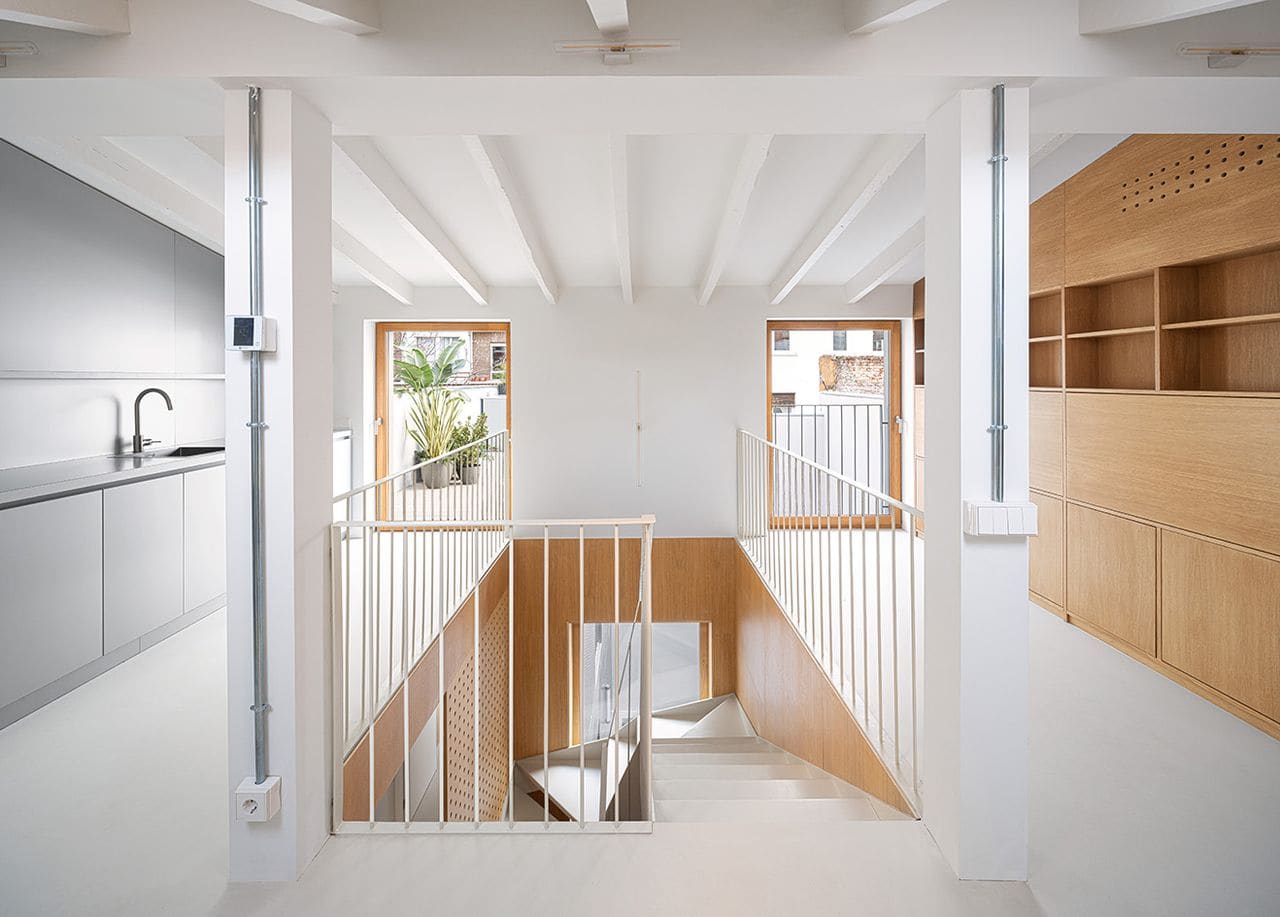
There's a quiet radicalism in choosing to keep what already stands. In Madrid, where property pressures have long favored demolition and densification, the survival of fourteen houses from an 1890s garden-city experiment feels less like preservation and more like resistance. Solar.xyz, a young practice founded by Pablo Canga and Ana Herreros in 2022, has built its ethos around this tension. Their work on Casa Castelar, a private residence within that surviving fragment of Madrid Moderno, demonstrates how adaptive reuse can function as both historical scholarship and environmental strategy.
At World Archi Design, we've been tracking a generational shift in how emerging studios approach existing building stock. Where an earlier wave of adaptive reuse often leaned on exposed brick and visible scars as aesthetic gestures, Solar.xyz treats the envelope and spatial logic of older structures as active participants in contemporary performance. Their intervention at Casa Castelar reduced household energy consumption by more than seventy percent, according to the studio, through a combination of upgraded thermal insulation, aerothermal systems, and optimized cross ventilation. The result is a building that reads as continuous with its 19th-century origins yet operates within 21st-century climatic realities.
A Practice Built on Repair
Canga and Herreros describe their methodology as challenging what they call the "disposable paradigm of contemporary building culture." That language reflects their parallel engagement with teaching and editorial work, most notably through a research initiative titled The Architectures of Repair. The project examines socio-ecological transformation within pre-existing structures, positioning repair not as nostalgia but as a form of technological agility.
The duo cites Alison and Peter Smithson's essay "The As Found and the Found" as a foundational text. The Smithsons, key figures in postwar British architecture and members of Team 10, argued for an attitude toward design that prioritizes direct engagement with a site's material and social conditions over imposed idealism. Solar.xyz extends that thinking into the realm of climate adaptation, treating craftsmanship and digital fabrication as complementary rather than oppositional tools. In 2024, the Chamber of Architects in Spain recognized the practice with its Emerging Award, signaling institutional acknowledgment of their approach.
Madrid Moderno and the Garden-City Fragment
Casa Castelar sits within Madrid Moderno, a late-19th-century development conceived around garden-city principles. The original scheme comprised ninety-six houses distributed across landscaped plots just outside the capital's historic core. By the 1970s, urban redevelopment had reduced that number to fourteen. What remains today functions less as a cohesive neighborhood and more as a scattered typological archive, each house a data point in the evolution of bourgeois domestic space in Spain.
The garden-city movement, as theorized by Ebenezer Howard and later adapted across Europe, sought to reconcile urban density with access to green space and light. Madrid Moderno represented a localized interpretation of those ideals, scaled to the social and economic conditions of turn-of-the-century Spain. Solar.xyz's intervention respects that lineage without romanticizing it. Their work acknowledges the house as a product of specific historical forces while refusing to treat it as a static artifact.
Bioclimatic Upgrade Without Erasure
The technical strategy at Casa Castelar centers on passive and active systems layered into the existing envelope. New joinery replaces deteriorated windows and doors, improving airtightness without altering the facade's rhythm or proportions. Aerothermal heating and cooling, which extracts ambient energy from outdoor air, replaces older fossil-fuel-dependent infrastructure. Cross ventilation, a feature often compromised in retrofits, was recalibrated through interior spatial adjustments that maintain period room sequences while improving airflow.
Thermal insulation presented a particular challenge. Inserting contemporary insulation into a masonry envelope risks altering interior volumes or creating moisture traps that accelerate material decay. Solar.xyz threaded that needle by applying insulation selectively, prioritizing zones where heat loss was most acute and leaving areas with adequate thermal mass undisturbed. The approach reflects an understanding of the building as a system rather than a collection of surfaces to be uniformly upgraded.
The seventy percent reduction in energy consumption is significant not only as a performance metric but as a proof of concept. It suggests that heritage structures, often dismissed as inherently inefficient, can meet rigorous environmental standards when treated with precision rather than sentiment. Solar.xyz's intervention also sidesteps the aesthetic pitfalls of many eco-retrofits, which tend to announce their sustainability credentials through visible technology. Here, the bioclimatic systems are embedded within the building's existing tectonic logic, legible to occupants through comfort rather than display.
Craftsmanship as Ecological Method
Solar.xyz reframes the relationship between handcraft and digital fabrication as an ecological question rather than a stylistic one. In their view, the debate over traditional versus contemporary construction methods often collapses into a false binary, nostalgia on one side and technological determinism on the other. Their practice proposes a third position: that both modes of production can contribute to a building's adaptive capacity when selected for their fitness to context.
At Casa Castelar, this meant retaining original joinery details where they remained functional and fabricating new components using CNC milling where precision tolerances were required. The distinction wasn't aesthetic but operational. Handcrafted elements carry embedded knowledge about local material behavior and climatic response; digitally fabricated components offer repeatability and performance consistency. The project treats both as tools in a larger ecological method, one that prioritizes resource efficiency and long-term durability over stylistic coherence.
This approach recalls the work of Anne Lacaton and Jean-Philippe Vassal, whose practice has long argued that existing structures represent accumulated energy and material investment that demolition squanders. Solar.xyz extends that logic into the realm of craft, suggesting that embedded knowledge within a building's original construction can inform contemporary interventions in ways that purely technical analysis cannot.
The Broader Trajectory
Casa Castelar is Solar.xyz's first completed project, yet it establishes a clear trajectory for the practice. Their inclusion in the 2026 Architects Directory, an annual survey of emerging talent now in its 25th edition, places them within a global cohort of studios rethinking the relationship between heritage, performance, and contemporary domestic life. The Directory, which features thirty practices this year spanning twenty-seven countries, has historically functioned as an early indicator of architectural directions that gain broader traction within the following decade.
What distinguishes Solar.xyz within that cohort is their integration of research and built work. Many young practices position themselves as either intellectually rigorous or practically adept; few manage both simultaneously. The Architectures of Repair project gives their built interventions a theoretical armature, while Casa Castelar demonstrates that their ideas can produce tangible environmental and spatial outcomes. That synthesis of thinking and making, increasingly rare in an era of disciplinary specialization, suggests a practice capable of influencing both discourse and construction standards.
Forward-Looking Preservation
The challenge for Solar.xyz, and for adaptive reuse more broadly, is scalability. Casa Castelar benefits from a motivated client, a structurally sound envelope, and a regulatory environment that permits substantial interior modification. Not every heritage structure enjoys those conditions. The question becomes whether the methods developed here can be adapted to buildings with greater decay, tighter budgets, or more restrictive preservation mandates.
Solar.xyz's emphasis on repair as an ethical commitment rather than a technical retrofit offers one possible answer. By positioning their work within a broader critique of disposability, they reframe adaptive reuse as a cultural project rather than a niche service. That shift in framing may prove as influential as any specific technical innovation. If heritage structures are understood not as burdens to be managed but as resources to be activated, the economic and regulatory barriers to their preservation begin to look less like obstacles and more like design constraints to be navigated with precision and imagination.
Save this story. A free account keeps your reading list and the 07:00 email in one place.
CREATE FREE ACCOUNT →SIGN IN