
The Geography of Neglect
In the architecture of healthcare, distance is destiny. Across India, dental caries afflict roughly 90% of the adult population, while periodontal disease reaches more than half of all citizens. Yet routine dental visits plummet after age 35, not because pain subsides but because access erodes. The Oral Health Observatory has documented this pattern since 2014: untreated conditions cost far more, economically and physically, than prevention ever would. The barrier isn't knowledge. It's infrastructure.
This is where spatial design intersects public health. MobiDent, a healthcare startup founded by Vivek Madappa, approached Analogy Design with a proposition that flipped the conventional clinic typology on its head. Rather than anchor dental care to fixed locations and expect patients to travel, what if the practice itself became mobile? What if the dentist came to the patient, particularly in rural and marginalized communities where clinical deserts are most acute?
After eight years of fragmented prototyping, MobiDent needed more than vision. They needed engineering discipline, usability logic, and manufacturing rigor. Analogy Design, a Bangalore-based studio, accepted the challenge and ultimately earned recognition as India's Best Design Studio at the 2025-26 IBDA Awards for the collaboration.
Compressing the Clinical Typology
A conventional dental practice is a sprawling assembly of instruments, cables, compressors, suction units, water lines, and sterilization equipment. The spatial footprint is substantial; the logistical complexity, even more so. The central design problem for Analogy was not simply miniaturization but reimagining the entire assembly from first principles. How do you preserve full clinical functionality while making the system transportable, hygienic, and cognitively manageable for practitioners working in variable field conditions?
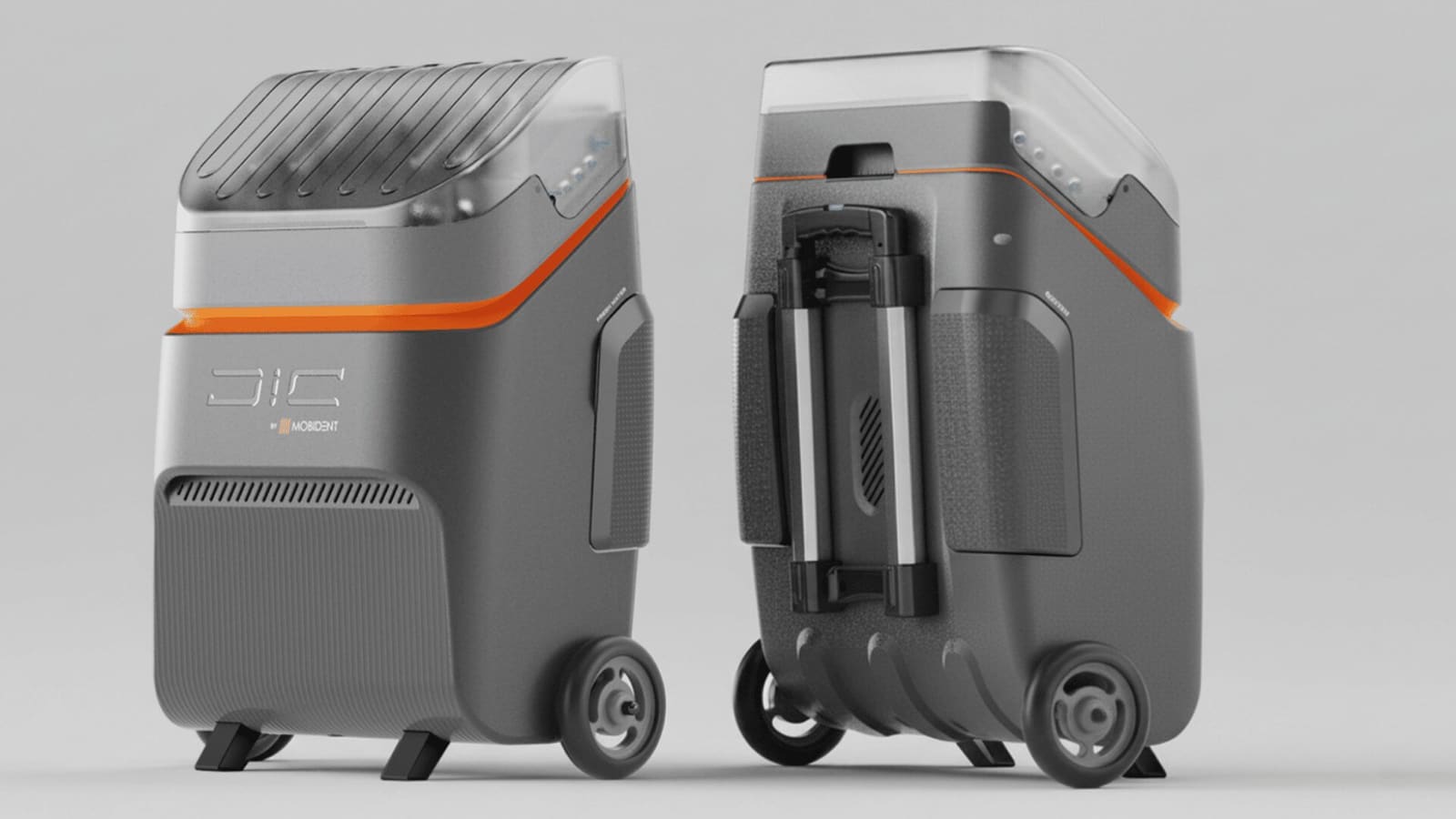
Analogy began with mechanical engineering and a focus on pneumatic simplification. By centralizing the system around pressurized air and water, the studio halved the internal volume and component count. This wasn't cosmetic reduction. It was a fundamental rethinking of how dental tools receive power and fluid, eliminating redundant subsystems and the tangle of connections they require.
The result is a two-part modular configuration. One unit houses the compressor and ancillary support systems; the other contains the personal instruments the dentist manipulates directly. This separation allows faster deployment and simpler troubleshooting in the field. Usability engineering informed every interface decision, reducing cognitive load during setup so that clinicians can focus on care rather than assembly protocols.
Material Hygiene and Field Durability
Healthcare design operates under constraints that architecture rarely confronts so directly: surfaces must resist microbial colonization, materials must endure repeated chemical cleaning, and every seam or crevice becomes a potential infection vector. For a mobile system expected to function in non-clinical environments, dusty village squares or community centers with minimal plumbing, these concerns intensify.
Analogy specified durable, easy-to-clean materials throughout. Smooth, non-porous surfaces dominate the exterior and interior alike, designed to withstand aggressive disinfection without degrading. The modular construction also aids maintenance; components can be swapped or serviced independently, extending the lifespan of the overall system and reducing downtime.
This attention to materiality reflects a broader understanding within contemporary design practice: that form and finish are not aesthetic flourishes but functional necessities, particularly in contexts where resources are constrained and failure carries human cost.
Economic and Social Scalability
Madappa noted that Analogy's strength lay in the "last mile," translating aspiration into rigorous engineering for manufacturing. This is where many socially motivated design projects falter. Prototypes work in controlled settings but collapse under the demands of mass production, field variability, or cost constraints. Analogy addressed this by streamlining assembly and reducing part counts, which directly lowers production expense and simplifies supply chains.
The modular system also enables scalability in deployment. A single mobile clinic can serve rotating schedules across multiple villages, supported by basic infrastructure. This decentralized model aligns with emerging paradigms in public health that prioritize distributed care over centralized facilities, particularly in geographies where population density and transportation networks make traditional clinics economically unviable.
At World Archi Design, we've observed a growing convergence between product design and infrastructural thinking. The mobile dental clinic is not merely a device; it functions as micro-infrastructure, a node in a potential network of community-based healthcare programs. Its significance extends beyond dentistry, offering a template for other medical specialties where mobility and modularity could dismantle barriers to access.
Precedents in Mobile Healthcare Design
The concept of mobile clinics is not new. From tuberculosis screening vans in mid-20th-century America to contemporary mobile stroke units equipped with CT scanners, healthcare has periodically experimented with bringing services to patients. What distinguishes the MobiDent system is its focus on routine, preventive care rather than emergency response or epidemic containment.
This positions it closer to the ethos of participatory design and appropriate technology movements, which emphasize solutions tailored to local contexts and resource realities. The modular, pneumatic simplicity echoes principles articulated by figures like Victor Papanek, who argued that design should serve human need over market novelty. Yet Analogy's work is no nostalgic throwback. It integrates contemporary engineering precision, medical device standards, and usability research into a package that meets regulatory and clinical demands.
There are also parallels in adaptive reuse and temporary architecture, fields where designers routinely confront constraints of mobility, assembly time, and environmental variability. The MobiDent clinic, in essence, applies these logics to medical equipment, treating the dental practice as a portable, reconfigurable space rather than a fixed institution.
The Policy and Cultural Context
Design alone cannot resolve systemic healthcare inequities, but it can materially enable new delivery models. The Oral Health Observatory data underscores the need for both policy intervention and grassroots solutions. MobiDent's mobile clinic addresses the latter, providing a tool that public health programs, NGOs, or government initiatives could deploy at scale.
Cultural factors also matter. In communities where dental care has historically been inaccessible, the arrival of a mobile clinic can shift perceptions, normalizing preventive visits and reducing stigma around oral health. The visibility of care, delivered locally and consistently, builds trust and habit over time.
This is where architecture and design intersect with social infrastructure. The built environment shapes behavior, and when that environment is mobile, it can reshape expectations across entire regions. The studio's work with MobiDent demonstrates that industrial design, when rigorously applied, can function as a form of infrastructural intervention, quietly reconfiguring the terms of access.
Forward Implications
As healthcare systems worldwide grapple with aging populations, resource scarcity, and geographic inequality, mobile and modular solutions will likely proliferate. The lessons from the MobiDent collaboration, particularly around pneumatic simplification, modular assembly, and usability engineering, offer a playbook for other domains. Ophthalmology, audiology, physiotherapy, each could benefit from similar rethinking.
The challenge will be ensuring that these innovations reach the populations that need them most, rather than remaining boutique solutions for affluent markets. Scalability, affordability, and policy support are prerequisites. Design can propose; implementation requires political will and economic alignment.
In the meantime, projects like this one remind us that the most meaningful design work often happens not in iconic towers or museum-worthy installations, but in the quiet engineering of systems that meet fundamental human needs. The mobile dental clinic is modest in scale, profound in implication. It asks us to reconsider what infrastructure looks like when it moves, when it adapts, and when it genuinely serves.
Save this story. A free account keeps your reading list and the 07:00 email in one place.
CREATE FREE ACCOUNT →SIGN IN