
The Problem Hiding in Plain Sight
Walk through any stone quarry and you will find it: the irregular blocks, the off-spec pieces, the material that fell short of dimensional requirements. For decades, this waste has accumulated at extraction sites, too small for conventional use yet too valuable to discard outright. The challenge has never been a lack of material. It has been a lack of systems capable of accommodating irregularity while maintaining architectural coherence.
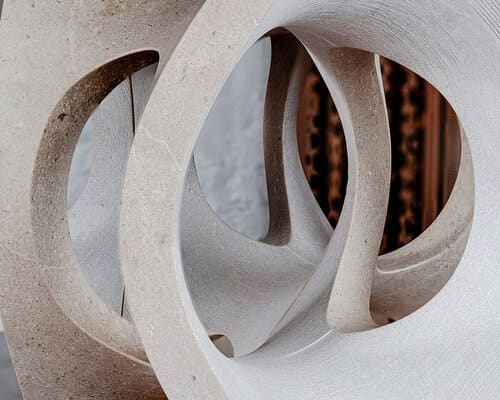
Vlad Tenu's installation addresses that gap. Presented during Clerkenwell Design Week in London and produced by Cereser Marmi, the work transforms reclaimed San Sebastian limestone into a ten-module system that can be reconfigured into furniture, partitions, screens, or facade elements. The material comes from quarry waste, the kind typically set aside during extraction. Each module is robotically carved to interlock with its neighbors, forming porous surfaces that derive their strength not from mass but from geometry.
Minimal Surfaces as Structural Logic
The formal language draws from periodic minimal surfaces, mathematical constructs found in natural microstructures like bone tissue and radiolaria skeletons. These surfaces minimize area for a given boundary condition, a property that translates into efficient load distribution when applied to physical materials. In stone construction, where weight has historically dictated form, this approach reverses the equation: geometry does the work that mass once did.
The modules are relatively thin compared to traditional stone components. Their self-supporting capacity comes from the way forces travel through the interlocking geometry, distributing load across multiple contact points rather than relying on a single plane of compression. The result is a system that uses less material while maintaining structural integrity, a meaningful shift in a sector where transportation costs and embodied carbon are tied directly to weight.
We have seen minimal-surface logic applied in parametric pavilions and 3D-printed prototypes, but its translation into stone remains uncommon. Stone is heavy, brittle, and expensive to machine. The tolerance for error is narrow. Tenu's work suggests that robotic fabrication can bridge the gap between computational ideation and material reality, enabling complex geometries that would be prohibitively difficult to produce by hand.
Robotic Carving and the Collapse of Ornament into Structure
The installation was fabricated using multi-axis robotic arms, a technology that has migrated from automotive manufacturing into architecture over the past fifteen years. Unlike CNC milling, which typically operates on planar surfaces, robotic carving allows for continuous toolpath adjustment across three-dimensional forms. This capability is essential when working with reclaimed material, where each block arrives with its own set of dimensional constraints.
What distinguishes this project from earlier experiments in robotic stone carving is the integration of structural and ornamental expression. The surface articulation is not applied decoration. It is the structure. Every ridge, every void, every transition in curvature corresponds to a load path or an assembly joint. This collapse of categories recalls the tectonic strategies of Gothic vaulting or the ribbed shells of Pier Luigi Nervi, where ornament and structure were inseparable.
In contemporary practice, we tend to separate these roles. Structural engineers optimize for performance; architects layer on visual expression afterward. Tenu's system resists that division. The geometry is simultaneously a structural solution and a formal one, a strategy that becomes legible only through fabrication methods capable of executing both at once.
Precedent and Context
The research traces back to work Tenu initiated at the Bartlett School of Architecture in 2009, part of a broader wave of computational design research emerging from institutions like the AA, ETH Zurich, and MIT. That period saw the rise of generative algorithms, material computation, and digital fabrication as distinct fields of inquiry. Many projects from that era remained speculative. What makes this installation noteworthy is its material realization at a scale that begins to suggest architectural application.
The use of reclaimed stone also positions the project within a growing discourse around circular material economies. Adaptive reuse of building stock is well established; adaptive reuse of raw material waste is less so. Stone quarries generate significant offcuts, and while some are crushed for aggregate, higher-value applications remain limited. A modular system that can accept irregular feedstock and produce standardized outputs offers a model for scaling waste recovery beyond one-off installations.
Comparisons might be drawn to the work of Gramazio Kohler's robotic brick assemblies or the stone-cutting research conducted by Philippe Block's lab at ETH. Both explore how digital fabrication can expand the formal and structural vocabulary of masonry. Tenu's contribution lies in the specific synthesis of minimal-surface geometry, reclaimed material, and modular reconfigurability, a combination that addresses material efficiency, fabrication precision, and spatial flexibility in a single framework.
Implications for Practice
The installation was accompanied by a panel discussion featuring representatives from Materials Council, Arup, and Cereser Marmi, organizations positioned at different points along the material supply chain. That conversation is significant. For robotic stone systems to move from exhibition to practice, they must navigate not only technical feasibility but also procurement, liability, and cost structures that favor conventional methods.
One barrier is tooling. Robotic fabrication requires upfront investment in equipment and expertise, costs that are difficult to amortize across small production runs. Cereser Marmi's involvement suggests a pathway: stone fabricators with existing robotic infrastructure can integrate custom geometries into their workflows, distributing the cost across multiple projects. This model has already proven viable in precast concrete, where digital molds enable mass customization within industrial production.
Another question is assembly. Interlocking modules reduce the need for adhesives or mechanical fasteners, but they also require precise alignment during installation. Tolerance stack-up becomes critical, especially when working with reclaimed material that may vary in density or fracture behavior. The success of such systems in the field will depend as much on installation protocols as on fabrication precision.
At larger scales, the porous geometry offers thermal and acoustic performance advantages. Stone screens with high surface area can modulate solar gain while maintaining visual transparency, a useful characteristic in facade design. The modular nature also allows for phased construction or disassembly, supporting building lifecycles that anticipate change rather than permanence.
What Comes Next
Fluid Stone occupies a productive space between research and application. It is not a prototype awaiting a client, nor is it purely speculative. It is a demonstration of technical capacity, a proof that reclaimed stone can be transformed into a system with architectural agency. Whether that system scales will depend on factors beyond design: material availability, fabrication access, regulatory acceptance, and market demand.
The broader trajectory, however, seems clear. As embodied carbon becomes a central criterion in material selection, strategies that reduce waste and optimize material use will gain traction. Digital fabrication tools are becoming more accessible, and the computational methods underpinning projects like this are now taught in most architecture programs. The question is not whether such systems are possible, but how quickly the industry can absorb them.
For now, the installation serves as a reference point, a calibrated example of what becomes possible when computational geometry, robotic precision, and material recovery converge. It is not the first project to explore these ideas, and it will not be the last. But it is among the first to do so with stone, a material whose weight and cost have long constrained its formal range. In that sense, it opens a door that has been closed for some time.
Photo: Neil Perry
Save this story. A free account keeps your reading list and the 07:00 email in one place.
CREATE FREE ACCOUNT →SIGN IN