
When Topography Becomes Collaborator
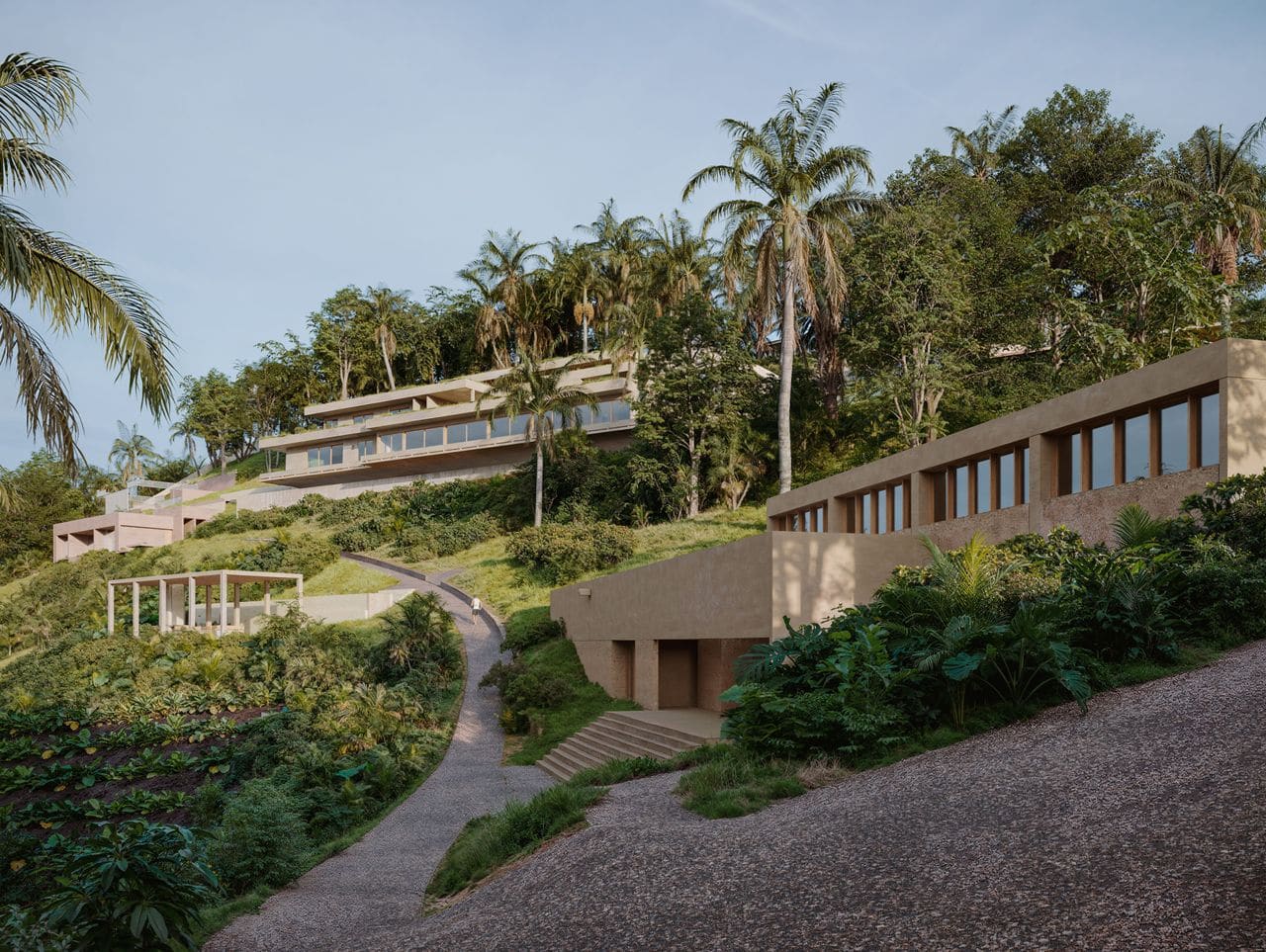
Most architects see a steep, forested mountainside as a problem to solve. Glenn DeRoche sees it as a design partner. His Aburi Residence & Retreat, perched on seven acres overlooking Ghana's Akwapim Ridge, rejects the convention of carving platforms into hillsides or anchoring structures with heroic cantilevers. Instead, the project disperses its program across six discrete pavilions that follow the land's natural contours, creating what amounts to an inhabited landscape rather than a compound imposed upon one.
This approach reflects a broader shift we've been tracking in tropical and subtropical architecture: the move away from monolithic resort typologies toward disaggregated, site-responsive interventions. Where previous generations might have terraced and flattened, DeRoche Projects allows elevation changes to dictate spatial sequencing. The result feels less like architecture colonizing terrain and more like a careful insertion into an existing ecological matrix.
A Campus of Functions, Not a Single Envelope
The pavilions house a private residence, artists' residencies, a wellness center, a gallery, a contemplative space, a paddle court, support facilities, and a productive farm. That programmatic diversity could easily have devolved into visual chaos or thematic incoherence. Instead, the project maintains material and formal consistency while allowing each structure to respond to its immediate site conditions and functional demands.
Pathways thread between buildings, transforming circulation into a deliberate engagement with the forest. This is not the manicured garden walk of a traditional estate but something closer to a trailhead network, where movement between functions requires negotiating changes in grade, canopy density, and exposure. The architecture becomes episodic rather than continuous, a series of encounters rather than a single spatial narrative.
Large glazed openings are set deep within recessed facades, a tectonic move that serves dual purposes. Visually, it dissolves the boundary between interior and forest, framing views while maintaining a sense of shelter. Thermally, the deep recesses provide critical shading in a climate where passive cooling strategies are not optional luxuries but fundamental design requirements. This is biophilic design with structural logic behind it, not simply a glass box dropped into greenery.
Low-Carbon Concrete and Local Craft
DeRoche Projects has made material provenance a central concern. All primary materials, fabrication methods, and labor were sourced within Ghana, a commitment that goes beyond rhetoric. The concrete itself incorporates locally produced pozzolanic ash as a partial cement replacement, reducing embodied carbon while supporting regional supply chains. Pozzolanic materials, volcanic or industrial byproducts that react with calcium hydroxide to form cementitious compounds, have been used since Roman times. Their reintroduction into contemporary practice represents a convergence of ancient building knowledge and modern sustainability imperatives.
This is not virtuoso tectonics in the manner of Herzog & de Meuron's material experiments or the parametric masonry of practices like Gramazio Kohler. It is quieter, more pragmatic, rooted in what is available and what makes sense within a specific economic and ecological context. The aesthetic is restrained, almost ascetic, which allows the forest to remain the dominant visual presence.
We've seen similar material strategies in practices like Anna Heringer's work in Bangladesh, where earth construction and local bamboo define both structural logic and architectural identity, or in the vernacular-inflected modernism of studios like MASS Design Group in Rwanda. What distinguishes the Aburi project is its willingness to let the site's topography, rather than a singular material palette, drive the overall spatial organization.
Regenerative Ambition Beyond Minimization
DeRoche articulates a design philosophy that moves beyond harm reduction toward active ecological contribution. According to the studio, sustainability is not treated as a checklist but embedded throughout the design process, with projects fostering ecological and social resilience through regenerative materials, passive strategies, and resource-conscious construction.
This framing aligns with the broader regenerative design movement, which argues that merely reducing impact is insufficient. Proponents like William McDonough and advocates of the Living Building Challenge have pushed for architecture that actively restores ecosystems, sequesters carbon, and enhances biodiversity. Whether the Aburi project achieves that level of environmental performance is difficult to assess without post-occupancy data, but the ambition is legible in the design decisions: dispersed massing that minimizes site disturbance, reliance on passive cooling, integration of productive agriculture, and prioritization of local materials.
The inclusion of a working farm within the campus is particularly noteworthy. It suggests that the project is not merely a retreat in the escapist sense but a productive landscape, one that might supply food for residents and visiting artists while contributing to soil health and water retention. This blurs the line between architecture and agronomy, a hybridization that has precedents in agrarian modernism and more recent experiments like Rural Urban Framework's work in China.
A Studio Expanding Across Typologies
Founded in 2022, DeRoche Projects has built a portfolio that spans residential, cultural, and commercial work, with a notable emphasis on civic and community-oriented projects. The studio's Backyard Community Club, a tennis facility and gathering space in Accra, and its collaborative projects like dot.ateliers Ogbojo, a residency for writers and curators, and Surf Ghana Collective in Busua, demonstrate a practice comfortable moving between scales and programs.
This versatility is increasingly characteristic of emerging practices that resist specialization in favor of broader engagement. Where previous generations of architects might have carved out a niche, younger studios are often working across typologies, testing ideas in one context and refining them in another. The experimental sensibility and commitment to eco-friendly materials evident in the Aburi project are consistent across DeRoche's public-facing work, suggesting a coherent design ethos rather than project-specific gestures.
Embedded Architecture as Regional Strategy
The Aburi Residence & Retreat offers a counter-model to the imported resort vernacular that has dominated much of West Africa's hospitality and high-end residential architecture. Rather than replicating international luxury tropes, the project draws on local material culture, construction knowledge, and climatic responsiveness. It is architecture that could only exist in this particular place, on this particular mountainside, built with these particular resources.
This specificity is both a design strength and a broader strategic position. As climate pressures intensify and the carbon cost of global supply chains becomes untenable, architecture that privileges local sourcing and passive environmental control will become not just ethically preferable but economically necessary. The Aburi project suggests that such an approach need not result in aesthetic compromise or reduced spatial quality. If anything, the constraints generate a richer, more grounded architecture than the generic transparency and minimalism that dominate much contemporary residential design.
The project's inclusion in a global survey of emerging talent underscores a growing recognition that innovative practice is no longer concentrated in traditional architectural centers. Studios like DeRoche Projects, working in contexts with different material economies, climatic imperatives, and cultural expectations, are producing work that challenges assumptions about what contemporary architecture should look like and how it should perform. The pavilions at Aburi are not simply a retreat. They are a proposition about how architecture might embed itself more thoughtfully, more responsibly, and more beautifully into the landscapes we inhabit.
Save this story. A free account keeps your reading list and the 07:00 email in one place.
CREATE FREE ACCOUNT →SIGN IN