
The Threshold as Editorial Device
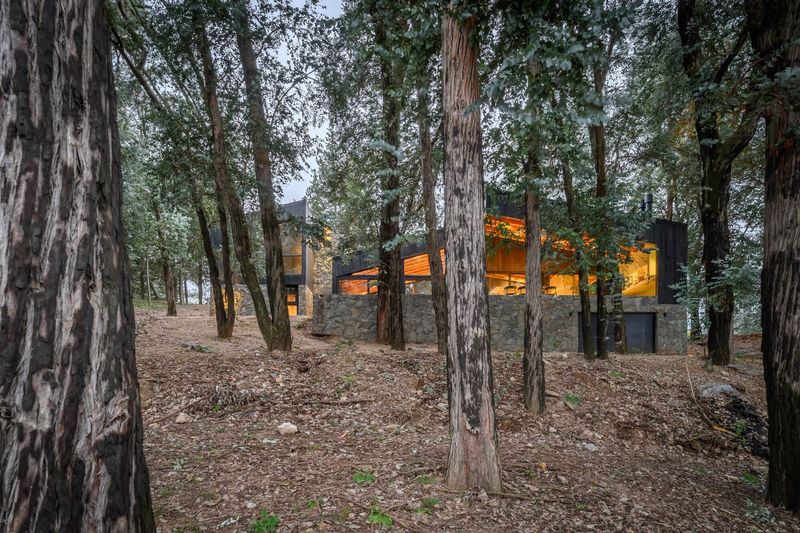
In an era when residential architecture often competes for attention through dramatic cantilevers and expansive glazing visible from the public realm, a house that withholds its character from the street represents a deliberate counterposition. Tenter Studio's recently completed residence in Valle de Bravo, Mexico, employs restraint not as minimalism but as a spatial editing strategy. The 750-square-meter dwelling, finished in 2025 under the direction of lead architect Felix Villaseñor, establishes a clear hierarchy between public-facing discretion and interior revelation.
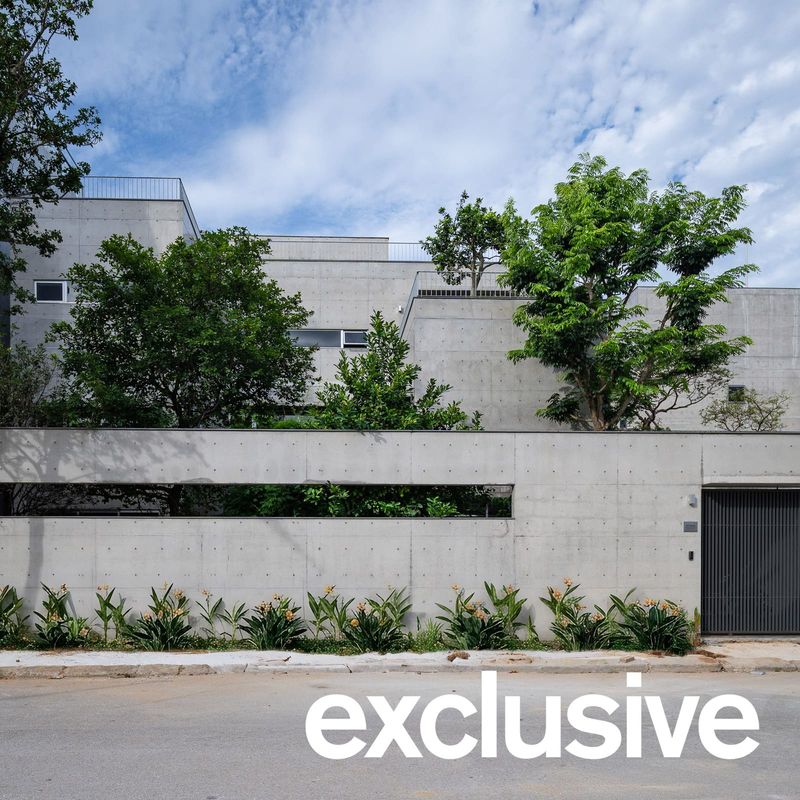
The approach recalls Peter Zumthor's tendency to create buildings that require entry to be understood, where the street elevation functions less as advertisement and more as perimeter. Here, stone volumes remain muted, their massing subdued rather than sculptural. There is no gestural overhang, no transparency hinting at the life within. The architecture refuses the conventional invitation.
Material Vocabulary and Regional Context
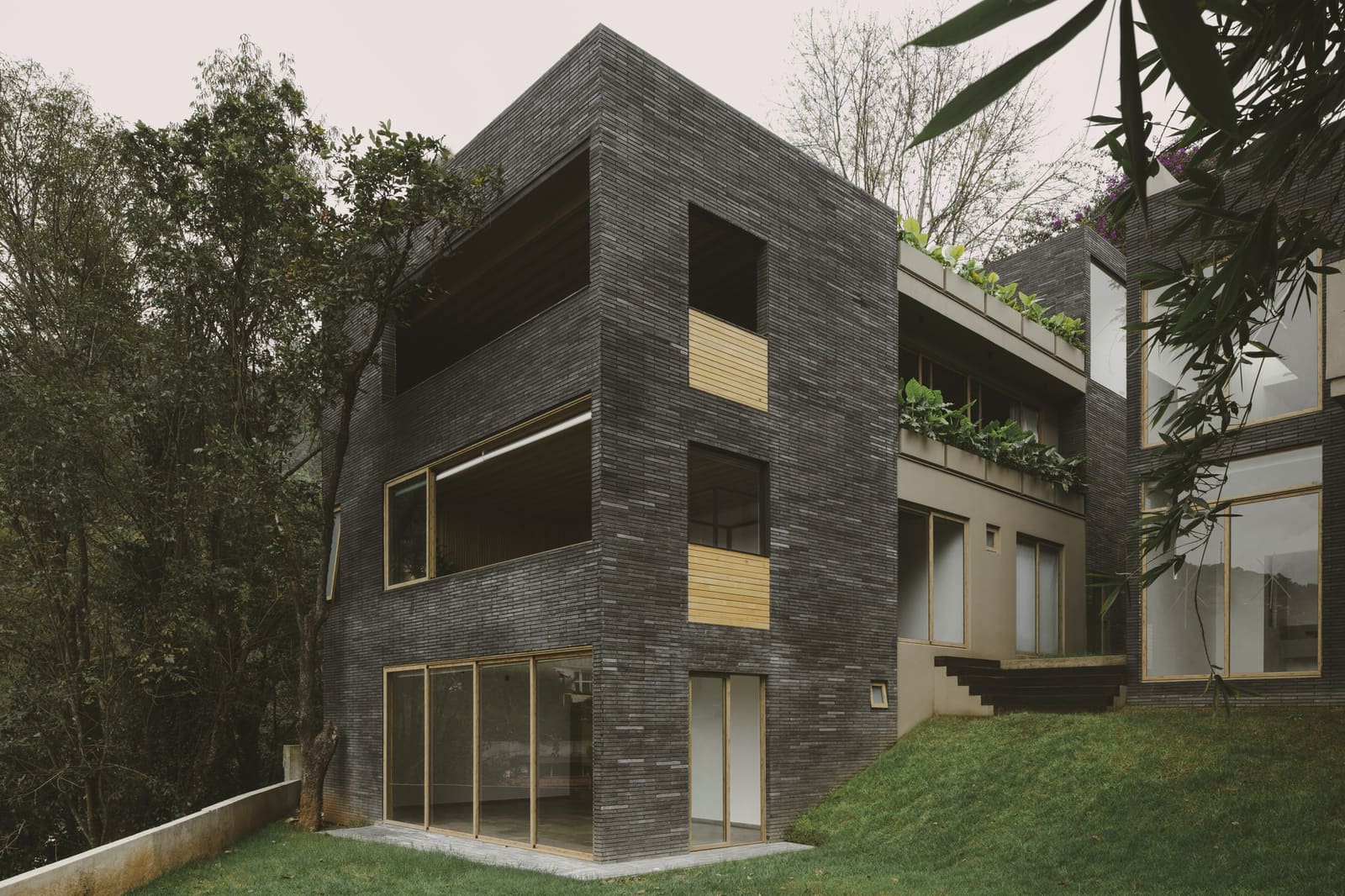
Valle de Bravo sits in the mountains west of Mexico City, a landscape where stone has long served both structural and symbolic roles. Tenter Studio's material selection engages this vernacular without pastiche. The stone cladding reads as mass rather than veneer, its texture absorbing light in a way that flattens the facade and reinforces the sense of enclosure. This is not the polished travertine of corporate lobbies but something more geologically direct, a surface that belongs to the hillside as much as to the building.
The choice aligns with a broader movement in contemporary Latin American residential design, where architects such as Tatiana Bilbao and Frida Escobedo have explored how indigenous materiality can inform modern spatial practice without resorting to folkloric reproduction. Stone becomes both contextual anchor and tectonic expression, a means of situating the house within its topography while maintaining formal autonomy.
Sequential Revelation and Spatial Choreography
What distinguishes this project is its reliance on sequence. The transition from street to interior is not immediate but calibrated through a series of thresholds. The property line marks the first shift, a legal boundary that the architecture treats as perceptual. Beyond it, the building begins to unfold, its volumes articulating relationships that were illegible from the approach. This is architecture that privileges the inhabitant's experience over the passerby's glance, a prioritization that has implications for how we think about residential privacy in increasingly dense contexts.
The strategy has precedent in the courtyard typologies of colonial Mexico, where high perimeter walls concealed gardens and living spaces from public view. But where those traditions relied on enclosure for security and social convention, Tenter Studio's deployment feels more phenomenological. The concealment is not defensive but orchestrated, a way of structuring the act of arrival so that disclosure feels earned rather than given.
The Politics of Visibility
At World Archi Design, we have observed a growing tension in residential architecture between transparency as a democratic ideal and opacity as a form of domestic agency. Glass-walled houses, popularized by mid-century modernism and amplified by contemporary sustainability narratives around daylighting, often assume that openness is inherently progressive. But projects like Casa Para Ver La Peña suggest an alternative reading: that the right to withhold, to control what is seen and when, is equally valid.
This is not about fortification. The stone volumes are not bunkers. Rather, they establish a contract with the visitor, one that requires movement and engagement to be fulfilled. The architecture does not perform for the street; it reserves its performance for those who cross into its domain. In a region where gated communities and high walls are often responses to security concerns, Tenter Studio's approach offers a more nuanced form of boundary-making, one rooted in spatial experience rather than exclusion.
Massing and Topographic Integration
The way the volumes sit on the site reflects an understanding of Valle de Bravo's steep terrain. Rather than imposing a singular geometric gesture, the massing fragments and steps, following the contours in a manner that reduces the building's apparent scale. This sectional strategy, common in hillside residential work from Rudolf Schindler to Elemental's incremental housing, allows the structure to embed itself into the landscape rather than dominate it.
The stone cladding amplifies this effect. Because the material reads as continuous across multiple volumes, the house appears less as a collection of distinct forms and more as a single mass carved and eroded by site forces. The parti is tectonic rather than sculptural, an assembly of load-bearing planes rather than a molded object. This gives the project a weight and permanence that feels appropriate to its mountainous context, a sense that it has been built to endure rather than to impress.
Quietude as Architectural Ambition
There is a temptation in architectural discourse to equate innovation with formal boldness, to assume that significant work must announce itself through striking silhouettes or novel materials. Casa Para Ver La Peña challenges that assumption. Its ambition lies in what it chooses not to do: not to grandstand, not to reveal prematurely, not to compete with the landscape for visual dominance. This is architecture that understands quietude as a form of confidence, a willingness to let the project unfold on its own terms.
The restraint evident in the street-facing elevation is not negation but deferral. The house holds its spatial richness in reserve, offering it incrementally to those who engage with it on foot. In doing so, it proposes that architecture's value might reside not in immediate legibility but in sustained encounter, in the kind of understanding that can only emerge through movement and time. For residential design in contexts where privacy, topography, and cultural tradition intersect, that proposition feels increasingly relevant.
Save this story. A free account keeps your reading list and the 07:00 email in one place.
CREATE FREE ACCOUNT →SIGN IN