
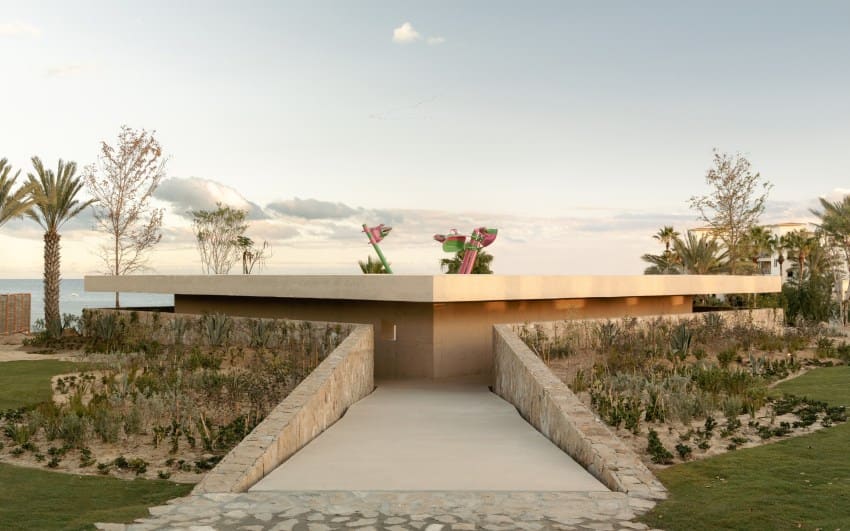
A Courtyard Carved From the Ground
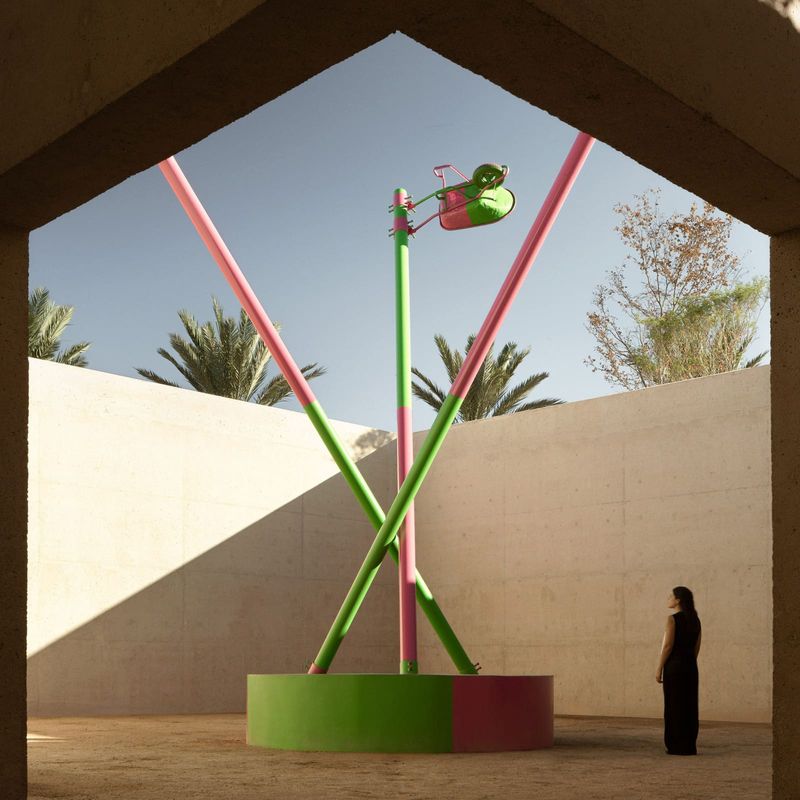
There is a particular quality to architecture that sits below rather than above the datum line. It relinquishes prominence, trades silhouette for enclosure, and in doing so often acquires a kind of intimacy that towers cannot. Arte Abierto Baja, a recently completed open-air gallery in Los Cabos, Mexico, demonstrates this principle with quiet conviction. Designed by Sordo Madaleno Arquitectos, the project descends four metres below grade, establishing a sunken courtyard where large-scale contemporary artworks inhabit a space that is simultaneously exposed to the sky and sheltered from the Baja desert's harshness.
The decision to bury the gallery is not gestural. Los Cabos sits at the southern tip of the Baja California peninsula, a region characterised by arid terrain, intense solar gain, and wind that can be punishing at certain times of year. By lowering the exhibition space into the earth, the architects have created a microclimate, one that moderates temperature fluctuations and reduces the need for mechanical intervention. The walls of the excavation become a thermal mass, absorbing heat during the day and releasing it slowly after dusk. This is passive environmental design in its most elemental form, recalling the sunken courtyards of Mesopotamian architecture or the patios of Andalusian vernacular, where depth equals refuge.
Massing and Material Strategy
The gallery is not a singular volume but rather a series of interconnected terraces and platforms that step down into the excavation. Visitors approach from grade level and descend via wide, shallow steps that double as informal seating. The materiality is deliberately restrained: exposed concrete, local stone aggregate, and minimal steel detailing. There is no applied finish, no veneer. The concrete retains the texture of its formwork, and the aggregate reveals the geology of the immediate site. This approach aligns with a broader trend in contemporary Latin American architecture, one that privileges tectonic honesty over decorative elaboration. We see echoes of this in the work of Elemental in Chile or Tatiana Bilbao's housing prototypes in Mexico, where material is both structure and surface.
The retaining walls that define the perimeter of the sunken courtyard are thick, almost fortress-like in their mass. They are punctuated at intervals by narrow slots that admit sightlines to the surrounding landscape, framing views of the distant Sierra de la Laguna mountains. These apertures are calibrated carefully, offering glimpses without compromising the enclosure's sense of protection. The effect is cinematic: the desert becomes a backdrop, visible but held at a distance, while the sky remains the primary visual field.
Art as Programme, Architecture as Frame
Arte Abierto Baja was conceived as a public gallery for rotating exhibitions of large-scale sculpture and installation work. The architecture does not compete with the art; it establishes the conditions under which art can be encountered. The floor of the courtyard is paved in a continuous surface of polished concrete, providing a neutral ground plane that allows artworks to be positioned with flexibility. There are no fixed plinths, no permanent walls. The space is, in essence, a blank stage, reconfigured with each new exhibition cycle.
This approach reflects a shift in how contemporary galleries are being designed, particularly those that engage with outdoor or semi-outdoor contexts. Rather than the white cube, which imposes a hermetic neutrality, spaces like Arte Abierto Baja offer a calibrated relationship between art and environment. The sky becomes a variable ceiling, changing in colour and intensity throughout the day. Shadows move across the courtyard floor, altering the perception of scale and form. Rain, when it comes, transforms the polished concrete into a reflective plane. These are not incidental effects; they are integral to the spatial experience.
Precedent and Context
The lineage of sunken public spaces in modern architecture is well established. One thinks immediately of the sculpture court at Mies van der Rohe's Barcelona Pavilion, or the sunken plaza at New York's Seagram Building, designed by Mies in collaboration with Philip Johnson. Both projects use descent as a device to create a sense of arrival, a transition from the public realm into a more controlled, contemplative zone. Arte Abierto Baja operates in a similar register, though its context is neither urban nor monumental. Here, the surrounding landscape is expansive and largely undeveloped, and the act of descending into the earth reads less as a retreat from the city than as an engagement with the ground itself.
Within the Mexican context, the project also invites comparison with Luis Barragán's use of walled courtyards and the interplay between solid planes and open sky. Barragán's architecture is often discussed in terms of colour and light, but it is equally about enclosure and the careful orchestration of views. Arte Abierto Baja shares this sensibility, though it strips away the chromatic intensity in favour of a more austere palette. The emphasis here is on texture, shadow, and the framing of the sky as a compositional element.
Environmental Performance and Longevity
The environmental logic of the sunken courtyard extends beyond thermal regulation. By embedding the gallery below grade, the project minimises its visual impact on the surrounding landscape, a consideration that is particularly relevant in a region where development pressures are increasing. The excavation also allows for efficient water management: runoff from the courtyard is channelled into subsurface drainage systems that feed into native planting zones at grade level, supporting the growth of drought-tolerant species without reliance on irrigation.
Concrete, when properly detailed and maintained, is a durable material in arid climates. The absence of applied finishes reduces long-term maintenance requirements, and the use of locally sourced aggregate lowers embodied carbon relative to imported stone or tile. These are incremental decisions, but they accumulate into a project that is more resilient and less resource-intensive over its lifespan.
Spatial Experience and Public Access
One of the more compelling aspects of Arte Abierto Baja is its accessibility. The gallery is open to the public without charge, and its design accommodates a range of uses beyond formal exhibition viewing. The wide steps and terraced platforms function as informal gathering spaces, suitable for small performances, talks, or simply sitting. This programmatic flexibility is critical in a region where cultural infrastructure is limited, and where public space is often conflated with commercial development.
The spatial sequence is intuitive. Visitors descend gradually, moving from the exposed desert floor into the sheltered courtyard. There is no single point of entry; the gallery can be approached from multiple directions, and the experience of arrival is cumulative rather than dramatic. This contrasts with the more conventional gallery typology, where entry is typically through a controlled threshold, often mediated by a lobby or reception area. Here, the architecture is porous, allowing movement and occupation to happen with minimal friction.
Looking Forward
Arte Abierto Baja represents a particular strand of architectural thinking that is gaining traction in regions where climate, material economy, and cultural context demand specificity. It is not a scalable prototype, nor is it intended to be. Its value lies in its responsiveness to place, its willingness to work with rather than against the constraints of site and programme. As cultural institutions continue to expand their definitions of what a gallery can be, projects like this offer a useful counterpoint to the globalised, climate-controlled museum model. They suggest that architecture can be both minimal and generous, both restrained and richly atmospheric, without recourse to spectacle or excess.
The challenge, as always, is maintenance. Open-air galleries require ongoing care to manage weathering, vegetation encroachment, and the inevitable wear that comes with public use. Whether Arte Abierto Baja will age gracefully or succumb to neglect depends on institutional commitment and community stewardship. For now, it stands as a compelling example of how contemporary architecture can engage with landscape, art, and public life through the simple, powerful gesture of digging down.
Save this story. A free account keeps your reading list and the 07:00 email in one place.
CREATE FREE ACCOUNT →SIGN IN