
When Insurance Isn't Enough
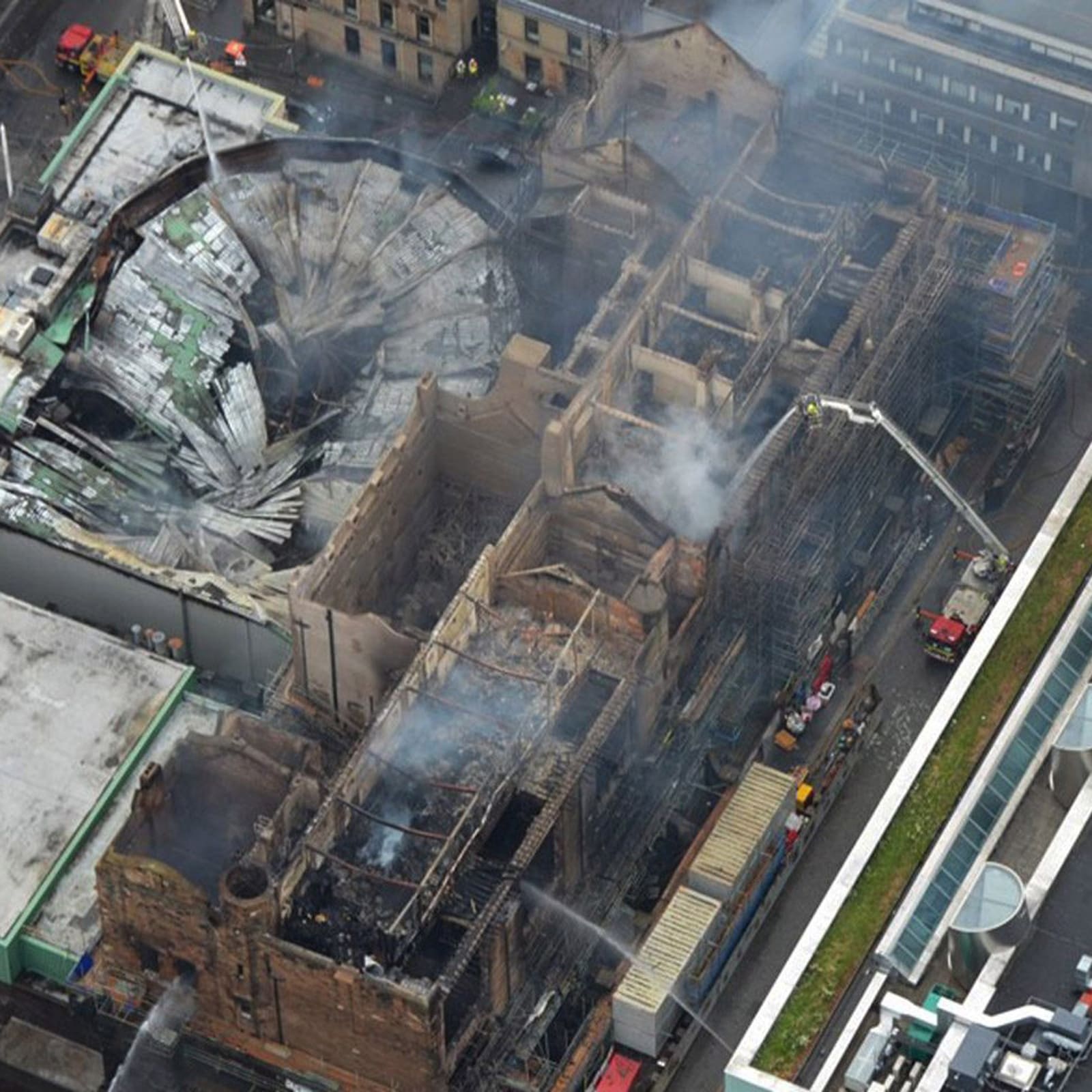
There exists a threshold where heritage preservation crosses from institutional duty into financial impossibility. Glasgow School of Art has reached that line. The institution announced recently that it lacks the resources to reconstruct the Mackintosh Building, the 1910 masterwork by Charles Rennie Mackintosh that suffered catastrophic fire damage in 2018. Instead of rebuilding, the school will remove the scaffolding that currently shrouds the structure, stabilize what remains, and leave the burned shell exposed while seeking external funding for future restoration.
The figure that prompted this decision carries weight: £265 million. That sum represents five times the school's annual operating budget and quadruples an earlier estimate of £62 million. Ann Priest, chair of the board of governors, stated plainly that attempting reconstruction would compromise the institution's financial viability. The school has settled its insurance arbitration, though terms remain undisclosed, and the gap between that settlement and actual restoration costs has proven insurmountable.
What emerges from this announcement is not merely a story of one damaged building, but a broader tension between the cultural imperative to preserve architectural heritage and the economic reality facing institutions tasked with that preservation.
The Mack: Precedent and Particularity
Mackintosh's building for the Glasgow School of Art stands among the most significant works of early modernism in Britain. Completed between 1897 and 1909, the structure synthesized Arts and Crafts sensibility with proto-modern spatial thinking. Its library, in particular, demonstrated Mackintosh's ability to marry ornament with tectonic clarity. Timber posts and beams articulated structure while carved details maintained the hand-crafted ethos central to the movement. The fenestration along the north facade, those tall studio windows, became iconic, flooding interior spaces with diffused Scottish light essential for art education.
The building's influence rippled through twentieth-century design pedagogy. Schools worldwide studied its integration of function and form, the way circulation shaped experience, how material choices reinforced programmatic intent. When fire first struck in 2014, restoration began immediately. The £35 million project aimed to reinstate lost elements while upgrading infrastructure. Then, in 2018, a second blaze erupted during that very restoration work. Investigation reports later noted that fifty percent of the structure was ablaze within 38 minutes of firefighters' arrival. The reconstruction materials, it seems, accelerated the destruction they were meant to prevent.
The Economics of Reconstruction
Why did cost estimates balloon from £62 million to £265 million? Construction inflation accounts for part of the increase. Post-pandemic supply chain disruptions, labor shortages, and rising material costs have affected projects globally. But reconstruction of historic buildings carries unique burdens. Matching original materials often means sourcing from specialized suppliers. Craftspeople skilled in period techniques command premium fees. Regulatory requirements for fire safety, accessibility, and environmental performance add layers of complexity absent from the original 1910 construction.
Glasgow School of Art's leadership acknowledged that a project of this magnitude exceeds both the institution's financial capacity and its technical expertise. The statement is remarkable for its candor. Many heritage organizations frame reconstruction as inevitable, even when resources remain uncertain. Here, the school has named the gap explicitly and admitted it cannot be bridged internally.
The insurance settlement, while undisclosed, clearly falls short. Insurance policies typically cover replacement value or actual cash value, not the full cost of heritage-appropriate reconstruction. Disputes over coverage, causation, and valuation can drag for years, as this one did. Even favorable settlements rarely match the true expense of restoring a structure of this cultural significance.
Precedents in Adaptive Preservation
Glasgow School of Art now proposes stabilizing the shell with temporary and permanent internal supports, leaving the exterior visible as a remnant. This approach has precedent. The Kaiser Wilhelm Memorial Church in Berlin, bombed during World War II, retained its damaged tower as a memorial while adding modern elements alongside. Coventry Cathedral preserved its ruined nave adjacent to the new sanctuary designed by Basil Spence. Both projects transformed destruction into a layered narrative about resilience and continuity.
Whether this model suits the Mackintosh Building remains contested. The church and cathedral examples involved wartime destruction, contexts that imbued ruins with collective memory. The Mack burned during a restoration project, a tragedy rooted in accident rather than conflict. Its shell may not carry the same symbolic resonance.
The school's report suggests potential for partial reinstatement or integration into a broader cultural district involving nearby institutions. These options acknowledge that full reconstruction may never occur, even with external funding. They also reflect contemporary thinking about adaptive reuse, where historic fabric is preserved while new functions and forms are introduced.
Who Pays for Legacy?
Adam Dunlop, an architect who has followed the case closely, questioned the school's framing. He argued that positioning the building as a catalyst for innovation and economic growth dilutes responsibility for reconstruction itself. The comment points to a fundamental question: should cultural institutions prioritize preserving their historic assets or advancing their contemporary missions? When budgets cannot accommodate both, which takes precedence?
Lisa Rigg, who works on heritage risk projects for Historic England, posed a different challenge. She invoked Andrew Carnegie, the Scottish-American industrialist whose philanthropy funded libraries and cultural institutions across the English-speaking world. Where, she asked, are today's equivalents? High-net-worth individuals own estates across Scotland, yet none have stepped forward with the investment required to save the Mackintosh Building.
Her question underscores a shift in philanthropic patterns. Twentieth-century industrial magnates often directed wealth toward public architecture and education, building legacies in stone and mortar. Contemporary wealth tends toward endowments, scholarships, and named programs. Physical infrastructure, especially reconstruction of damaged historic buildings, attracts less enthusiasm. The reasons are complex: tax structures have changed, donor priorities have shifted, and the reputational risks of high-profile projects may deter potential funders.
The Shell as Artifact
If reconstruction remains financially out of reach, what becomes of the Mackintosh Building? The stabilized shell will stand as evidence of both the original design and the fires that consumed it. In architectural conservation circles, this approach is sometimes termed "arrested decay." The structure is prevented from further deterioration but not restored to its former state.
There is intellectual honesty in this. The building that survives is not the building Mackintosh completed in 1910. It is a palimpsest, marked by fire, by attempted restoration, by economic constraints. Presenting it as such respects the layered history rather than attempting to erase the damage through reconstruction that mimics the original.
Yet this approach also forfeits function. The Mackintosh Building served as studios, classrooms, and library. The shell, however evocative, cannot house students or support the pedagogical mission that justified its construction. Glasgow School of Art must find or build other facilities, effectively duplicating program space while maintaining a non-functional monument.
Forward Trajectories
The school's call for external funding acknowledges that reconstruction, if it happens, will require intervention beyond institutional resources. Trusts established specifically for heritage projects offer one model. The National Trust for Scotland or a newly formed body could assume responsibility, separating the building's future from the school's operational budget.
Government funding presents another avenue. Scotland's heritage agencies might view the Mackintosh Building as a national asset warranting public investment. However, public funds face competing demands, and the £265 million price tag would consume resources that could support multiple smaller preservation projects.
International fundraising campaigns have succeeded for other landmarks. Notre-Dame Cathedral in Paris attracted nearly one billion euros in pledges after its 2019 fire. The difference lies partly in scale of recognition. Notre-Dame holds global iconic status; the Mackintosh Building, while architecturally significant, resonates most strongly within design communities and Scotland itself.
Glasgow School of Art's announcement reframes the Mackintosh Building's future as conditional rather than certain. Reconstruction depends on variables beyond the institution's control: donor willingness, funding availability, political priorities. The building's fate now rests with parties who have yet to declare their interest.
What This Signals
For architecture and design institutions worldwide, the Mackintosh case offers a cautionary precedent. Heritage buildings carry prestige but also liability. When disaster strikes, reconstruction costs can exceed an institution's entire financial capacity. Insurance provides partial relief but rarely covers full heritage-appropriate restoration. Fundraising, even for iconic structures, cannot be assumed.
The decision to stabilize rather than rebuild reflects a pragmatic assessment of limits. It also represents a philosophical shift. Rather than insisting on reconstruction at any cost, Glasgow School of Art has chosen financial sustainability over architectural restoration. Whether this choice will be vindicated or regretted depends largely on what happens next. If visionary funding materializes, the pause may prove temporary. If it does not, the Mackintosh Building will remain a ruin, a reminder that even the most celebrated works of architecture are vulnerable to forces beyond design: fire, economics, and the difficult mathematics of legacy.
Save this story. A free account keeps your reading list and the 07:00 email in one place.
CREATE FREE ACCOUNT →SIGN IN