
The Ownership Question
Public space has long been governed by a simple binary: either a government agency owns and maintains it, or a private entity does. Yet the reality on the ground has grown more nuanced. In cities where budgets are stretched thin and civic engagement is rising, a third category is emerging - spaces that remain publicly accessible but are cared for, programmed, or even co-designed by residents, nonprofits, or private sponsors. This distributed model challenges the assumption that collective access requires centralized control, and suggests that stewardship can be shared without sacrificing the commons.
At World Archi Design, we have been tracking how this tension plays out across different urban contexts. Three initiatives - one in Paris rooted in heritage conservation, another in the same city centered on urban agriculture, and a third in New York embedded within public housing - offer distinct answers to the same underlying question: who takes responsibility for the spaces we share?
A Parisian Bench, a Decade of Care
The Musée du Louvre introduced a sponsorship framework for the Jardin des Tuileries that allows individuals or groups to fund the restoration of historic cast-iron benches, many of which date to the nineteenth century. Under this arrangement, sponsors receive recognition via a small plaque affixed to the bench for ten years. The contribution covers the cost of artisanal reproduction or repair, carried out by a French foundry as part of a larger effort involving 166 benches. Reinstallation was completed in spring 2026.
What makes this model notable is not the act of donation itself - patronage has always existed - but the way it formalizes a temporary claim on a piece of public infrastructure without removing it from collective use. The bench remains open to anyone. The sponsor gains symbolic authorship, a kind of civic nameplate, but not control. It is a model of distributed funding married to heritage preservation, one that treats everyday furniture as both utilitarian object and civic monument.
This approach reflects a broader shift in how institutions think about maintenance. Rather than relying solely on municipal budgets, the Louvre has created a participatory funding stream that taps into individual attachment to place. The ten-year timeframe is crucial: it signals commitment without permanence, allowing the institution to refresh relationships and redistribute recognition over time. The result is a public space sustained by a rotating cast of private stakeholders, each contributing to the longevity of a shared amenity.
Gardens as Self-Governed Commons
Elsewhere in Paris, a different model has taken root - literally. Since 2002, the city has granted citizen groups access to plots ranging from roughly 70 to 1,000 square meters for community gardening. These sites, managed under the Main Verte framework, sit on land owned by the municipality, railway operators, or housing cooperatives. Ownership remains with the institution, but day-to-day control is delegated to neighborhood associations that organize planting, maintenance, and programming.
Participation requires adherence to the Charte Main Verte, a set of guidelines that govern collective use, ecological practices, and public access. The charter functions as a kind of social contract, ensuring that these gardens remain open and accountable even as they are managed by small, self-selected groups. The model has precedents elsewhere - GreenThumb in New York, Prinzessinnengarten in Berlin, the Slow Food Gardens network across Africa - but the Parisian iteration is notable for its formalization. It is not ad hoc or provisional; it is embedded in municipal policy.
What distinguishes this arrangement from traditional allotment gardens is the emphasis on shared space rather than individual plots. These are not subdivided parcels leased to private gardeners, but collectively governed sites where decisions about planting, harvesting, and use are made communally. The result is a hybrid: public land, private labor, and collective governance. The city provides the site and a degree of technical support; the association provides the care, knowledge, and social infrastructure that turn bare ground into productive, welcoming space.
This model has implications beyond food production. It demonstrates that public agencies can relinquish operational control without relinquishing ownership, and that residents can assume responsibility without claiming exclusive rights. It is a form of urban commoning that depends on institutional support but is not institutionally managed.
Resident Authorship in the Bronx
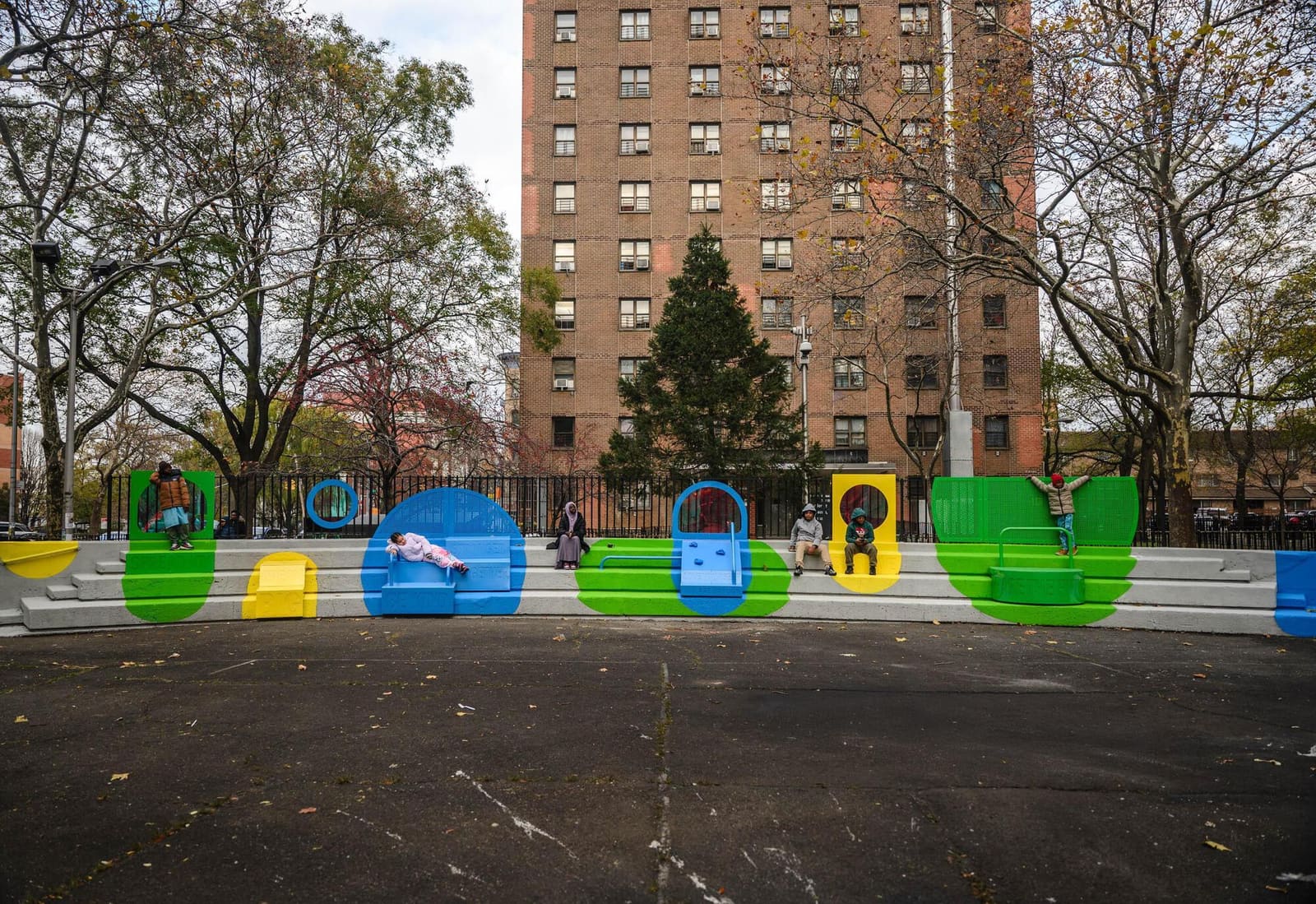
In the Bronx, a different kind of collaboration has produced a permanent public amenity within a New York City Housing Authority development. Common Corner, completed in November 2025, transformed a deteriorating concrete bleacher at Morris Houses into a 600-square-foot gathering space designed to support multigenerational use. The project was initiated by the NYCHA's Connected Communities program, which uses participatory planning and public-private partnerships to modernize open space in public housing.
The bleacher was identified as a priority through a resident survey, and the design was developed by The Urban Conga in partnership with the Center for Justice Innovation, following a series of workshops with Morris Houses residents. The final installation incorporates resident-generated ideas: words of affirmation, dichroic panels that shift color with light, a climbing wall, and a perforated surface for community crafting. Funding came from the Public Housing Community Fund, with ongoing management by NYCHA.
This is not a case of residents taking over maintenance or raising money themselves. It is a model in which institutional actors - government agencies, nonprofits, designers - facilitate and formalize resident input, translating it into built form. The residents do not own the space, nor do they manage it independently. But they authored its program, its aesthetic, and its social function. The result is a publicly owned, institutionally maintained space that reflects the priorities and identity of the people who use it.
Common Corner represents a third pathway, distinct from sponsorship and self-management. It is participatory design embedded within a large-scale housing authority, a model that depends on the capacity of institutions to listen and the willingness of designers to relinquish some control. It is also a model that requires resources - staff time, facilitation expertise, flexible funding - that are not always available in under-resourced contexts.
Precedents and Parallels
The three cases described here are not isolated experiments. They echo a longer history of shared stewardship, from the neighborhood councils that manage playgrounds in Bologna to the business improvement districts that program plazas in North American cities. What unites these diverse models is a recognition that public space can be sustained by a mix of actors, each contributing different forms of capital - financial, social, or creative - without undermining collective access.
At the same time, these models raise questions. Who is included in processes of co-management, and who is excluded? What happens when a sponsor's values conflict with broader community norms? How do we ensure that participatory design does not become a form of outsourced labor, extracting unpaid expertise from residents while institutions retain ultimate control? These are not rhetorical concerns; they are design problems that require ongoing attention.
Toward Distributed Responsibility
The shift from centralized ownership to distributed stewardship is not a retreat from public responsibility. It is, instead, a reconfiguration of how that responsibility is enacted. Institutions remain essential - they provide land, legal frameworks, funding, and long-term accountability. But they are no longer the sole authors of public space. Residents, sponsors, and associations become co-producers, contributing care, knowledge, and labor that institutions cannot always supply.
This distributed model has architectural implications. Spaces designed for shared management often require flexibility, modularity, and social infrastructure - seating that invites gathering, surfaces that accommodate DIY intervention, planting beds that can be tended collectively. They are spaces that anticipate participation, rather than merely tolerating it.
As cities continue to grapple with budget constraints and rising expectations for civic engagement, these models will likely proliferate. The challenge will be to scale them without bureaucratizing them, to formalize them without stripping away the local knowledge and commitment that make them work. The bench, the garden, and the bleacher may seem like modest interventions, but they suggest a larger possibility: that public space can be both collectively owned and individually cared for, sustained by a web of relationships rather than a single institution.
Save this story. A free account keeps your reading list and the 07:00 email in one place.
CREATE FREE ACCOUNT →SIGN IN