When Constraint Becomes Methodology
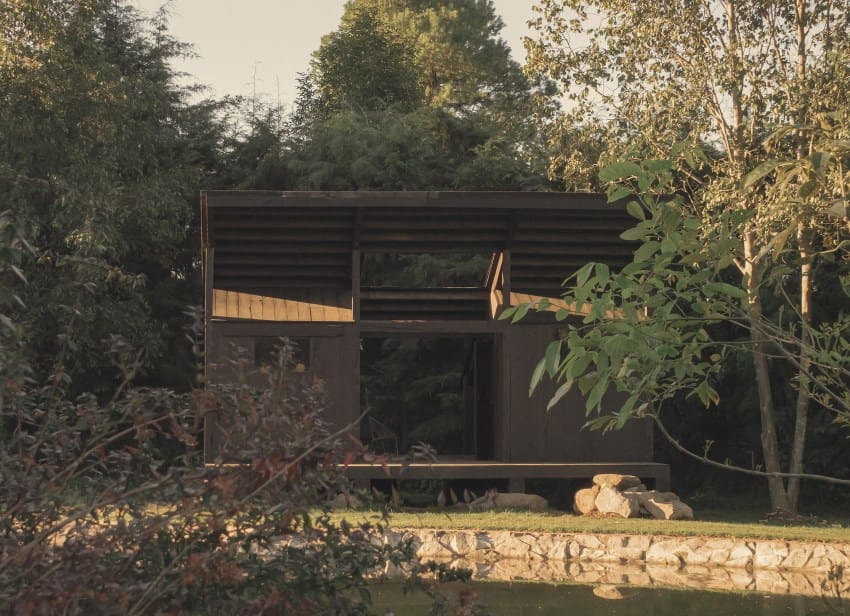
It is one thing to design with sustainability in mind; it is another to let material scarcity dictate every decision. Sauna Los Batanes, a modest lakeside structure in Valle de Bravo, Mexico, belongs to the latter category. Architect Iñigo Artigas worked exclusively with oak recovered from trees that had fallen on the property, a limitation that shaped not only the building's palette but its structural logic, its detailing, and ultimately its architectural character. The project offers a useful counterpoint to the prevailing discourse around timber construction, which often centres on engineered products and industrial supply chains. Here, the supply chain was a matter of metres, not kilometres.
Valle de Bravo sits at approximately 1,800 metres above sea level, a landscape defined by pine-oak forest and a reservoir that has, since the 1940s, drawn weekend visitors from Mexico City. The climate is temperate but variable, with sharp temperature swings between day and night. The site for Los Batanes slopes gently towards the water, and the sauna is positioned to take advantage of lakeside views whilst remaining discreet within the existing vegetation. Artigas raised the structure on stone supports, a gesture that responds both to seasonal flooding and to the desire to minimise ground disturbance. The elevation also lends the building a lightness that contrasts with its heavy materiality.
Charring as Preservation and Expression
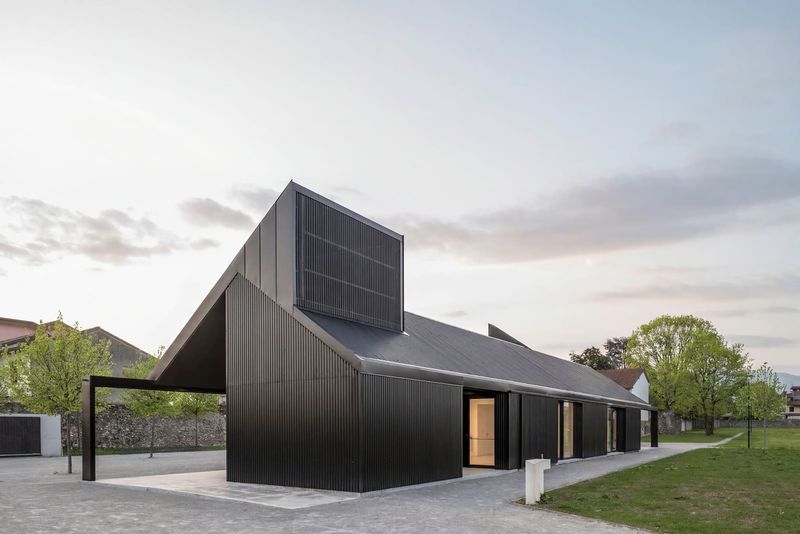
The oak cladding that wraps the sauna has been treated using a controlled charring process, a technique with deep roots in both Japanese and European vernacular traditions. Known in Japan as shou sugi ban, the method involves charring the surface layer of timber to increase its resistance to moisture, insects, and fire. The result is a blackened, textured skin that weathers slowly and requires minimal maintenance. In the context of Valle de Bravo, where humidity near the lake can accelerate decay, the decision to char the oak is as much pragmatic as it is aesthetic.
What distinguishes Artigas's application of the technique is its integration with the building's tectonic expression. The charred boards are laid vertically, emphasising the sauna's modest height and creating a rhythm that shifts subtly as the viewer moves around the perimeter. The blackened surface absorbs light during the day and appears to recede into the landscape at dusk, a quality that recalls Peter Zumthor's treatment of timber at the Bruder Klaus Field Chapel, where charring was used to achieve a similar dissolution of form into context. Here, however, the material's origin story remains legible: the oak was not milled off-site but processed on the property, and the irregularities in board width and surface texture bear witness to that fact.
Structural Simplicity and Spatial Compression
The interior of Los Batanes is deliberately compact, measuring just enough to accommodate a small group. The plan is orthogonal, with a single entrance and a continuous bench running along three walls. The ceiling is low, a condition that intensifies the experience of heat and encourages a posture of stillness. Light enters through narrow openings that frame views of the lake without compromising thermal performance. The openings are positioned to create cross-ventilation when the sauna is not in use, allowing the structure to dry out between sessions.
The structural system is legible and direct. Oak posts support a simple gable roof, also clad in charred timber. The stone piers that elevate the building are uncut or minimally dressed, a detail that grounds the project in local building practices. In rural Mexico, stone plinths have long been used to protect timber structures from ground moisture and termites; Artigas adopts the convention without nostalgia, treating it as a functional datum rather than a historical reference. The result is a building that reads as both contemporary and continuous with its context, a balance that is difficult to achieve without either pastiche or estrangement.
Material Economy and the Ethics of Reuse
Salvaged timber has become a familiar motif in contemporary architecture, but its use is not always substantive. Too often, reclaimed wood functions as a surface treatment, applied to buildings that are otherwise conventional in their material sourcing and construction methods. Los Batanes avoids this pitfall by making salvage the organising principle of the project. The oak was not chosen for its aesthetic qualities and then sourced from a specialised supplier; it was chosen because it was there, and the design emerged from the constraints it imposed.
This approach has implications beyond the immediate project. In regions where timber resources are limited or where transportation costs are prohibitive, on-site salvage offers a viable alternative to imported materials. The charring process, meanwhile, extends the lifespan of the timber without requiring chemical treatments or synthetic coatings, both of which carry environmental costs. Artigas's methodology suggests a model for small-scale construction that is replicable in contexts where material availability is uncertain and where craft labour remains more accessible than industrial fabrication.
Precedent and Context
The lineage of small-scale timber saunas is rich and varied, stretching from the smoke saunas of Finland to the contemporary installations of architects such as Reiulf Ramstad and Studio Puisto. What unites these projects is an attention to thermal performance, material durability, and the orchestration of ritual experience. Los Batanes shares these concerns but departs from its northern precedents in its engagement with a specific site and a specific material constraint. The decision to char the oak, for instance, is not an import of Japanese or Scandinavian technique but a response to local conditions: the availability of oak, the proximity of the lake, and the need for a low-maintenance envelope.
The project also invites comparison with other recent works in Mexico that have explored vernacular construction through a contemporary lens. Mauricio Rocha's Mercado de San Pablo Oztotepec, for example, reinterprets traditional market typologies using rammed earth and timber, whilst Tatiana Bilbao's housing prototypes have demonstrated how local materials and self-build processes can be integrated into architecturally ambitious projects. Artigas's sauna operates at a different scale, but it shares with these projects a commitment to material specificity and a refusal to treat vernacular methods as merely picturesque.
The Sauna as Architectural Laboratory
Small buildings often serve as testing grounds for ideas that are difficult to realise at larger scales. The sauna, in particular, has proven fertile territory for experimentation with material, structure, and environmental performance. Its modest programme demands little beyond thermal mass, ventilation, and a view; its scale permits a degree of craft that is prohibitive in larger projects. Los Batanes exemplifies this tradition, using a simple brief to explore the architectural possibilities of salvaged timber and controlled charring.
At World Archi Design, we have been tracking a broader turn towards hyper-local material sourcing, particularly in projects that operate outside the circuits of industrial production. What these projects share is a willingness to let material availability shape design outcomes, rather than treating materials as interchangeable commodities. Los Batanes demonstrates that this approach need not result in crude or provisional architecture. On the contrary, the constraints of salvage have produced a building of remarkable coherence, one in which every element, from the stone piers to the charred cladding, feels both necessary and considered.
Thermal Performance and Ritual
A sauna is, above all, a thermal machine. Its success depends on its ability to reach and maintain high temperatures whilst managing humidity and ventilation. The use of timber as both structure and finish is conventional in sauna design, but the decision to char the interior surfaces is less common. Charred wood has a lower thermal conductivity than untreated timber, which means it retains heat more effectively. This property, combined with the building's compact volume and low ceiling, allows Los Batanes to achieve the temperatures required for a traditional sauna experience with relatively modest energy input.
The ritual dimension of the sauna is also considered. The approach to the building, slightly elevated and set back from the water, creates a sense of separation from the everyday. The narrow entrance compresses space and light, heightening the contrast with the interior. Inside, the benches are positioned to face the lake, framing the view through the narrow openings. The experience is one of enclosure and release, heat and air, darkness and light. These are elemental contrasts, and the architecture amplifies them without overstatement.
What the Project Suggests
Los Batanes will not appear in surveys of large-scale sustainable construction, nor will it influence the specification practices of commercial developers. Its significance lies elsewhere: in its demonstration that material constraint can be generative, that vernacular techniques can be adapted without sentimentality, and that small buildings can carry architectural ambition. The project suggests that sustainability is not only a matter of certification and calculation but also of proximity, of knowing where materials come from and how they will behave over time. In an era when timber construction is increasingly synonymous with cross-laminated panels and prefabrication, Los Batanes offers a reminder that wood can still be sourced, processed, and assembled on-site, with minimal infrastructure and maximal specificity. The charred oak cladding will weather, darken, and eventually silver, a slow transformation that the building has been designed to accommodate. In this sense, the project is less a finished object than an ongoing negotiation between material, climate, and use.
Save this story. A free account keeps your reading list and the 07:00 email in one place.
CREATE FREE ACCOUNT →SIGN IN