
An Overlooked Lineage
For much of the twentieth century, art historians catalogued Ukrainian creative output as a regional variant of Russian imperial culture, or later, as an undifferentiated part of the Soviet monolith. The result was a flattening of distinct traditions. Embroidery patterns from Poltava, carved wooden icons from the Carpathians, and painted ceramics from Opishne were archived under broader Slavic taxonomies, their geographic and cultural specificity erased. This erasure was not merely administrative. It obscured the generative role that Ukrainian folk practices played in shaping the visual language of early modernism, a genealogy that recent scholarship has only begun to reconstruct.
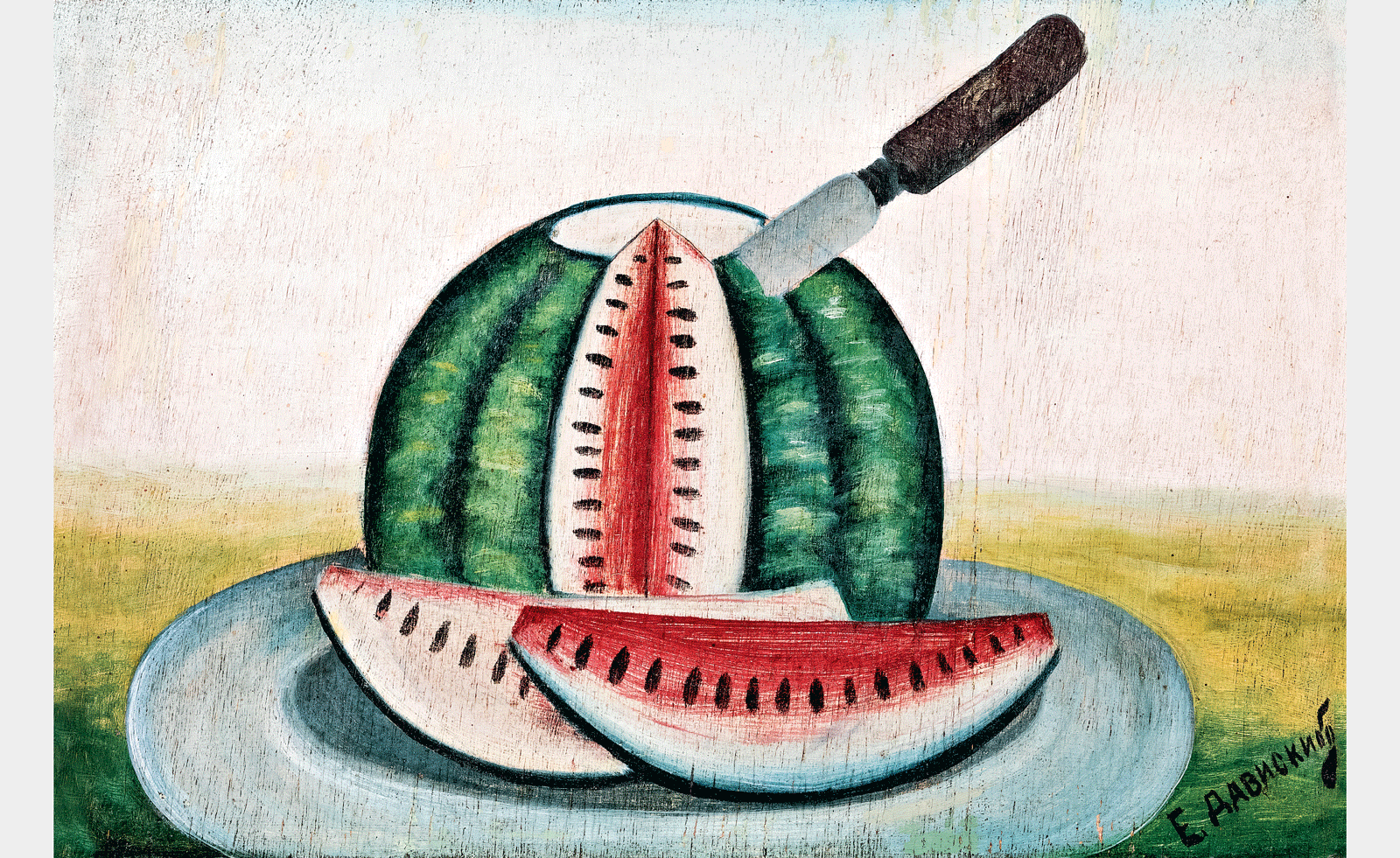
A new publication from Assouline, developed in collaboration with Ukrainian design studio Gunia Project, offers a corrective. The volume examines naïve art produced in Ukraine during the late nineteenth and early twentieth centuries, a body of work characterized by instinct-driven expression rather than academic training. The book positions these objects not as charming curiosities but as foundational influences on movements that have long been attributed elsewhere.
Instinct Over Institution
The term "naïve art" has often been deployed pejoratively, implying a lack of sophistication. In the Ukrainian context, however, the designation points to something more precise: a visual idiom rooted in rural craft traditions, where makers worked without formal atelier training but with deep fluency in inherited techniques. Wood painting, textile embroidery, carving, and object-making were not hobbies but lived practices, passed through generations and adapted to shifting material conditions.
These artists drew on a visual vocabulary that predated academic conventions. Geometry was intuitive, colour relationships were experiential, and iconography was vernacular. The resulting works possess a tectonic clarity, an economy of form that resonates with the reductive impulses of early modernism. Yet for decades, art historians framed these objects as folk ephemera, disconnected from the avant-garde movements that emerged in the same regions during the same period.
Restoring Context
Gunia Project's founders argue that the detachment was deliberate. Imperial and Soviet curatorial frameworks absorbed Ukrainian artists into broader narratives, severing their work from its cultural substrate. The result was a historiography that credited Russian avant-garde innovation while ignoring the rural Ukrainian environments where many of those artists trained their eyes. Icons, embroidered textiles, and decorative painting were not peripheral influences but primary sources, shaping the visual sensibilities of figures who would later be celebrated in Moscow and Saint Petersburg.
The Assouline volume attempts to restore these connections without overcorrecting. The goal is not to replace one nationalist narrative with another but to render the historical record more accurate. By placing lesser-known works alongside canonical pieces, the book constructs a more complete picture of how Ukrainian folk art functioned within the broader European modernist project. The juxtapositions are deliberate: a carved wooden panel beside a Constructivist composition, an embroidered textile pattern adjacent to a geometric abstraction. The visual rhymes are undeniable.
Craft as Living Practice
The book's curatorial approach reflects a broader philosophy held by Gunia Project. For the studio, documentation alone does not preserve a tradition. Archival work is necessary but insufficient. A craft remains vital only when it remains practiced, when it evolves in response to contemporary needs and contexts. This conviction informs the studio's collaborations with artisans across Ukraine, working in blown glass, weaving, ceramics, embroidery, carving, and wickerwork.
The model is one of adaptive continuity. Traditional techniques are not frozen in amber but recontextualized for contemporary design applications. A nineteenth-century embroidery stitch might inform a textile produced for a twenty-first-century interior. A carving method used for devotional objects might be applied to furniture. The goal is to sustain the knowledge base while allowing it to mutate, ensuring that craft remains a viable profession rather than a museum exhibit.
This approach has precedent. Across Europe and Asia, design studios have worked to revive endangered techniques by embedding them in contemporary production chains. The Mingei movement in Japan, the Arts and Crafts revival in Britain, and the Bauhaus's engagement with vernacular craft all operated on similar principles. The difference here is political. In Ukraine, the preservation of folk craft is also an assertion of cultural autonomy, a refusal to let tradition be absorbed into external narratives.
Materiality and Memory
The objects reproduced in the book span a wide range of media. Wood paintings from the early twentieth century display bold chromatic contrasts, with figures rendered in flat planes that anticipate Matisse's later experiments. Embroidered textiles exhibit geometric precision, their patterns governed by systems of repetition and variation that echo the serial logic of minimalism. Carved wooden sculptures possess a formal directness, their volumes articulated with an economy that recalls Brancusi's reductive forms.
These comparisons are not anachronistic. Many modernist artists working in the early twentieth century were actively collecting and studying folk objects, seeking alternatives to academic naturalism. The influence flowed in both directions. Rural makers incorporated new materials and motifs encountered through trade and migration, while urban artists borrowed compositional strategies from vernacular sources. The boundary between high and low culture was more porous than later historiography suggests.
A Shift in Emphasis
By presenting this work in a luxury publishing format, Gunia Project and Assouline are making a deliberate argument about value. The book's production quality, its large-format reproductions and archival documentation, signal that these objects merit the same scholarly and aesthetic attention afforded to canonized modernist works. The gesture is both preservationist and future-oriented. It acknowledges a historical debt while insisting that Ukrainian craft traditions remain relevant to contemporary design discourse.
The volume draws on collections from institutions including the Ivan Honchar Museum National Centre of Folk Culture in Kyiv and the Mykola Babak Foundation in Cherkasy. These archives have become increasingly important in recent years as scholars work to reconstruct cultural histories that were suppressed or distorted under Soviet rule. The digitization and publication of these collections serve a dual function: they make the work accessible to international audiences while safeguarding it against physical loss.
Beyond Nostalgia
The risk in any folk revival is sentimentality, the tendency to romanticize rural tradition as a refuge from modernity. Gunia Project avoids this trap by treating craft as a dynamic system rather than a static inheritance. The studio's collaborations with contemporary artisans are not exercises in nostalgia but experiments in translation. The question is not how to replicate historical forms but how to extend the logic of traditional techniques into new contexts.
This approach aligns with broader trends in contemporary design, where practitioners increasingly look to vernacular methods as sources of material intelligence. In an era of ecological crisis and supply chain fragility, localized craft traditions offer models of resourcefulness and adaptability. The knowledge embedded in these practices, accumulated over centuries, represents a form of distributed expertise that cannot be easily replicated by industrial processes.
The Assouline book, then, is less a monument to the past than a provocation for the future. It asks what might happen if Ukrainian folk art were understood not as a marginal tradition but as a central thread in the history of modernism. It asks what contemporary design might gain by engaging seriously with techniques that have been dismissed as premodern. And it asks how cultural traditions survive not by remaining static but by remaining practiced, adapted, and renewed.
Save this story. A free account keeps your reading list and the 07:00 email in one place.
CREATE FREE ACCOUNT →SIGN IN