
When Function Becomes Ritual
There is a particular kind of architecture that emerges when a client's obsession becomes the brief. Not the casual enthusiasm of weekend hobbyists, but the deep, almost devotional attention that transforms objects into relics and storage into pilgrimage. Alessandro Isola Studio's recent completion, a vertically stacked automotive sanctuary for a private Porsche collection, occupies precisely this territory. Working alongside project architect Roberto Zanlucchi, Isola has delivered what might be described as a secular chapel, one where German engineering replaces iconography and the liturgy is performed by a hydraulic car lift.
The project inhabits a former industrial building at an undisclosed site in Italy. From the exterior, the structure offers no clues. A sliding metal entrance, deliberately anonymous, conceals the spatial sequence within. This reticence is strategic. The architecture operates through controlled revelation, a series of calibrated transitions that heighten perception as one moves through the interior. We have seen this approach in other collector spaces, from Peter Zumthor's Kolumba Museum in Cologne to Herzog & de Meuron's Schaulager in Basel, where anticipation is as carefully designed as the artifacts themselves.
Material Restraint and the Logic of the Cabinet
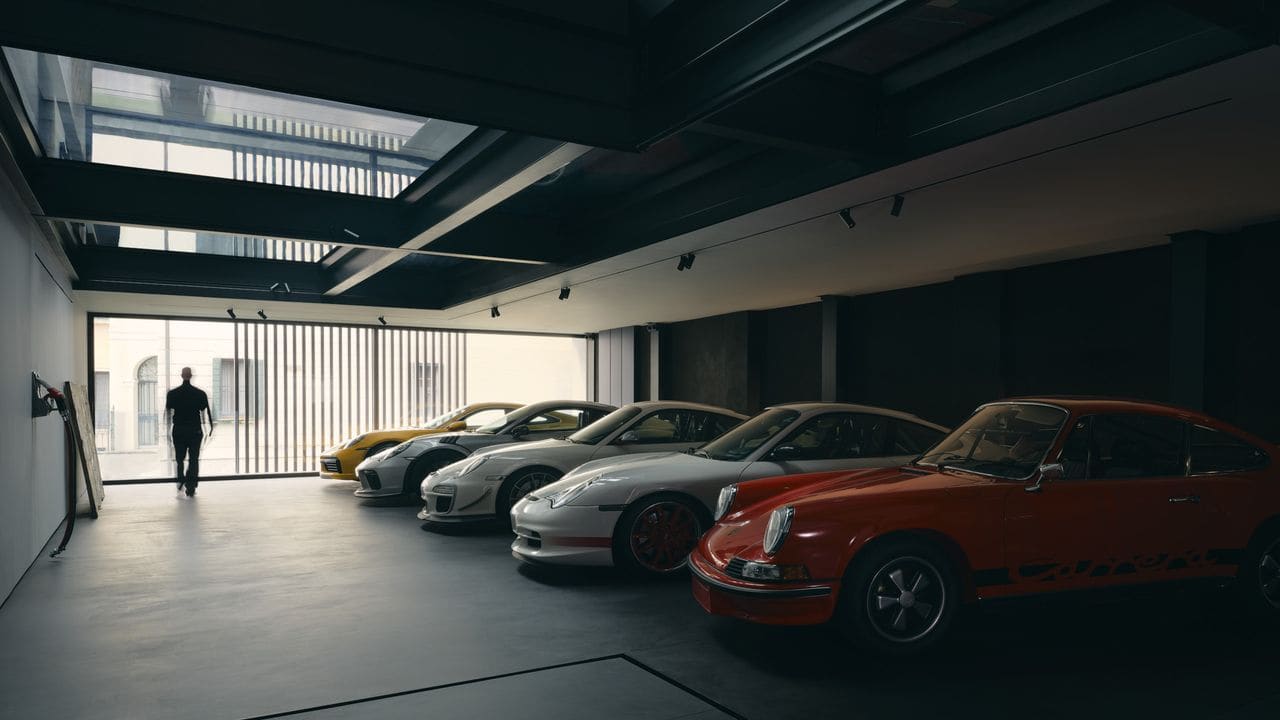
Across four levels, with utilities and mechanical systems relegated to a basement, the collection unfolds as a vertical cabinet. The ground floor initiates the sequence, followed by two intermediate levels and a top-floor reception space that doubles as study and hospitality area. Throughout, the material palette remains deliberately austere: black resin floors, black resin walls, and a folded black-metal staircase that threads through the volume. This near-monastic restraint serves a clear purpose. In an environment where the cars themselves provide chromatic punctuation, the architecture recedes, becoming frame rather than subject.
The decision to push all structural elements to the perimeter allows for column-free interiors, a move that recalls the spatial ambitions of Mies van der Rohe's universal space but here deployed in service of automotive display. Uninterrupted rows of vehicles sit on each level, visible both horizontally and vertically through expanses of glazed flooring. These glass planes, paired with strategically placed skylights, create sightlines that collapse the building's four stories into a single, interconnected volume. Standing on the uppermost floor, one can look directly down through three layers of Porsches, an effect Isola describes as altering instinctive perceptions of stability and depth.
The Lift as Spatial Protagonist
At the heart of the project sits the car lift, a piece of engineering that functions as both infrastructure and spatial event. When lowered, the platform sits flush with the ground floor, disappearing into the architecture. When activated, it rises through the building, bracketed by glass barriers that maintain visual continuity while ensuring safety. The lift can transport vehicles all the way to the topmost level, adjacent to the bar, wine cellar, and vinyl listening room.
This vertical circulation system is not merely utilitarian. It introduces a temporal dimension to the space, transforming static display into kinetic performance. The act of moving a car between floors becomes theatre, watched from multiple vantage points through glass floors and open voids. In this sense, the lift operates similarly to the Paternoster elevators of mid-century European office buildings, continuous loops that made circulation visible and participatory. Here, however, the payload is considerably more valuable, and the movement considerably more deliberate.
Programmatic Hybridity and the Porsche Silhouette
While the cars remain the undisputed focus, Isola has woven in spaces for hospitality and contemplation. A professional kitchen occupies one level, suggesting the building functions as more than passive storage. On an upper floor, a custom-designed table stretches six meters, its form inspired by the classic Porsche profile. Fabricated from brass-finished metal, the table incorporates a Tangerine accent within its support structure, a chromatic nod to one of Porsche's vintage hues from the 1970s. This gesture, subtle yet intentional, demonstrates how the architecture engages with automotive history without resorting to literal quotation.
The top floor, where the car lift terminates, opens onto a roof terrace through sliding glass doors. A planted roof and broad skylight provide yet another vantage point into the collection below. This level serves as a transitional zone between the controlled interior environment and the exterior landscape, a space where the rituals of viewing give way to more conventional social functions. The outdoor kitchen here suggests gatherings, meals taken with the collection as backdrop, visible through the skylight like specimens in a vitrine.
Marble, Mystery, and Material Memory
In the guest bathroom, Isola departs from the project's prevailing restraint. The space is deliberately darkened, almost cave-like, with a basin carved from a single block of white Palissandro marble. Fed by a ceiling-mounted spout, the fixture becomes sculptural event. Isola selected the original block at the quarry, and the finished piece retains visible texture and natural fracture lines, what he describes as preserving the memory of origin. This approach to material, where process and provenance remain legible, aligns with a broader movement in contemporary architecture toward tectonic honesty. We see echoes of this thinking in the work of Junya Ishigami, whose projects often foreground the labor and transformation embedded in building materials.
The bathroom moment also serves a spatial function. In a building defined by transparency and vertical sightlines, this enclosed, opaque room offers respite. It is a pause in the sequence, a moment of compression before the architecture opens up again into the collection galleries.
Precedent and the Collector's Architecture
Private automotive collections have generated a small but significant typology within contemporary architecture. Herzog & de Meuron's work for the Mullin Automotive Museum in Oxnard, California, explored similar themes of display and spatial choreography, though in a public rather than private context. Closer to this project in intent, if not in formal language, is the Antinori Winery in Tuscany by Archea Associati, where product storage becomes architectural spectacle through vertical stacking and controlled transparency.
What distinguishes Isola's approach is the degree to which the architecture refuses to compete. There are no grand gestures, no signature forms that might distract from the collection. The design operates through subtraction and precision, qualities that mirror the engineering ethos of Porsche itself. This is not minimalism as style, but minimalism as strategy, a deliberate withdrawal that amplifies the presence of the cars.
Engineering as Spectacle
Isola describes the building as concealing significant technical complexity behind a form that appears effortless and controlled, a characterization that could equally apply to the vehicles it houses. The flush-mounted lift, the glass floors capable of supporting automotive loads, the climate control systems managing temperature and humidity across multiple levels, all of these represent substantial engineering challenges resolved without visible strain. In this regard, the project aligns with a particular strand of Italian design thinking, one that values sprezzatura, the appearance of ease achieved through meticulous effort.
The integration of systems is particularly noteworthy in the context of adaptive reuse. Transforming an industrial building into a precision-controlled environment for automotive storage requires coordination between structure, mechanical, electrical, and life-safety systems. That this complexity remains invisible to the visitor is itself an achievement, one that speaks to the collaboration between Isola, Zanlucchi, and the engineering consultants.
Objects of Passion, Not Status
Throughout our conversation about the project, Isola returns to a key distinction: these cars are not symbols of status but objects of passion, engineering, and memory. This framing shifts how we might read the architecture. Rather than a vault for financial assets or a stage for conspicuous consumption, the space functions as a study collection, a place where design evolution and mechanical refinement can be examined across decades of production.
This lens, viewing the Porsches as artifacts worthy of sustained attention rather than mere possessions, elevates the project beyond the realm of luxury amenity. It places the work in dialogue with other spaces dedicated to the preservation and contemplation of designed objects, from the Vitra Design Museum's Schaudepot to the study collections of institutions like the Cooper Hewitt. The difference, of course, is scale and access. This is private scholarship, a personal archive made spatial.
The Architecture of Anticipation
What Isola and Zanlucchi have ultimately delivered is an architecture of anticipation. The anonymous exterior, the controlled entrance sequence, the gradual revelation of the collection through layered views and vertical circulation, these elements construct an experience where arrival is never instantaneous. The visitor is made to wait, to move through transitional spaces, to encounter the cars from unexpected angles before fully entering the galleries. This temporal dimension, the deliberate pacing of disclosure, is where the project achieves its most sophisticated effects.
In an era when so much architecture seeks immediate impact, the Instagram moment captured from a single vantage point, this restraint feels both radical and necessary. The building asks for sustained attention, rewards multiple visits, and withholds its full spatial logic until one has moved through all four levels. It is, in the end, an architecture as obsessive as the collection it houses, equally committed to precision, performance, and the quiet satisfaction of engineering done right.
Save this story. A free account keeps your reading list and the 07:00 email in one place.
CREATE FREE ACCOUNT →SIGN IN