
A Collective That Moves
Design pilgrimages have quietly shifted their trajectories. Where once they circled the same polished capitals, they now veer toward cities carrying rougher, more layered narratives. Belgrade has been building exactly this kind of gravity, and a recent arrival at the boutique Pavilion Hotel makes the argument for paying attention. Esthetic Joys Embassy Belgrade opened this year inside the Dorćol neighbourhood at Dobračina 39, combining a dining room, discothèque and forthcoming hotel under one roof.
The Esthetic Joys collective formed in Moscow in 2016, relocating outward in 2022 and establishing its first Embassy in Yerevan the same year. Each outpost operates as a gathering point across cultures, deliberately sidestepping geopolitics in favour of what the team calls cultural ping-pong: every new location generates its own conversation with the city rather than replicating a formula. For Belgrade, the collective brought in Supaform, the studio led by artist and designer Maxim Scherbakov, whose practice has long mined design history for references that feel both nostalgic and self-aware. His Hidden Entourage exhibition in Rome explored functionless objects with a sly historical wink; here, he turns that sensibility toward spatial design.
Modular Icons and Oval Glow
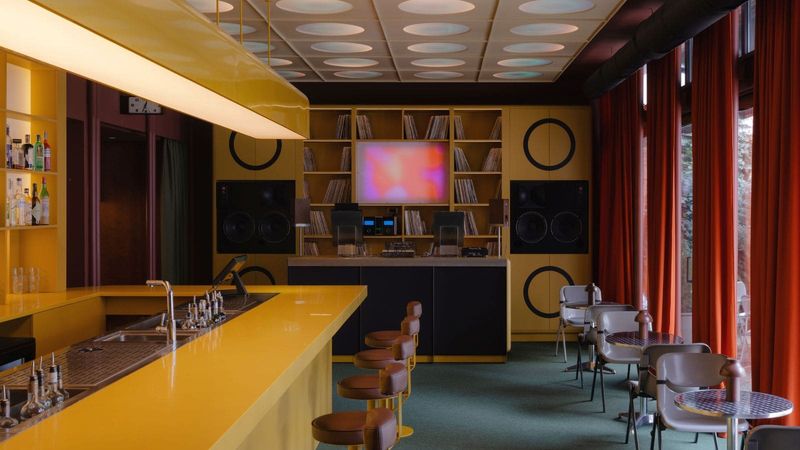
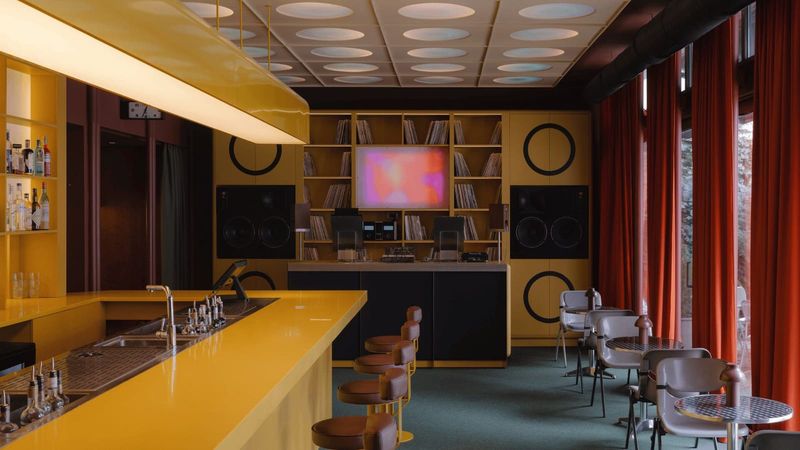
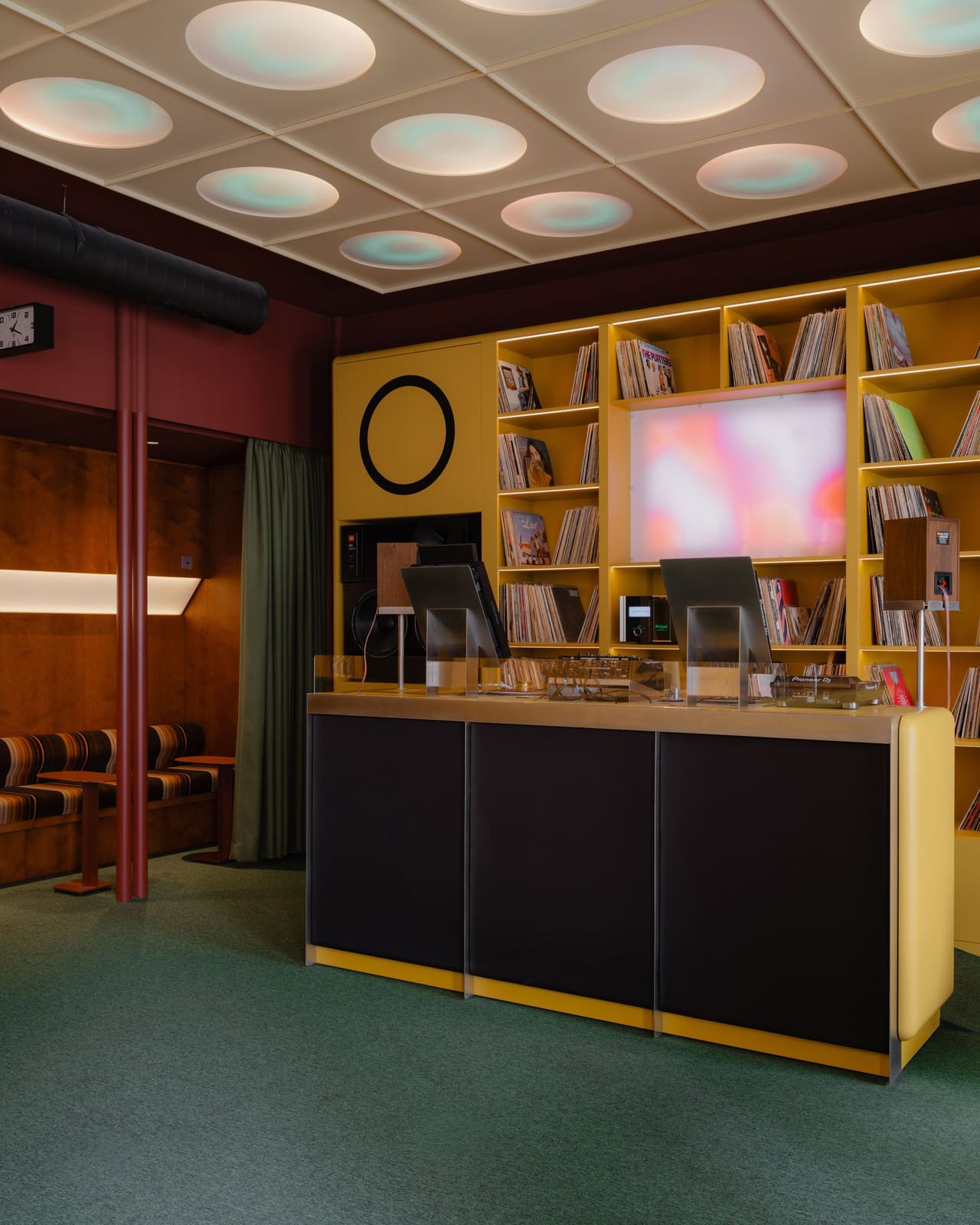
The spatial concept filters Yugoslav modernism of the late 1950s and early 1960s through a postmodern lens that leans gently hallucinatory. The key reference is Saša Mächtig's K67 kiosk, the 1966 modular icon whose rounded geometry became ubiquitous on Yugoslav streets and beyond. Scherbakov takes that aerodynamic optimism and stretches it into a full environment: oval light panels wash the ceiling in shifting colour, the DJ booth pays direct homage to the K67's form, and a warm, deep yellow runs through the space like a thread of optimism. The effect is speculative rather than literal, a dreamscape that acknowledges history without attempting documentary recreation.
At World Archi Design, we've been tracking how designers reinterpret vernacular modernism, particularly when they do so from outside the culture that produced it. Scherbakov's approach is instructive. Rather than treating the K67 as a sacred relic, he treats it as a starting point for formal play. The kiosk's modular logic becomes a rhythm that organises the space, its curves echoed in light fixtures and furniture profiles. The palette borrows from Yugoslav colour theory of the era, but pushes saturation higher, turning historical reference into contemporary atmosphere.
Listening as Architecture
The other defining layer is sound. A pair of vintage JBL 4435 studio monitors and a curated vinyl library anchor what functions as a Japanese listening bar transplanted into the Balkans. Six ichiran-style booths line one side of the bar, each with a curtain you can draw and headphones you can slip on to disappear entirely. The booths are upholstered in original London Underground moquette, specifically the final run of Misha Black's District line pattern, sourced directly from the mill.
This is where the project's cross-cultural ambition becomes most legible. Listening bars emerged in postwar Japan as spaces for focused audio appreciation, often intimate and ritualistic. Transplanting that typology into a Balkan context creates a productive friction. Belgrade's café culture has historically been social, conversational, even political. The listening booth offers the opposite: isolation, introspection, a voluntary retreat from the collective. The tension between these modes, between the Embassy's communal dining and the private booth, gives the space its conceptual charge.
Yoshoku Meets Pljeskavica
The kitchen, led by Moscow-based chef Katsuhiko Kobayashi, extends the cultural ping-pong into cuisine. The menu leans yoshoku, the Japanese interpretation of Western dishes that emerged during the Meiji era, and includes bisque ramen alongside hambagu, the Japanese cousin of Serbia's beloved pljeskavica. The parallel is deliberate. Both yoshoku and Yugoslav café culture represent hybrid traditions, cuisines that absorbed outside influence and transformed it into something locally rooted. Kobayashi's menu doesn't attempt fusion so much as juxtaposition, letting each dish speak its own lineage while sitting next to another.
Graphics by artist Ilona Skorobulatova and music programming by Ignat Akimov and Igor Horozović round out the creative team. The programming approach mirrors the spatial one: rather than defaulting to a single genre or era, it treats the Embassy as a platform for cultural exchange, where Balkan electronic music might follow Japanese city pop, and postpunk from Moscow might precede dub from London.
Precedent and Postmodern Play
The project invites comparison with other recent attempts to reanimate modernist vernaculars. Studio Kochi's Brutalist Bar in Tokyo reinterpreted Soviet mass housing aesthetics for a nightlife context; Estudio Normal's work in Buenos Aires has mined Argentine rationalism for contemporary hospitality projects. What distinguishes Scherbakov's approach is the degree of abstraction. Where some designers lean heavily on material authenticity, sourcing original fixtures or finishes, Scherbakov treats the K67 and its era as a formal vocabulary rather than a material one. The result feels less like preservation and more like translation.
There's a risk in this kind of work. When designers from one culture reinterpret another's modernism, the line between homage and appropriation can blur. The Esthetic Joys model, built on cultural ping-pong and cross-pollination, offers one way through. By framing each Embassy as a site of exchange rather than extraction, the collective positions itself as facilitator rather than author. Whether that framing holds depends on how the space functions over time, how it engages with Belgrade's own design community, and whether it becomes a place for local conversation or simply a stop on the design tourist circuit.
Why Belgrade, Why Now
Belgrade's appeal as a design destination is not accidental. The city carries a deep modernist legacy, from the work of Bogdan Bogdanović to the residential towers that still define its skyline. But that legacy has often been underexplored in global design discourse, overshadowed by Cold War narratives or dismissed as peripheral. Projects like Esthetic Joys Embassy signal a shift. They treat Belgrade not as a blank canvas but as a site with its own dense history, one worth engaging seriously.
The project also reflects broader shifts in how cultural collectives operate. In an era when geopolitics increasingly constrains movement and collaboration, the Embassy model offers a counter-narrative: spaces that insist on cross-cultural gathering, that refuse to let borders dictate creative conversation. Whether that idealism can sustain itself in practice remains to be seen. But as a spatial proposition, as an argument for what hospitality design might do beyond serving drinks and meals, Esthetic Joys Embassy Belgrade makes a compelling case.
The Question of Authenticity
One question the project raises is what authenticity means in a space built on layered references. The K67 kiosk is Yugoslav. The listening booth is Japanese. The moquette is British. The chef is Moscow-based. The designer is working across multiple cultural registers at once. Is the result authentic to any of them, or is it something else entirely?
Perhaps the better question is whether authenticity, in the traditional sense, is even the goal. Scherbakov and the Esthetic Joys team seem more interested in what happens when cultural references collide, when you let a Yugoslav kiosk inform a Japanese listening bar inside a Serbian hotel. The result is not a faithful recreation of any single tradition but a new hybrid, one that could only exist in this particular moment, in this particular city, under these particular conditions.
That hybridity, that willingness to let references blur and overlap, is what gives the project its energy. It refuses the easy path of pastiche or the safer route of minimalism. Instead, it embraces complexity, layering history upon history until the space becomes a kind of three-dimensional collage. Whether that complexity reads as richness or confusion will depend on who's looking. But it's hard to deny the ambition.
Photo: Varvara Toplennikova / Supaform
Save this story. A free account keeps your reading list and the 07:00 email in one place.
CREATE FREE ACCOUNT →SIGN IN