
A Score as Birth Certificate
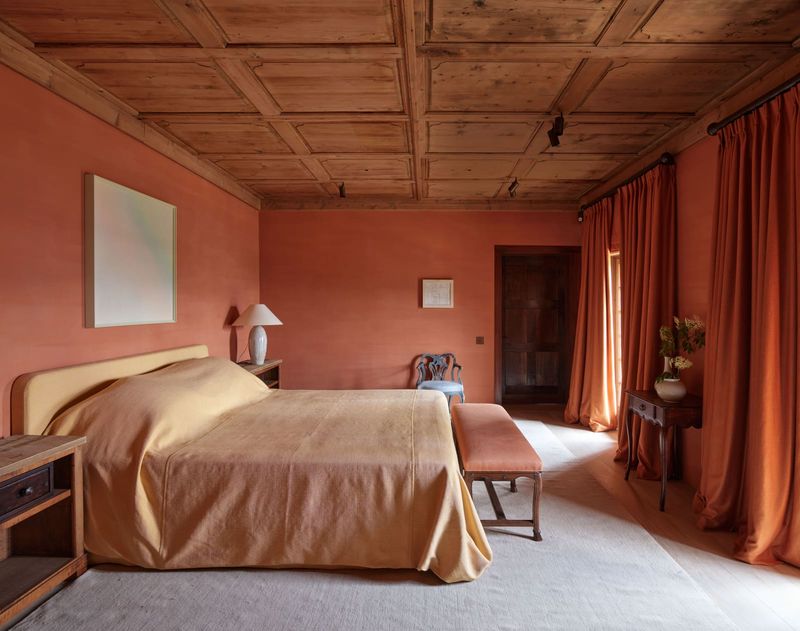
There is a framed piece of sheet music in the bedroom. Not a reproduction or a decorative print, but an original manuscript composed by a pianist shortly after her daughter was born. For Clara Nahas, that score functions less as memorabilia and more as a foundational document, what she calls a birth certificate for her artistic sensibility. The apartment she designed for this year's Casacor São Paulo, currently on view at Parque da Água Branca through early August, builds outward from that single artifact.
At World Archi Design, we have long tracked how designers encode personal narrative into residential space, but rarely do we encounter a project that uses musical structure as its organizing principle so literally. Nahas named the 55-square-meter studio Semibreve, after the longest note value in Western musical notation, a whole note that demands sustained attention. That choice sets the tone for everything that follows.
Inverting Residential Sequence
The typical apartment announces its public face first. You step into a foyer or living area, and private zones retreat toward the back. Nahas flips that convention. Visitors to Semibreve Studio enter through what would normally be the intimate threshold, passing the bedroom and study before arriving at the open kitchen and living areas. The inversion is deliberate, a spatial device meant to slow perception and encourage lingering.
This reversal echoes a strategy we have seen in adaptive reuse projects, particularly those that repurpose industrial or ecclesiastical buildings, where circulation is choreographed to delay revelation. Here, the technique operates at a compressed scale, but the effect is similar. You are made aware of passage, of thresholds crossed, in a way that conventional residential layouts rarely achieve.
The Burgundy Cylinder
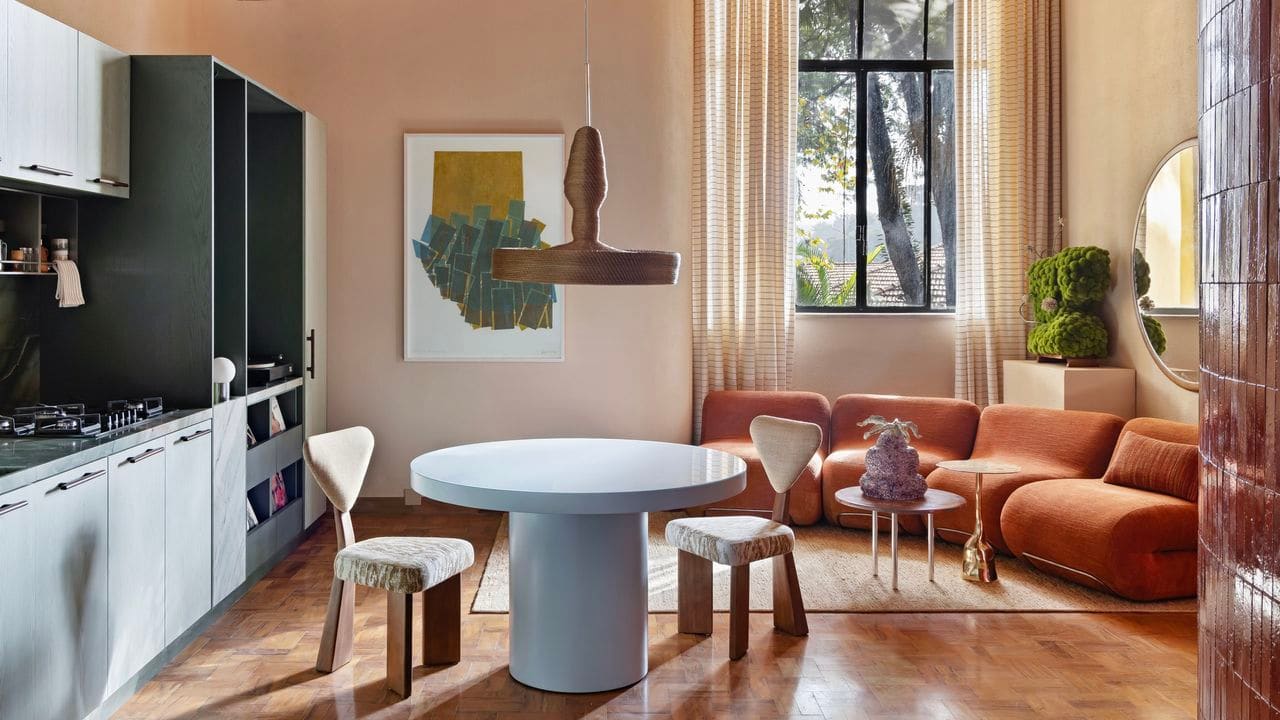
At the center of the plan stands a sculptural volume clad in deep red ceramic tiles manufactured by Keramika, a Turkish producer known for richly saturated glazes. The cylinder is proportioned to nestle beneath the building's primary ceiling beam, a constraint that Nahas transforms into formal clarity. The element performs triple duty: it encloses the bathroom, carves out a study desk on one side, and on the bedroom face, combines a music nook with a vanity.
Above this core, a collection of hourglasses is displayed, another temporal marker that reinforces the semibreve metaphor. The red ceramic, honed Napoleon Bordeaux marble in the bathroom, and dark-finished fixtures by Deca create an immersive monochrome environment that feels less like a functional wet room and more like a compressed chapel.
The choice of burgundy is worth parsing. In residential interiors, red often signals either theatrical maximalism or heritage formality. Here, it functions as a kind of emotional anchor, a color that demands pause and resists the bright, neutral palette that dominates contemporary Brazilian residential design. The cylinder becomes a tectonic element, a massing decision that organizes the entire apartment around a single, saturated gesture.
Material Continuity and Craft
The apartment retains the building's original timber parquet floors and gabled beam-and-slat ceiling, a vernacular detail common in mid-century São Paulo construction. Rather than strip these elements for a clean modernist envelope, Nahas preserves them as textural counterpoints to her interventions. The Todeschini kitchen, finished in Giardino-tinted oak veneer, flows into a sideboard designed to house a record player and vinyl collection, topped with a Da Vinci quartzite countertop. The material transitions are seamless, a demonstration of millwork precision.
Furniture selections favor soft, organic forms. The Amana modular sofa by Nildo José anchors the living area, its rounded profiles echoing the cylinder's geometry. The bedroom features a bed by Líder Design and a Botteh rug, both chosen for their tactile qualities and muted palettes that defer to the apartment's stronger gestures.
Foregrounding Women Creators
Nahas curates a deliberate roster of Brazilian design and art that privileges women makers. Pieces by Lina Bo Bardi and Cristiana Bertolucci appear alongside a golden-grass pendant lamp crafted by Quilombola artisans, a community of Afro-Brazilian descendants with deep roots in sustainable craft. Artworks by Maria Bonomi and Jandyra Waters punctuate the walls, embedding the apartment within a lineage of female authorship in Brazilian modernism.
This curatorial choice resonates beyond mere representation. Bo Bardi, in particular, understood architecture as a social and emotional instrument, a philosophy that aligns closely with Nahas's approach. The inclusion of Quilombola craft also situates the project within ongoing conversations about material culture, sustainability, and the recognition of marginalized producers in Brazilian design discourse.
Temporal Layering
The semibreve, as a musical notation, signifies duration. It holds space in a composition, creating room for resonance and reflection. Nahas translates that temporal quality into spatial terms through layered indirect lighting, the hourglass display, and circulation that refuses to hurry. The bedroom, for instance, employs multiple light sources at varying heights, creating a diffuse glow that shifts throughout the day.
This attention to temporal experience distinguishes the project from much showcase design, which often prioritizes visual impact over lived duration. Casacor installations are, by definition, ephemeral, yet Semibreve Studio reads as a fully inhabited environment, one that anticipates daily rituals and the slow accumulation of meaning that comes with use.
Personal Mythology as Design Brief
Tribute projects carry inherent risk. They can collapse into sentimentality or become so coded in personal reference that they alienate broader audiences. Nahas navigates this by allowing her mother's influence to function as conceptual infrastructure rather than decorative theme. The score in the bedroom is the only overtly biographical element; everything else operates through metaphor and material choice.
We have observed a similar approach in projects like Peter Zumthor's Bruder Klaus Field Chapel, where personal devotion is sublimated into form, or Eileen Gray's E-1027, where domestic space becomes a vehicle for exploring identity and autonomy. Nahas's apartment, though operating at a different scale and context, shares that willingness to use residence as a site for introspection.
Casacor as Laboratory
Casacor São Paulo has functioned for decades as a testing ground for Brazilian designers, a format that allows experimentation without the full constraints of client-driven practice. The exhibition transforms an existing building into a series of discrete environments, each authored by a different designer or studio. This year's edition, located in the historic Parque da Água Branca, benefits from the site's layered history and proximity to the city center.
Semibreve Studio demonstrates what the format can achieve when a designer approaches it not as a portfolio showpiece but as a coherent spatial argument. The apartment feels complete, a microcosm of Nahas's broader design philosophy condensed into 55 square meters.
Sustained Resonance
The longest note in a musical score does not demand silence. It asks for attention, for the listener to remain present through its duration. Nahas has built an apartment that operates on the same principle, using material richness, inverted circulation, and careful curation to create an environment that resists quick consumption. In a city as relentless as São Paulo, that act of resistance carries weight.
As Casacor concludes in early August, Semibreve Studio will be dismantled, its elements dispersed or archived. Yet the project's logic, its insistence on pause and reflection as architectural values, offers a model that extends beyond the exhibition context. It suggests that residential design can function as both memorial and manifesto, honoring the past while proposing a slower, more deliberate way of inhabiting space.
Save this story. A free account keeps your reading list and the 07:00 email in one place.
CREATE FREE ACCOUNT →SIGN IN