
The Birth of Computational Nature
What happens when architects of data attempt to reconstruct wilderness? The question has hovered over digital art for years, typically answered with underwhelming screen-based installations. But Refik Anadol and Efsun Erkılıç, working within a 25,000-square-foot volume at the base of a Frank Gehry high-rise in Los Angeles's arts district, have produced something closer to environmental design than exhibition.
Their project emerged from a pandemic-era absence. In 2019, with trails and parks shuttered, the Turkish artists began constructing a computational analog to the natural world they could no longer access. The result, initially titled Machine Dreams: Rainforest, has evolved into Dataland, an installation that deploys eighty-four 4K projectors and material drawn from the Smithsonian's Encyclopedia of Life to generate a responsive spatial experience.
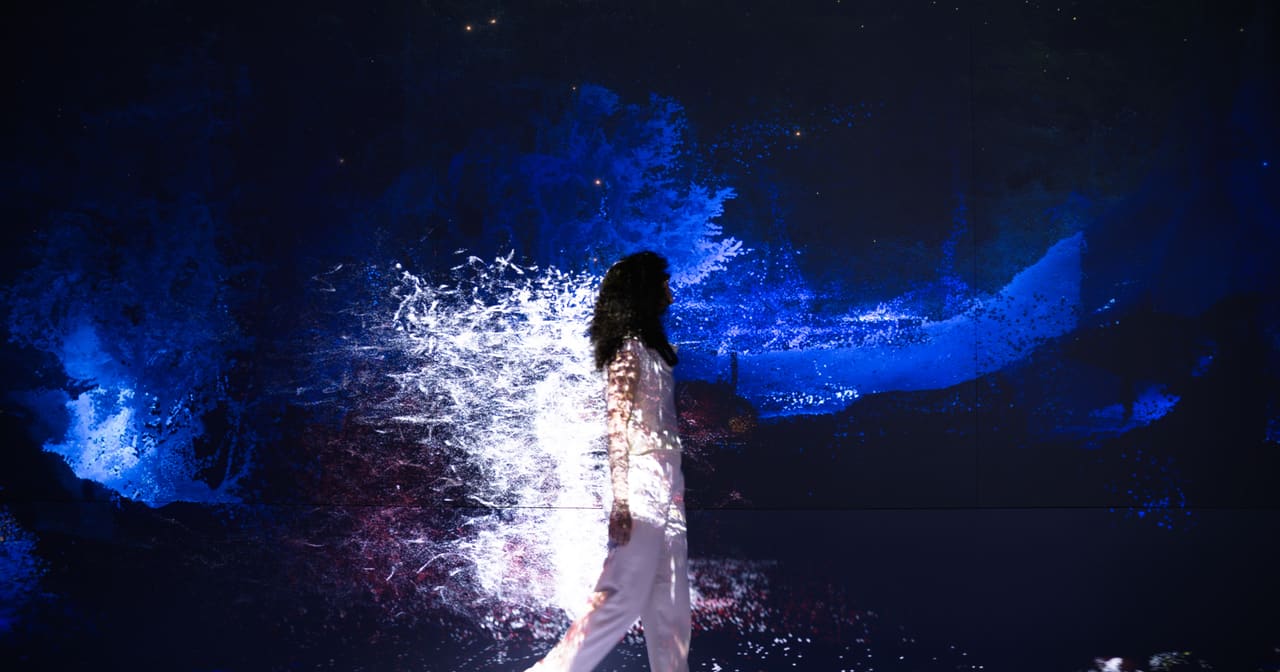
This is not immersive art as we have come to know it: walk-through projections with ambient soundtracks. Dataland operates as a feedback system, reading visitor physiology and adjusting its output accordingly. Wristbands track biometric data; a padded collar disperses scent profiles developed in collaboration with L'Oréal. The environment shifts in response to collective presence, a kind of crowd-sourced choreography of light, sound, and olfactory cues.
A Spatial System That Listens
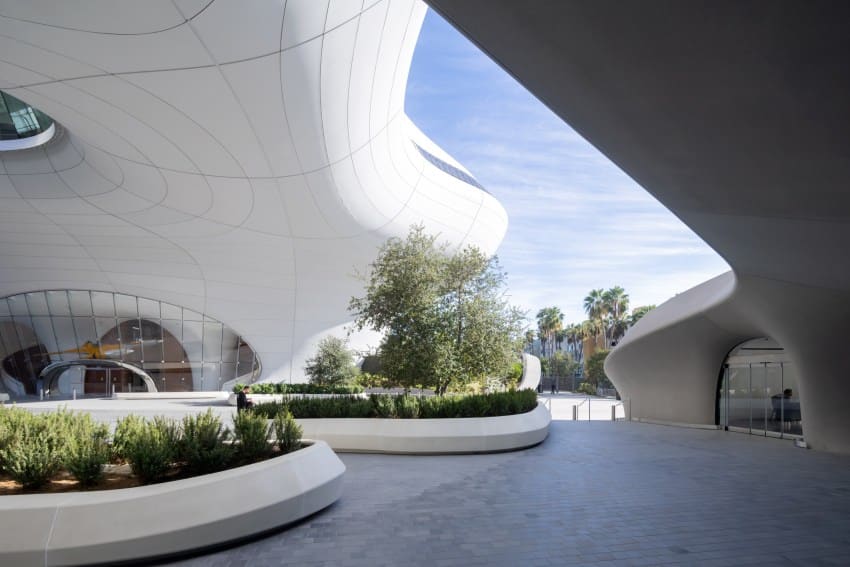
The architectural proposition here is unusual. Rather than a static container for art, the Gehry shell becomes the substrate for a living computational organism. Anadol and Erkılıç have designed the space to eliminate visible infrastructure: no exposed cabling, no projection rigs intruding into the field of view. The technical apparatus recedes, leaving only the phenomena it produces.
Visitors move through a sequence of towering rooms, each saturated with patterns derived from Amazonian flora and fauna. Butterflies, orchids, ferns, the iridescent wings of beetles. These are not video loops but algorithmically recombined essences, fifty billion pixels of photographic data synthesized in real time. Lightning bugs trace arcs overhead. Bird calls, sourced from the Cornell Laboratory of Ornithology, punctuate a soundtrack that veers between techno-pop and passages from Mahler's Symphony No. 3, a suggestion from Esa-Pekka Salonen, conductor laureate of the Los Angeles Philharmonic.
The Mahler is revealing. By weaving Romantic-era orchestration into a digitally native environment, Anadol and Erkılıç anchor their speculative space in historical continuity. The gesture acknowledges that nature-as-subject has always been mediated, whether through oil painting, symphonic movement, or machine learning model.
The Large Nature Model and Ethical Training Data
Anadol's practice has long centered on what he calls the Large Nature Model, an open-source AI trained exclusively on datasets he describes as ethically sourced. The claim warrants scrutiny. In an era when generative models routinely scrape the web for training material, often without consent or compensation, Anadol's insistence on verified, institutional archives (the Smithsonian, Cornell) positions his work within a different epistemological framework.
The Encyclopedia of Life, a digital repository maintained by the National Museum of Natural History, catalogs millions of species through high-resolution imagery and taxonomic data. By limiting his model to this corpus, Anadol constructs a nature that is curated, peer-reviewed, scientifically validated. It is a vision of wilderness filtered through institutional knowledge systems, a second-order nature built from the residue of field research and museum collections.
This approach distinguishes Dataland from much AI-generated imagery, which tends toward the hallucinatory and the uncanny. Here, the hallucination is deliberate. Anadol himself took ayahuasca with a spiritual leader, an experience that informed the project's visual language. The final gallery, called the Sanctuary, features a healing song from the Yawanawá people, an Indigenous community in the Brazilian Amazon. The gesture nods toward the cosmologies that have long understood the rainforest as animate, responsive, conscious.
Biometric Feedback and the Question of Reciprocity
Anadol frames Dataland as an investigation into reciprocal sensing. For millennia, he notes, humans have looked at art and felt something. His model inverts the equation: can art perceive the viewer? Can it register heartbeat, galvanic skin response, emotional arousal, and adjust its behavior accordingly?
The wristbands collect this data continuously, feeding it into the system's decision-making algorithms. The environment responds not to individual visitors but to the aggregate biometric profile of everyone present. In this sense, Dataland is less a static work and more a performance, co-authored by the crowd.
The ethical implications are non-trivial. Refik Anadol Studio states that visitor data is erased after thirty days, though participants may opt to retain it for personal use, including printed textiles available in the gift shop. The transparency is commendable, but the broader question remains: what does it mean to architect a space that reads you as you move through it?
Precedents exist. Diller Scofidio + Renfro's Blur Building, constructed for the 2002 Swiss Expo, used weather sensors to modulate a fog-shrouded platform over Lake Neuchâtel. More recently, studios like Random International have built installations that respond to gesture and proximity. But Dataland's integration of biometric tracking, scent delivery, and real-time computational synthesis represents a step change in complexity.
The Infinity Room and the Ghost of Extinction
One gallery, the Infinity Room, departs from the Amazonian theme to present an Avatar-like virtual landscape centered on a glass hummingbird. The image emerged from Anadol's dreams, a personal mythology rendered in luminous geometry. But the accompanying soundscape introduces a haunting counterpoint: the mating call of a now-extinct Hawaiian bird, the last known recording of its voice.
The juxtaposition is deliberate. Dataland's celebration of natural abundance is shadowed by the knowledge of loss. The Smithsonian's archives preserve not only living biodiversity but also the traces of species that no longer exist. The hummingbird, a symbol of vitality and iridescence, becomes a memorial.
This is where the project's conceptual architecture reveals itself most clearly. Dataland is not an escape into digital fantasy but a confrontation with the fragility of the systems it represents. The rainforest, even in its most exuberant algorithmic form, is under siege. The installation does not resolve this tension; it holds it open.
Data Sculptures and the Return to Materiality
At the conclusion of the circuit, visitors encounter a robotic arm capable of translating their biometric data into physical paintings. The gesture is both playful and pointed. After twenty minutes of immersion in a dematerialized, screen-based environment, the project offers a return to the tangible: pigment on canvas, something to hang on a wall.
Valerie Confections, a Los Angeles chocolatier, has contributed another form of materialization: data sculptures in chocolate, each flavor profile derived from patterns within the installation. Some taste fruity; others carry ashy, woodsy notes. The metaphor is almost too neat: consuming the data, making it part of your body.
The gift shop, predictably, extends the logic. Membership tiers offer priority access; NFT options provide blockchain-authenticated souvenirs. The commercial apparatus is transparent, even brazen. But it also underscores a pragmatic reality: projects of this scale, with their eighty-four projectors and custom scent delivery systems, require revenue models beyond ticket sales.
A Decade of Practice, A New Spatial Typology
Anadol has spent ten years refining the technical and conceptual infrastructure that makes Dataland possible. His earlier work, pulsing screens that appeared to oscillate between two and three dimensions, drew mixed critical responses. Comparisons to lava lamps were unkind but not entirely unfounded. The work read as spectacle, impressive in its computational sophistication but lacking a clear architectural proposition.
Dataland represents a consolidation. By embedding the technology within a purpose-built spatial sequence, Anadol and Erkılıç have moved beyond screen-based display into something closer to environmental design. The Gehry building provides the envelope; the AI provides the atmosphere. The result is a hybrid typology: part gallery, part laboratory, part theater.
Whether this constitutes architecture in the traditional sense is debatable. There is no program beyond the experience itself, no functional requirement beyond circulation. But as a proof of concept, it is compelling. If buildings can read their occupants and adjust environmental conditions in real time, what does that mean for spatial practice?
The Limits of Synthetic Wilderness
For all its technical accomplishment, Dataland cannot escape a fundamental paradox. It is a mediated experience of nature, twice removed: first through the Smithsonian's photographic archives, then through algorithmic recombination. The rainforest it presents is pristine, idealized, free of the mosquitoes and humidity and decay that characterize actual wilderness.
This is not a critique so much as an observation. Anadol and Erkılıç are not claiming to replicate the Amazon but to construct a new kind of space, one that uses natural data as raw material for computational synthesis. The question is what we learn from this translation, what insights emerge from experiencing wilderness as algorithm.
At minimum, Dataland foregrounds the extent to which our relationship to nature is already mediated. We encounter ecosystems through screens, documentaries, data visualizations, scientific models. Anadol simply makes this mediation explicit, turning it into the subject of the work.
The project also raises questions about access and equity. Who gets to experience this computational rainforest? Membership models and NFT offerings suggest a target demographic comfortable with digital culture and disposable income. The irony is acute: a project inspired by pandemic-era exclusion from public parks now operates within its own regime of exclusivity.
Looking Forward
Dataland will likely inspire imitators, as immersive installations always do. But the precedent it sets is less about spectacle and more about infrastructure. The integration of biometric sensing, scent delivery, real-time computational synthesis, and spatial choreography suggests a roadmap for future projects at the intersection of architecture and AI.
We are watching the emergence of environments that respond not just to occupancy but to emotional states, collective moods, physiological rhythms. The implications extend beyond art into hospitality, healthcare, urban design. If a museum can read your heartbeat and adjust its lighting accordingly, why not an airport terminal, a hospital ward, a public plaza?
The challenge, as always, will be navigating the ethical terrain. Dataland's thirty-day data retention policy is a start, but the broader questions of consent, surveillance, and algorithmic bias remain unresolved. As responsive environments proliferate, so too must the frameworks for evaluating them.
For now, Dataland stands as a singular experiment: a 25,000-square-foot argument for architecture as feedback loop, nature as dataset, and the museum as a space that looks back.
Save this story. A free account keeps your reading list and the 07:00 email in one place.
CREATE FREE ACCOUNT →SIGN IN