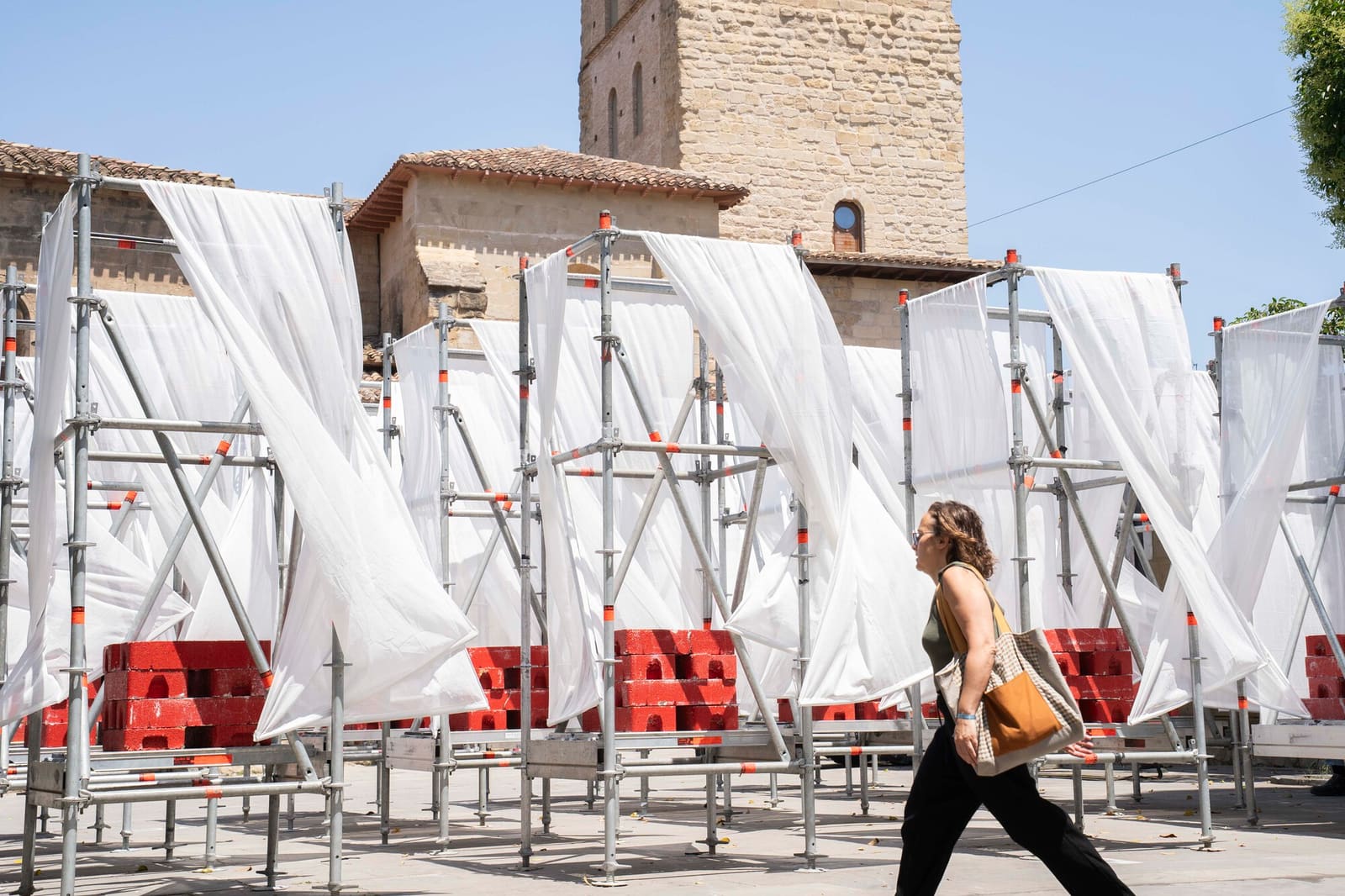
The Experiment in Impermanence
Most architecture aspires to outlast its creators. But what happens when the brief is measured in weeks, not decades? In Logroño this past June, more than twenty full-scale installations appeared across streets, plazas, and vacant lots, each designed to exist for a single summer before vanishing. The occasion was Concéntrico's 12th edition, a festival that has spent over a decade proving that architecture's most urgent questions might be answered not in monuments, but in structures built to disappear.
Since 2015, Concéntrico has operated on a simple premise: embed design directly into the rhythms of daily life rather than sequester it behind gallery walls or cordoned-off exhibition spaces. The city becomes both canvas and collaborator. Residents encounter interventions on their commute, during lunch breaks, while walking dogs. The architecture is not announced by placards or docents. It simply exists, demanding attention through presence rather than preamble.
This year's program gathered architects, designers, and researchers working across continents and methodologies, each contributing a piece to a citywide interrogation of what public space can become. The festival organized projects into three curatorial threads, though in practice the boundaries blurred. Identity and Fiction treated the city as a repository of narrative, using architecture to surface buried stories. Urban Ecologies examined the entanglement of built form with climate, matter, and landscape. Ephemeral Agents explored how temporary structures might activate social dynamics and unlock new possibilities for collective use.
Narrative as Structure
The Identity and Fiction track operated on the understanding that every urban site carries latent stories, and that architecture can function as a tool for recovery. Smiljan Radic's contribution transposed the spatial logic of a traveling circus into a collective architectural form, a move that collapsed the distance between spectacle and shelter. The circus, after all, has always been a study in ephemeral construction: structures raised quickly, used intensely, then packed away and moved to the next town. Radic's installation honored that tradition while asking what happens when such transience is reframed as civic infrastructure.
OFREIA's project delved into the memory of bathing practices along Logroño's fluvial landscape, recovering rituals that have faded from contemporary use. The work functioned less as reconstruction than as conjecture, proposing how historical practices might inform present-day relationships with water and public hygiene. In this sense, the installation was as much research as it was architecture, a physical hypothesis about how memory can be encoded in form.
These projects share a commitment to architecture as storytelling, but they resist nostalgia. The goal is not to recreate the past but to make visible the layers of use, habit, and meaning that accumulate in urban space over time. Temporary installations, paradoxically, may be better suited to this work than permanent buildings. They can afford to be speculative, incomplete, even wrong. They invite conversation rather than closure.
Microclimates and Material Thinking
The Urban Ecologies thread addressed a question that has become unavoidable: how does architecture respond to a planet in flux? NOOF Group's experimental pavilions offered one answer, generating microclimates through careful manipulation of ventilation, shade, and thermal mass. These were not simply shelters from heat but studies in how small-scale interventions can alter the sensory experience of a plaza or street corner. In a city where summer temperatures routinely exceed comfort thresholds, such work is neither abstract nor optional.
Sahra Hersi's civic garden took a different approach, focusing on cultivation and seed exchange as acts of ecological citizenship. The installation created space for residents to grow food, share knowledge, and participate in a local seed bank. It was, in effect, a proto-institution, testing whether a temporary structure could catalyze ongoing practices that outlive the installation itself. The architecture here was less object than framework, a scaffold for social and ecological processes that might continue after the physical elements were dismantled.
Both projects reflect a shift in how we think about sustainability in architecture. The emphasis is no longer on isolated green buildings but on systems, on how design can facilitate relationships between people, plants, climate, and urban infrastructure. Ephemeral installations are particularly well suited to this work because they can be iterative. Each edition of the festival becomes an opportunity to test, refine, and rethink strategies that might eventually inform more permanent interventions.
Activation and Agency
The Ephemeral Agents category took as its subject the social life of public space, asking how temporary structures might unlock new modes of collective use. Gabriel Fontana's Multiform exemplified this approach, creating a flexible framework that could be reconfigured for multiple activities. The installation refused to dictate a single program, instead offering infrastructure that residents could appropriate according to need or whim.
AAU Anastas developed urban listening capsules, small enclosures designed to heighten acoustic awareness. The project was a study in attention, using architecture to tune perception to the soundscape of the city. In an era of constant visual stimulation, the capsules proposed a different kind of engagement, one rooted in stillness and listening. The work recalls earlier experiments in phenomenological architecture, from Bernard Tschumi's follies in Parc de la Villette to Peter Zumthor's sound installations, but with a lighter touch, a willingness to be provisional.
Future Firm's intervention connected a pedestrian bridge to the riverside park below, creating a new circulation route where none had existed. The installation was infrastructure in miniature, solving a real urban problem while remaining temporary. It raised an interesting question: if a temporary structure successfully addresses a need, at what point does it demand permanence? And what do we lose when ephemeral solutions are replaced by conventional construction?
The Case for Disappearance
At World Archi Design, we've been tracking the rise of temporary architecture over the past decade, from festival pavilions to disaster relief shelters to pop-up retail. What distinguishes Concéntrico from much of this work is its refusal to treat ephemerality as a limitation. The festival does not position temporary structures as placeholders for "real" architecture. Instead, it argues that impermanence offers distinct advantages: the freedom to experiment, the ability to respond quickly to changing conditions, the opportunity to test ideas in situ before committing resources to permanent construction.
There is also an ethical dimension. In a time of resource scarcity and climate urgency, building less, building lighter, and building temporarily may be acts of responsibility. Concéntrico's installations use modest materials, often sourced locally, and are designed for disassembly and reuse. They leave minimal trace. This is not austerity for its own sake but a recognition that architecture's impact extends beyond its lifespan.
The festival also challenges the profession's obsession with legacy. Architects are trained to think in terms of permanence, to design buildings that will stand for generations. But much of what cities need right now is not monumental. It is adaptive, responsive, capable of evolution. Temporary installations model a different relationship to time, one that privileges iteration over fixity, process over product.
What Remains
By late summer, the installations in Logroño will be gone, dismantled and stored or repurposed elsewhere. The city will return to its usual rhythms. But something lingers. Residents who encountered the projects will carry memories of different uses, different possibilities. A plaza that once hosted a pavilion may be reimagined by those who experienced it. A vacant lot activated for a season may resist returning to neglect.
This is perhaps the real argument for ephemeral architecture: not that it replaces permanent construction, but that it expands the field of what architecture can be and do. It operates at a different scale, with different ambitions. It is architecture as intervention rather than monument, as question rather than answer. And in a discipline often weighed down by its own seriousness, there is something liberating about structures built to last just long enough to matter.
Save this story. A free account keeps your reading list and the 07:00 email in one place.
CREATE FREE ACCOUNT →SIGN IN