
The Paradox of Permanence
In an economy engineered for obsolescence, what does it mean to design something meant to last? The question cuts to the heart of contemporary luxury, where objects and spaces are often valued precisely because they're inaccessible, rare, or ephemeral. Yet a growing cohort of practitioners is asking whether true value might lie not in scarcity but in durability, not in privacy but in civic presence, not in novelty but in how gracefully a building wears its years.
At World Archi Design, we've been tracking this shift as it moves from theory into built work. The tension is real: clients still equate luxury with exclusivity, yet the projects that endure in the collective imagination are often those that serve broader publics, that accumulate patina rather than resist it, and that embed themselves in local material cultures rather than import generic finishes. This isn't a nostalgic retreat into craft-for-craft's-sake. It's a recalibration of what we measure when we measure quality.
Competing Definitions of Value
The architects at the center of this debate don't agree on a single definition. One camp holds fast to traditional markers: sensory comfort, acoustic privacy, spatial generosity, and the kind of quietness that only money can buy. These are not trivial concerns. In dense urban contexts, silence is a luxury good. So is natural light that doesn't come with the noise of a busy street, or the ability to control your thermal environment without relying on mechanical systems that hum and rattle.
But another camp argues that this framing is too narrow, even selfish. They propose that the highest expression of architectural value is public infrastructure, spaces where craft and material intelligence are deployed not for a single household but for civic life. In this view, luxury becomes a question of distribution: should the best detailing, the most considered proportions, the finest stone or timber be reserved for private interiors, or should they define the shared environments where collective memory forms?
This isn't purely ideological. It's also practical. Buildings that serve many users over many decades develop a kind of resilience that private homes rarely achieve. They're maintained, adapted, sometimes radically transformed, but the underlying structure and spatial logic persist. The question then becomes whether longevity itself, the capacity to outlive the original program and client, should be considered a form of luxury.
The Case for Handmade Details
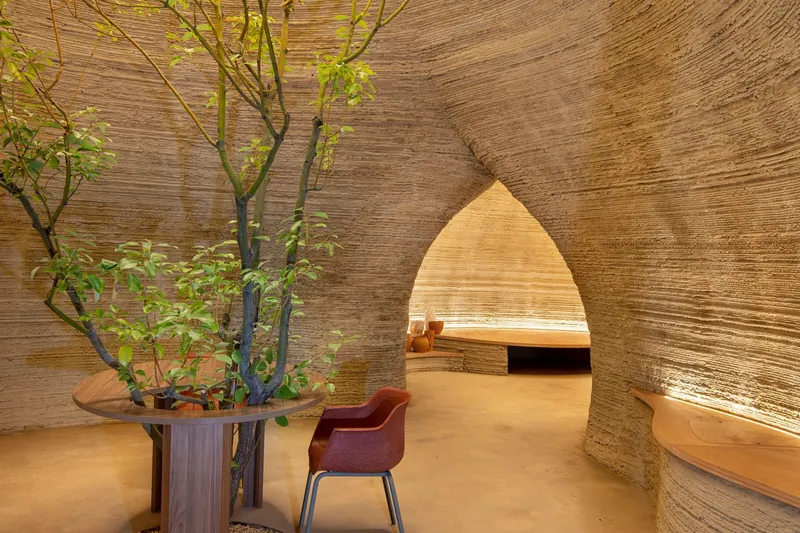
Craftsmanship enters the conversation as both method and metaphor. Several architects in this discussion point to handmade details as a deliberate counterpoint to factory mass production. This isn't about fetishizing the artisan or rejecting digital fabrication outright. It's about recognizing that manual building techniques introduce variation, texture, and a kind of embodied knowledge that automation tends to flatten.
Consider the difference between a CNC-milled panel and a hand-plastered wall. The former is precise, repeatable, and efficient. The latter carries the trace of the person who made it: slight irregularities in surface, subtle shifts in tone, a tactile quality that registers at a subconscious level. These aren't defects. They're information. They tell you something about how the building came into being, and they create a perceptual richness that smooth, industrially produced surfaces often lack.
This approach also has implications for sustainability, though not in the way the term is usually deployed. Passive, low-tech strategies, thermal mass, natural ventilation, daylighting, often align with craft-based construction. They require a different kind of expertise, one rooted in material behavior rather than mechanical systems. And they tend to age better. A well-detailed masonry wall doesn't need software updates or replacement parts. It just sits there, doing its job, for a very long time.
Sustainability Versus Material Excess
Here's where the argument gets complicated. High-end design has historically been associated with material abundance: rare marbles, exotic hardwoods, custom metalwork, finishes that require specialized labor and significant energy inputs. This is the aesthetic language that signals luxury to most clients. But it's also fundamentally at odds with the resource constraints and carbon targets that define contemporary practice.
The architects wrestling with this tension aren't proposing austerity. They're suggesting a shift in how we think about richness. Instead of accumulating materials, they focus on how materials are used: the quality of joinery, the logic of assembly, the way light interacts with surface. This is a slower, more labor-intensive process, and it doesn't photograph as well as a room full of statement pieces. But it tends to produce spaces that feel better to inhabit, and that retain their character as they age.
Net-zero targets complicate this further. Achieving operational carbon neutrality often requires a layer of mechanical systems and high-performance envelopes that can feel at odds with the tactile, low-tech qualities that craft-based design emphasizes. The challenge is to integrate these without losing the sensory and spatial qualities that make a building worth preserving in the first place. It's a design problem, not a technical one, and it requires a level of coordination between architect, engineer, and builder that the conventional procurement process doesn't always support.
Measuring Architecture by How It Ages
One of the more provocative ideas in this debate is the notion that value should be measured not at the moment of completion but over decades. How does a building wear? Does it accommodate change gracefully, or does it become brittle and obsolete? Do the materials improve with use, or do they degrade into something shabby and depressing?
This is a fundamentally different way of thinking about design. It shifts the focus from the initial image to the long-term performance, from the architect's vision to the users' experience across multiple generations. It also requires a different kind of client, one willing to invest in durability rather than novelty, and a different kind of construction industry, one that values skill and longevity over speed and cost minimization.
There are precedents, of course. Vernacular architectures around the world have always been designed to age, to be repaired, to be incrementally improved by successive occupants. What's new is the attempt to bring this ethos into high-end contemporary practice, to argue that the real luxury is a building that gets better with time rather than one that peaks at the ribbon-cutting and declines thereafter.
The Public Dimension
The most challenging aspect of this redefinition is the idea that luxury might not be private at all. If the best architecture is that which serves the most people over the longest time, then the highest expression of architectural value isn't a villa or a penthouse but a library, a market hall, a transit station. These are the projects that shape urban life, that become landmarks not because they're exclusive but because they're essential.
This isn't a popular position among clients who are, after all, paying for exclusivity. But it raises a question that the profession has been avoiding: if architects have a responsibility to the built environment as a whole, not just to individual clients, then how should we allocate our best work? Should the most talented designers, the most careful detailing, the most durable materials be directed primarily toward private commissions, or should they be deployed in service of public infrastructure?
There's no easy answer. The economics of practice make it difficult to do high-quality public work without the financial cushion that private commissions provide. But the question persists, and it's reshaping how a generation of architects thinks about success. For some, the ultimate measure of a career isn't the number of luxury homes completed but the public projects that outlive them, the civic spaces that become part of the collective memory of a city.
A Slow Alternative
What emerges from this debate is not a manifesto but a sensibility. It values permanence over novelty, craft over automation, public presence over private exclusivity. It's skeptical of the consumption-driven model that has defined luxury for the past century, and it's searching for an alternative grounded in material intelligence, long-term thinking, and a more generous understanding of who architecture should serve.
This is a slow approach, and it doesn't scale easily. It requires clients who are willing to wait, builders who possess skills that are increasingly rare, and architects who can articulate a vision of value that isn't tied to market trends or Instagram metrics. But it's also producing some of the most compelling work we've seen in recent years, projects that feel less like products and more like places, less like statements and more like conversations that will continue long after the original participants are gone.
The question isn't whether craftsmanship can redefine luxury. It's whether we're willing to accept a definition of luxury that doesn't center on exclusivity, that doesn't equate value with scarcity, and that measures success not in the moment of completion but across generations. For a growing number of architects, the answer is yes. And that shift, quiet and incremental as it may be, has the potential to reshape not just high-end practice but the broader culture of building.
Photo: INDX|GLOBAL
Save this story. A free account keeps your reading list and the 07:00 email in one place.
CREATE FREE ACCOUNT →SIGN IN