
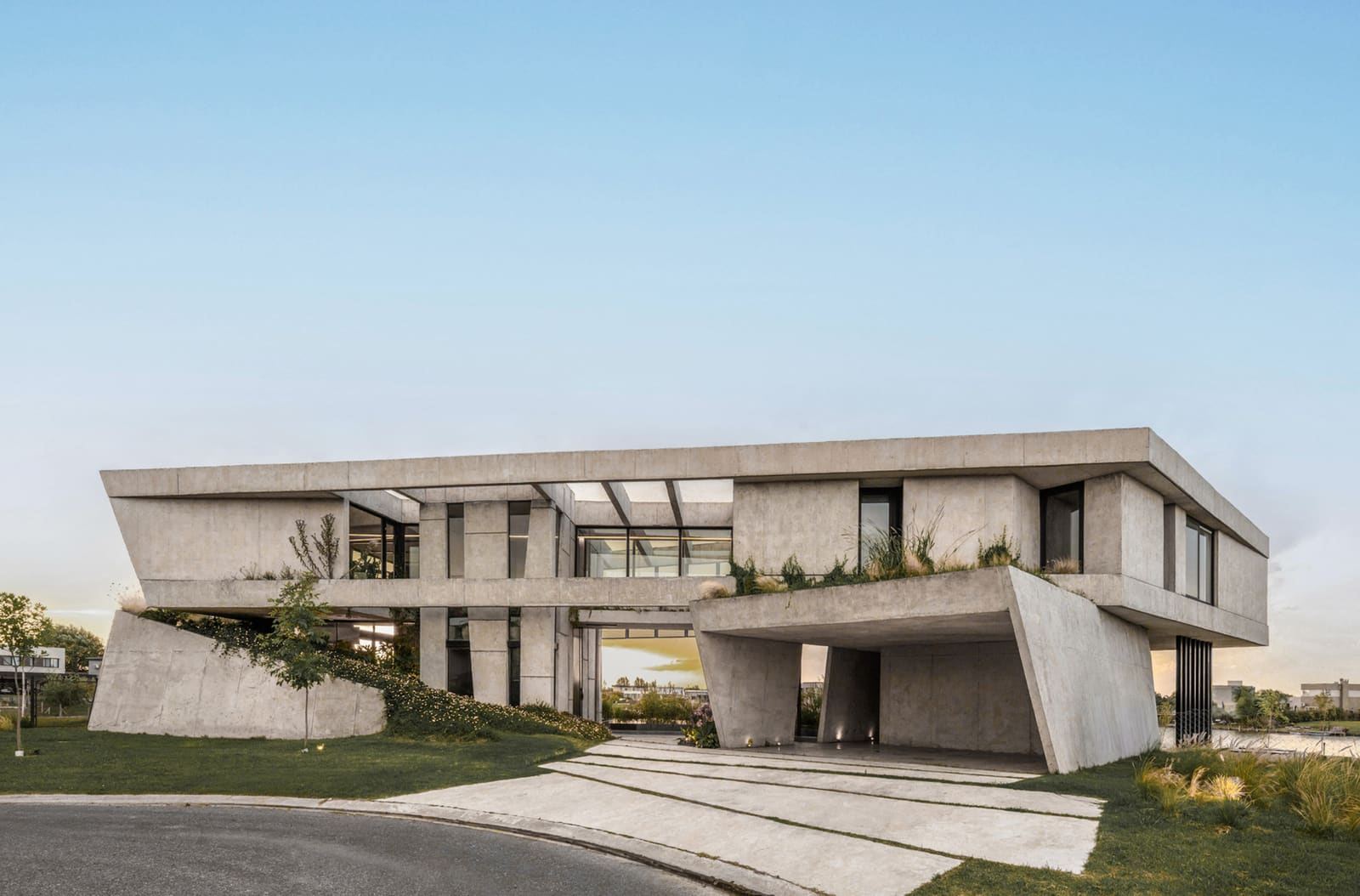
A Gesture of Elevation and Integration
What happens when a house refuses to sit on the ground in the conventional sense? Casa Lomadas, completed in 2023 by Grizzo Studio, poses this question along the edge of a lagoon in Pilar, Argentina. Rather than carving into the site or spreading horizontally across it, the 460-square-meter residence hovers - literally - on two mounds of native vegetation. The architects, Lucila Grizzo, Federico Grizzo, and Rocío Martínez Serra, have crafted a morphological operation that is as much about what lies beneath as what rises above.
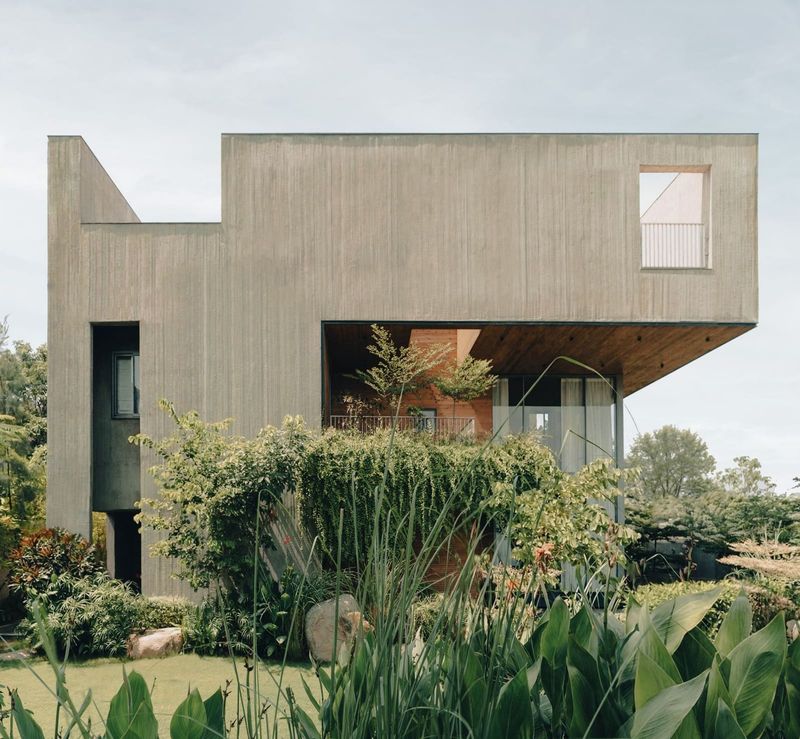
The site itself offers generous conditions: a double plot with over one hundred meters of lagoon frontage. Yet the design resists the temptation to dominate this expanse. Instead, the project is distilled into a single folded bar of exposed concrete, a tectonic element that reads as both bridge and beam. This formal restraint is deliberate. By concentrating the built mass into a linear volume and elevating it, the architects preserve the continuity of the landscape and amplify the presence of the water.
The Folded Bar and Its Structural Logic
The folded concrete bar is not merely a sculptural gesture; it is a structural strategy. The form allows the house to span between two artificial berms without interrupting the terrain below. This creates a void - a shadowed, permeable zone - that functions as both threshold and outdoor room. The concrete surface, left raw and unfinished, records the formwork and the pour, grounding the house in material honesty.
In this sense, Casa Lomadas recalls the tectonic clarity of Paulo Mendes da Rocha's work, where structural expression and spatial generosity are inseparable. The folded plane becomes roof and wall simultaneously, blurring the boundary between enclosure and canopy. The result is a house that feels less like a discrete object and more like an inhabited infrastructure, mediating between sky, earth, and water.
Mounds as Architecture
The two planted mounds are not incidental; they are designed elements, integral to the spatial and environmental logic of the project. By raising the house on these vegetated landforms, the architects achieve several effects. First, they elevate the living spaces to capture views of the lagoon while maintaining privacy from neighboring plots. Second, they create microclimates beneath the concrete bar, where shade and airflow moderate temperature. Third, they establish a visual rhythm - earth, void, concrete, void, earth - that organizes the composition.
The choice of native vegetation is significant. Rather than introducing exotic species or manicured lawns, the project embeds itself within the ecological character of the region. The mounds become habitats, supporting local flora and fauna while anchoring the house to its context. This approach aligns with a broader discourse in contemporary Argentine architecture, where designers like Adamo-Faiden and Luciano Kruk have explored ways to work with, rather than against, the landscape.
Materiality and Atmosphere
Exposed concrete is the dominant material, but it is not monolithic. The surface texture varies depending on the formwork and the angle of light. At midday, the concrete reads as almost white, reflecting the intense sun. At dusk, it absorbs warmth, turning amber and gray. This temporal quality transforms the house throughout the day, making it responsive to its environment in ways that more inert materials cannot achieve.
The interiors, though not extensively documented, are likely defined by the same material palette. Concrete ceilings and floors create a sense of continuity, while openings are carefully calibrated to frame views and modulate light. The folded geometry produces varied ceiling heights, which in turn shape the character of each room - compressed in some moments, expansive in others.
Landscape as Co-Author
At Casa Lomadas, landscape is not a backdrop; it is a co-author of the architectural experience. The lagoon, the mounds, and the native grasses are as essential to the project as the concrete itself. This is not biophilic design in the decorative sense - plants added to soften hard surfaces - but a more fundamental integration, where the house and the land are conceived as a single system.
The project also engages with the Argentine tradition of the quinta, the country estate where architecture and nature are intertwined. But where the quinta often implies a domesticated landscape, Casa Lomadas leans toward a wilder, less controlled aesthetic. The mounds are not manicured; they are allowed to grow and shift, introducing an element of unpredictability into the composition.
Precedents and Parallels
The folded concrete bar invites comparison to other works that explore the potential of the linear volume. One thinks of the Farnsworth House, where a horizontal plane floats above the floodplain, or the more recent work of Pezo von Ellrichshausen, who deploy geometric rigor to create spatial tension. But Casa Lomadas differs in its relationship to the ground. Where Farnsworth is lifted on slender columns and Pezo von Ellrichshausen often sit heavily on the earth, Grizzo Studio's house negotiates a middle condition: grounded yet elevated, anchored yet light.
There is also a kinship with the tectonic experiments of Smiljan Radić, whose projects often feature raw concrete paired with natural materials and irregular topographies. Both practices share an interest in the poetic potential of construction, where the means of making are visible and celebrated.
Living on the Mounds
To inhabit Casa Lomadas is to occupy a threshold. The house mediates between land and water, between built and grown, between the geometric and the organic. Daily life unfolds along the folded bar, with views shifting as one moves through the volume. The lagoon becomes a constant presence, visible from nearly every room, while the mounds frame and support the domestic rituals within.
This is architecture that asks its occupants to engage with the site, to notice the changing light on the water, the movement of grasses in the wind, the play of shadows beneath the concrete. It is not a house that insulates or isolates; it is a house that opens, connects, and reveals.
Reflections on a Morphological Operation
Grizzo Studio describes Casa Lomadas as a morphological operation, and the term is apt. The project is not about ornament or style; it is about form-making in response to site, program, and material. The folded bar and the paired mounds constitute a clear, legible system - one that could be diagrammed in a few lines yet yields rich spatial and atmospheric effects.
This clarity is a strength. In an era when residential architecture often defaults to complexity for its own sake, Casa Lomadas demonstrates the power of restraint. The architects have made a few key moves - elevation, folding, integration - and allowed those moves to generate the architecture. The result is a house that feels inevitable, as if it could not have been otherwise.
As we continue to track projects that rethink the relationship between architecture and landscape, Casa Lomadas stands as a compelling example. It suggests that the most profound integrations are not those that blur boundaries indiscriminately, but those that articulate them with precision and care. Here, concrete and earth, geometry and growth, structure and site coexist not in opposition but in dialogue, each sharpening the presence of the other.
Save this story. A free account keeps your reading list and the 07:00 email in one place.
CREATE FREE ACCOUNT →SIGN IN