
The Paradox of Domestic Taste
There's an interesting tension at the heart of short-term rental culture: most of us want to stay somewhere that feels personal without actually having to interact with the homeowner's lived reality. We want the charming details, the thoughtful material choices, the sense that someone cared deeply about the fenestration and the finish schedule, but we also want the bed made and the refrigerator empty when we arrive.
At World Archi Design, we've been tracking a small but growing phenomenon of interior designers who've turned this tension into an opportunity. Rather than simply offering a bed and a door, a handful of professionals have opened their own homes or design commissions to guests, creating a kind of living portfolio where you can actually sleep inside someone's aesthetic worldview.
Japandi Meets Art Deco on the East End
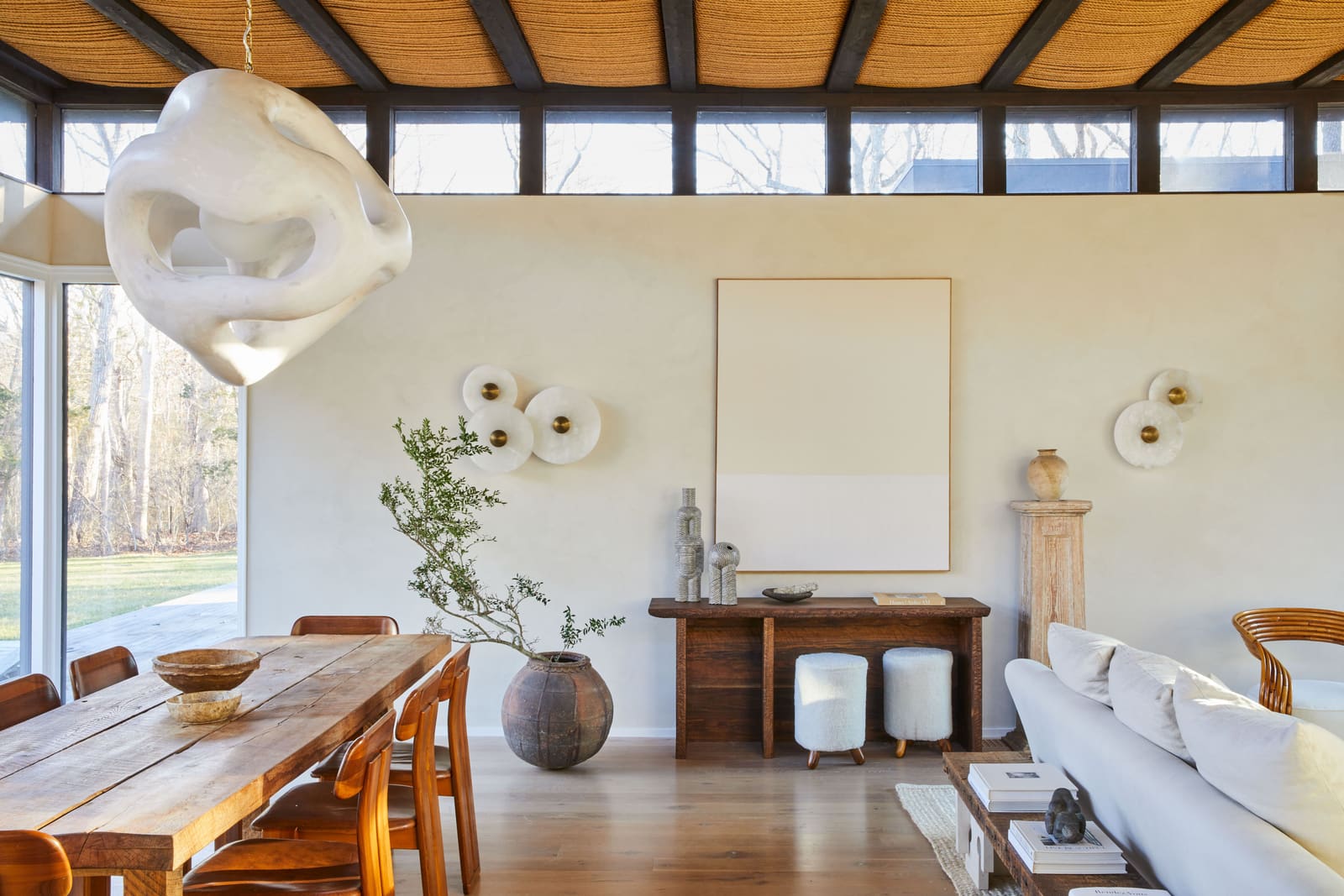
Athena Calderone's four-bedroom property in East Hampton operates as a study in cross-cultural layering. While her urban work often draws from French and Greco-Roman precedents, this residence pivots toward Japanese restraint, anchored by a substantial Noguchi pendant and punctuated with low-slung benches and unfinished warm timber. The centerpiece is a Mario Bellini sofa from the 1970s, upholstered in a faded teal that reads almost as a neutral in the space's broader palette.
The property spans 1.5 private acres and includes a heated pool, hot tub, and home gym. Every bedroom offers at least a queen-size bed, and the outdoor program features a barbecue, firepit, and multiple sun loungers. It's a level of amenity that positions the home less as a weekend escape and more as a short-term primary residence, priced accordingly at $4,500 per night with a three-night minimum.
What makes the space legible as a designer's work is not just the objects themselves but the restraint in their arrangement. There's none of the visual clutter that afflicts so many high-end vacation rentals, where every surface becomes a stage for decorative excess. Instead, Calderone allows negative space to function as a design element, a principle more common in Japanese residential architecture than in American hospitality.
California Neutrality at Altitude
Jenni Kayne's Lake Arrowhead property demonstrates how a signature aesthetic, honed through years of retail and editorial work, can be transposed onto a specific site without losing coherence. The four-bedroom house overlooks a freshwater reservoir in the San Bernardino mountains, surrounded by pine forest and accessible via a private dock.
The interiors deploy the vocabulary you'd expect from Kayne's commercial work: shag rugs, sling chairs, rattan fixtures, and a palette restricted to whites, beiges, and pale blues. Light wood accents provide warmth without heaviness. It's a style that could easily read as generic in less disciplined hands, but here the restraint feels intentional rather than timid. The greenery is abundant but not overwhelming, and the furnishings are scaled appropriately to the architecture rather than fighting it.
The property is priced at $1,500 per night with a two-night minimum, positioning it as a mid-range option relative to Calderone's East Hampton estate but still well above the typical vacation rental threshold. The surrounding town offers restaurants, boutiques, and recreational infrastructure, which matters when you're staying somewhere that prioritizes visual calm over entertainment amenities.
Cultural Fluency in 700 Square Feet
Jarett Yoshida's work on a guest suite in Brooklyn's Bed-Stuy neighborhood offers a counterpoint to the spatial generosity of the lakefront properties. At 700 square feet, the one-bedroom unit relies on bold color and cultural specificity rather than square footage to create a sense of place.
Yoshida incorporates elements of his Japanese and Hawaiian heritage throughout: a lacquered koi-print backsplash in the kitchen, a gilded room divider in the living area, mandala bowls in the bathroom. Walls in teal, red, and blue give each space a distinct character, a strategy that could fragment the experience but instead creates a sense of procession through the compact floor plan.
The natural light is exceptional, a critical factor in any space under 1,000 square feet. The unit includes a four-top dining table and a well-equipped kitchenette, making it suitable for hosting small dinners despite its modest size. At $390 per night with a two-night minimum, it's priced for digital nomads and couples rather than families, and the inclusion of an in-building washer suggests Yoshida understands the priorities of urban renters.
Organic Modernism for Large Groups
Emily Henderson's eight-bedroom Lake Arrowhead property represents a different scale of ambition entirely. The house accommodates large groups, with 4.5 bathrooms, bunk beds, a rock-climbing wall, a play loft, and abundant outdoor amenities including a hot tub, firepit, hammock, and lake access.
Henderson's "organic modern" approach, visible in projects like Mandy Moore's residence, involves layering eclectic details into minimalist frameworks. A tribal rug, mushroom stools, and a Nordic armchair coexist with contemporary sectionals, white oak surfaces, and chunky knit poufs. The strategy works because the underlying architecture remains neutral, allowing the furnishings to register as deliberate choices rather than stylistic confusion.
The property is priced at $390 per night with a two-night minimum, which is remarkably accessible given the bedroom count and amenity load. It's clearly designed for group bookings, reunions, and celebrations rather than quiet weekends, and the child-friendly features suggest Henderson anticipated multigenerational use.
Rustic Minimalism Without Connectivity
Leanne Ford's three-bedroom property in Round Top, Texas, takes a more ascetic approach. There's no television, no Wi-Fi, just a long porch, a wood hearth, abundant antiques, and a dining table that seats at least ten. The house sleeps eight comfortably, bathed in natural light and surrounded by native landscape.
Ford's signature warm minimalism, developed through projects in Pittsburgh and documented in her residential work, involves imbuing contemporary spaces with historical resonance. The Round Top property achieves this through material authenticity rather than stylistic pastiche. The antiques feel earned rather than curated, and the absence of digital connectivity reads as a design decision rather than an oversight.
At $800 per night with a two-night minimum, the property occupies a middle pricing tier. It's clearly intended for guests who value contemplation over entertainment, and the large dining table suggests Ford anticipated the house would host gatherings centered around meals rather than screens.
The Economics of Aesthetic Hospitality
What unites these five properties is not a shared aesthetic language but a shared commitment to treating interior design as a form of hospitality. Each designer has made choices that prioritize spatial coherence and material quality over the kind of feature bloat that afflicts most high-end vacation rentals.
The pricing ranges from $390 to $4,500 per night, reflecting not just square footage and amenity count but also location, designer recognition, and the intended guest experience. Calderone's East Hampton property commands a premium because it offers both spatial luxury and proximity to an established resort community. Ford's Round Top retreat and Henderson's Lake Arrowhead house price more accessibly because they're targeting group bookings in less competitive markets.
For designers, the decision to rent out a personal residence or design commission on short-term platforms represents a kind of living advertisement. Guests experience the work directly, inhabiting the spatial sequences and material choices in a way that photographs can never convey. It's a portfolio you can sleep in, and for designers whose work emphasizes livability over pure aesthetics, that distinction matters.
The risk, of course, is that hospitality and design excellence don't always align. A beautiful space can be uncomfortable to live in, and a comfortable space can photograph poorly. The designers who succeed in this hybrid model are those who understand that short-term rental guests want something different from hotel luxury. They want to feel like they're borrowing someone's carefully considered life, even if only for a weekend.
Save this story. A free account keeps your reading list and the 07:00 email in one place.
CREATE FREE ACCOUNT →SIGN IN