
From Barrier to Breathing Ground
At World Archi Design, we've watched countless riverfront regeneration projects attempt to soften the hard edge between city and water. Most fail because they treat flood infrastructure as a problem to hide rather than a topography to inhabit. TJAD Original Design Studio's intervention along the Jiaojiang River in Taizhou offers a different proposition: what if the embankment itself became the public realm, its protective function expressed not as a wall but as a chain of inhabitable mounds that rise and fall like frozen ripples?
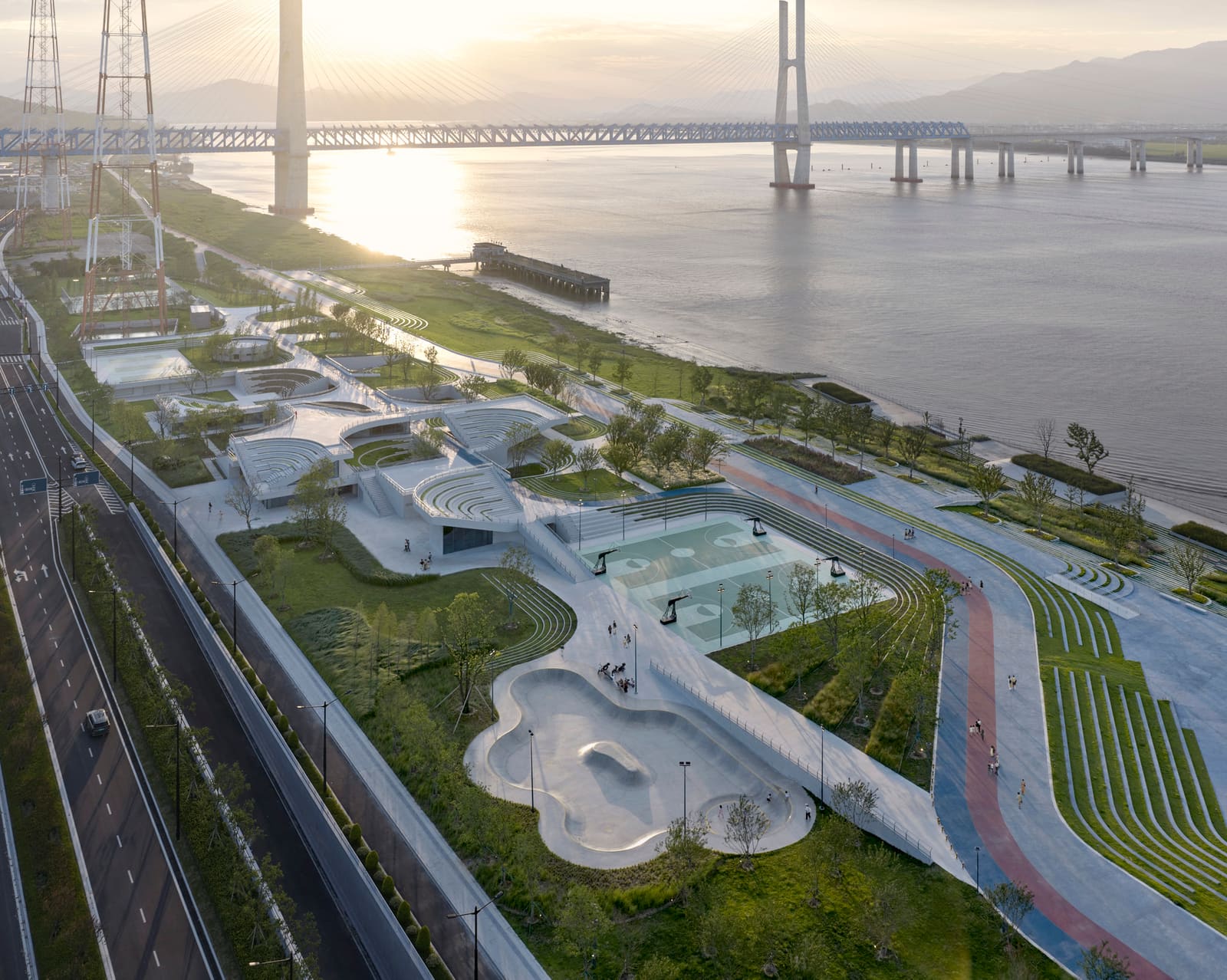
The 1,691 sqm project, completed in 2026 under the direction of Zhang Ming, Zhang Zi, Ding Chun, and Chen Kaiyang, sits on a brownfield stretch where industrial activity once dominated the southern riverbank. Adjacent to the Jiaojiang Bridge that carries high-speed rail passengers into the city, the site functions as a visual threshold - a first impression that previously spoke of extraction and neglect. The design team's response was to dissolve the conventional levee typology into a series of gentle swells, each mound calibrated to absorb flood surges while creating pockets for gathering, resting, and observing the river's moods.
Massing as Topographic Gesture
Rather than impose a singular architectural object, TJAD worked with the language of landform. The embankment's linear rigidity gives way to a sinuous profile that reads as both engineered and organic. Each mound varies in height and curvature, creating a rhythm that echoes the river's own fluctuations. This approach recalls the tidal parks of West 8's Eastern Scheldt Storm Surge Barrier landscape in the Netherlands, where infrastructure and recreation occupy the same volumetric envelope, but TJAD's intervention is more intimate in scale - less monumental, more woven into the grain of everyday movement.
The undulations are not arbitrary. They correspond to flood modeling data, with each swell designed to channel water while providing elevated platforms during high-water events. This dual function - protective and recreational - transforms the embankment from a line of exclusion into a zone of negotiation, where hydrology and human activity share the same spatial logic. The mounds cradle benches, plantings, and pathways, their slopes gentle enough for children to climb yet steep enough to define distinct spatial rooms within the larger continuum.
Material Continuity and Tectonic Restraint
TJAD's material palette reinforces the project's ambition to blur the boundary between built and natural systems. The mounds are clad in a composite of stabilized earth and permeable paving, allowing stormwater to infiltrate while maintaining structural integrity. This choice avoids the slick, impermeable surfaces common to many contemporary waterfront projects, instead embracing a tactile, slightly roughened finish that ages gracefully and supports low vegetation.
The detailing is deliberately understated. There are no railings to interrupt sightlines, no dramatic cantilevers or sculptural flourishes. Instead, the design relies on subtle grade changes and material transitions - concrete pathways that taper into gravel, gravel that melts into planted swales. This restraint allows the topography itself to become the primary architectural expression, a tectonic strategy that prioritizes experience over image. It's a move we've seen in the work of studios like Carve and OKRA, where landscape becomes structure and structure recedes into ground.
Reconnecting Blue, Green, and Gray
The project sits within a broader ecological restoration effort coordinated by Taizhou Urban and Rural Planning and Design Research Institute, which has been working to reintegrate blue-green-gray infrastructure systems along the Jiaojiang River corridor. TJAD's design contributes to this framework by creating a permeable edge that supports both riparian habitat and urban programming. Native grasses and shrubs colonize the mounds, their root systems stabilizing soil while providing habitat for insects and birds. Stormwater runoff from adjacent urban blocks is channeled through bio-swales embedded within the undulating terrain, filtering pollutants before reaching the river.
This layering of ecological and social functions reflects a growing recognition in Chinese urban design that post-industrial riverfronts must perform multiple roles simultaneously. The embankment is no longer a mono-functional barrier but a hybrid infrastructure - part levee, part park, part ecological corridor. It's an approach that aligns with the resilience thinking articulated by landscape urbanists like Kongjian Yu, whose Turenscape projects have long advocated for sponge city strategies that embrace rather than resist water's dynamism.
Public Life on an Engineered Slope
What distinguishes this project from more conventional flood-control landscapes is its willingness to let infrastructure shape the character of public space rather than disguise it. Visitors move through a sequence of spatial conditions - ascending a mound to gain a panoramic view of the river, descending into a sheltered hollow where wind is buffered and conversation easier, traversing a ridge that offers oblique views back toward the city. These experiences are direct consequences of the project's hydraulic logic, yet they read as intentional acts of placemaking.
The design team's careful calibration of slope angles and mound spacing creates micro-climates within the larger site. South-facing slopes catch morning sun and become favored spots for tai chi practitioners; north-facing slopes remain cooler and attract afternoon readers. The project's success lies in this granular attention to how people will occupy the terrain - not through prescribed programs but through the affordances the topography itself provides.
A Gateway Redefined
Because the site is visible from passing high-speed trains, TJAD treated the project as a form of civic representation - a signal of Taizhou's commitment to ecological urbanism. The undulating profile creates a distinctive visual signature that registers at speed, a soft counterpoint to the hard geometries of the rail bridge overhead. This dual address - to the train passenger and the pedestrian - required a design that performs across scales, legible both as a graphic gesture from a distance and as a nuanced spatial sequence up close.
The project also serves as a model for the ongoing transformation of Taizhou's industrial waterfront. As manufacturing activities continue to relocate, the city faces the challenge of reimagining kilometers of riverbank without resorting to generic green corridors. TJAD's approach suggests a methodology: start with the infrastructure, understand its performance criteria, then sculpt those criteria into inhabitable form. It's a process that respects engineering constraints while refusing to let them dictate aesthetic or experiential outcomes.
Towards a Softer Infrastructure
Across the projects we've covered this year, a pattern emerges - designers increasingly understand that resilience and amenity need not be separate agendas. The best contemporary waterfront work integrates flood mitigation, ecological restoration, and public programming within a single spatial proposition. TJAD's Jiaojiang embankment exemplifies this synthesis, demonstrating that infrastructure can be both legible and inviting, both engineered and atmospheric.
The project's real achievement is its refusal of the binary between nature and artifice. The mounds are clearly shaped by human hands, yet they read as extensions of the river's own morphology. They protect the city from flooding, yet they feel like places people choose to be rather than spaces they pass through. In this sense, the embankment has indeed become everyday ground - not a monument to engineering prowess but a terrain where urban life and ecological process unfold together, wave after wave.
Save this story. A free account keeps your reading list and the 07:00 email in one place.
CREATE FREE ACCOUNT →SIGN IN