
The Market's Grip on Meaning
We've watched over the past ten years as "collectible design" moved from descriptive shorthand into something closer to dogma. What once helped us talk about objects that lived between furniture and sculpture has become a formula: limited runs, artisanal finishes, and price tags that justify themselves through scarcity rather than substance. The label has its own trade fairs now, its own aesthetic codes, its own secondary markets. But at what point does a category stop clarifying and start flattening?
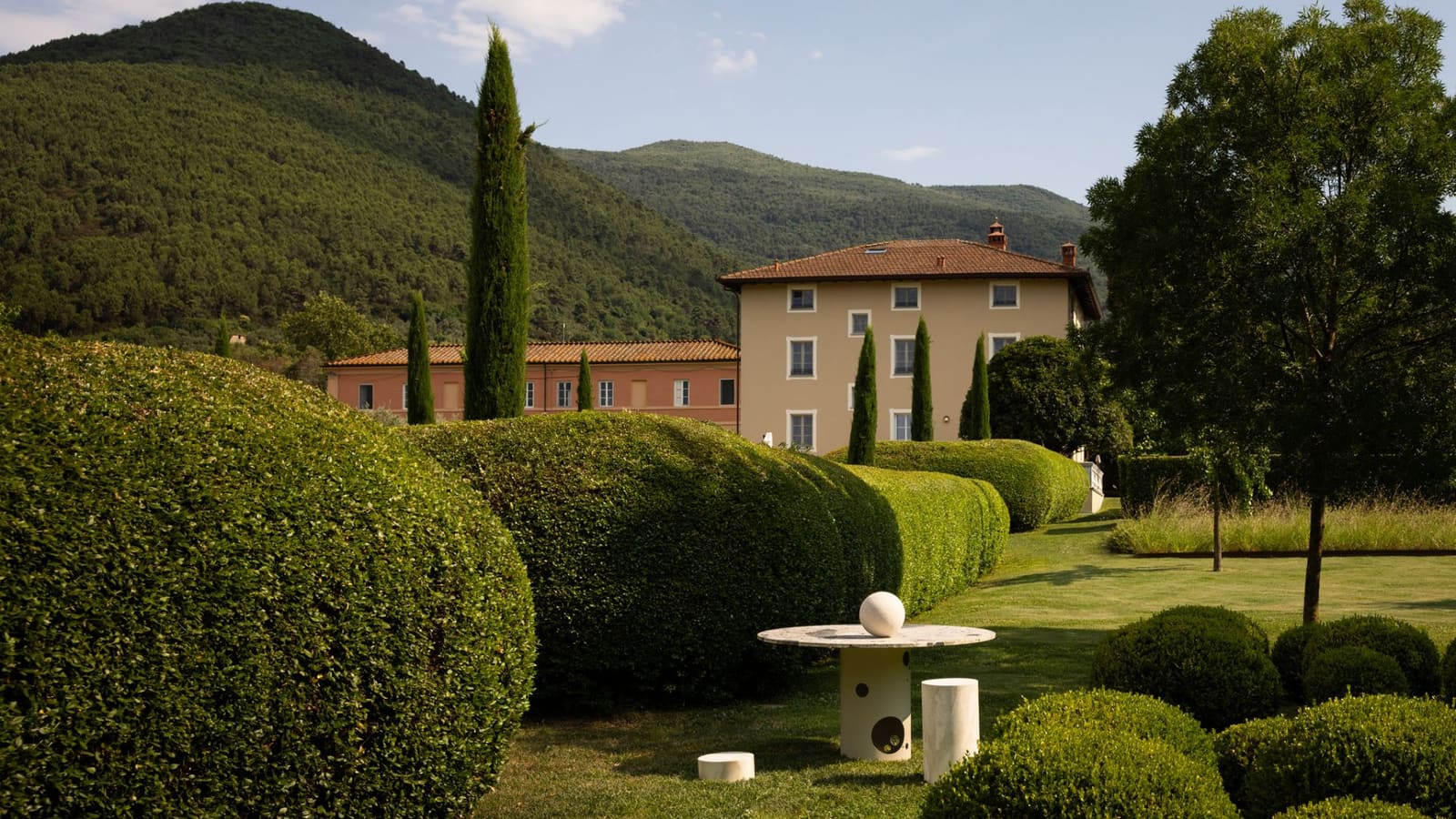
Vestigia, the design exhibition installed in the gardens of Villa Marie in Tuscany from early July through late September 2026, opens with a declaration that doubles as a diagnosis. "Don't call me collectible!" isn't a rejection of craft or uniqueness; it's a rejection of letting those qualities substitute for intellectual rigor. The show, curated by Cosimo Bonciani of Bunker Studio and Bunker Galleria, proposes a different framework: research design. The term repositions the object not as endpoint but as evidence - of process, of inquiry, of material negotiation.
Founded in 2025 by Jonathan Bocca, who also serves as Creative Director, alongside Costantino Gucci, Vestigia's inaugural edition explored the friction between industrial pace and local craft. This year's iteration sharpens that conversation into something more methodological: how do we read an object when we're invited to see the decisions embedded in it?
Transparency as Design Ethic
Research design, as Bonciani frames it, demands a kind of legibility. The work on view at Villa Marie asks to be understood on terms beyond rarity or finish. It insists that we look not just at form but at the chain of choices that produced it - material selection, fabrication logic, the questions that drove the designer's hand. This isn't about demystifying craft; it's about making the intellectual architecture visible.
The setting reinforces that ethic. Tuscany's relationship to making runs deep: Renaissance workshops, marble quarries, centuries of knowledge embedded in stone and pigment. Villa Marie's grounds become an outdoor gallery where work is exposed to weather, to shifting light, to the instability of context. The white cube's neutrality is refused. Twenty-five exhibitors, from Tuscan specialists like marble producer Acquasanta Edizioni working with Francesco Maria Messina to internationally recognized figures such as Laurids Gallée and Jacob Egeberg, installed pieces that respond to - and are shaped by - their surroundings.
At World Archi Design, we've been tracking how site-specificity functions less as aesthetic gesture and more as a form of accountability. When work exists outdoors, it can't pretend to transcend its conditions. It must negotiate them.
Reflection as Disruption
Costantino Gucci's Altera sits in the villa's lake, a mirrored monolith composed of two inclined planes. It's the first piece many visitors encounter, and it establishes the show's spatial logic immediately. The work doesn't reflect the viewer back to themselves; its geometry keeps the observer peripheral, redirecting attention outward toward landscape and sky. Perspective fractures. The surface becomes less about vanity than about reorientation.
Gucci's practice has long treated reflective materials - mirror, glass - as unstable fields rather than static planes. A recent solo presentation at Movimento Gallery explored how these surfaces can multiply and distort rather than simply return an image. Altera extends that investigation into environmental scale, using the lake's movement and the changing quality of daylight to activate the piece continuously. The mirrored surface doesn't stabilize the view; it destabilizes it, turning the act of looking into a kind of spatial negotiation.
The precedent here runs through artists like Robert Smithson, whose Mirror Displacements in the Yucatán used reflection to fragment landscape into non-hierarchical fragments, and Anish Kapoor's polished steel works that warp viewer and context into new configurations. But where Smithson's mirrors were temporary and Kapoor's forms often envelop, Gucci's monolith holds its ground, insisting on the landscape as subject.
Inhabiting the Path
Jonathan Bocca's Silenti, developed in collaboration with OMBRE-1, presents a series of illuminated, anthropomorphic forms built from Geolite, a mineral-based composite chosen for its durability and tactile resemblance to stone. The sculptures are positioned to interrupt the visitor's movement through the garden, forcing shifts in trajectory and sightline. They're not objects to be observed from a distance; they're obstacles, prompts, presences that demand physical response.
Bocca trained at IED Florence and spent time at Fabrica's research center in Treviso, where he developed a practice centered on transforming industrial paper waste from his hometown's mills into dense sculptural composites. That attention to material provenance carries into Silenti, where the choice of Geolite isn't decorative but structural, a decision about longevity and surface quality that shapes how the work reads in situ.
The installation's logic recalls James Turrell's use of light as spatial medium, though Bocca's forms are more figurative, more explicitly bodied. They also echo the environmental choreography of Richard Serra's steel arcs, which similarly compel viewers to move differently, to recalibrate their sense of scale and proximity. Silenti asks for a slower mode of engagement, one that resists the quick scan and insists on embodied encounter.
Dark Matter, Material Memory
Tommaso Pardini's Stygian prototypes take upcycled styrofoam blocks - originally display structures from Fuorisalone 2026 - and carve them into forms that evoke oil spills or industrial fossils. The series carries the label "UFOs," which Pardini defines as Unfunctional Fictional Objects, a deliberate move away from utility and toward speculative narrative. Set against Villa Marie's pastoral backdrop, the blackened forms read as artifacts from a parallel present, one shaped by extraction and waste rather than pastoral fantasy.
The work's material strategy is both pragmatic and poetic: styrofoam, ubiquitous in exhibition infrastructure, is typically discarded after a single use. Pardini intercepts that cycle, treating the material as both raw stock and conceptual payload. The resulting objects carry the weight of their origin story, a kind of material memory that refuses to be decorative.
This approach aligns with practices like Formafantasma's investigations into industrial byproducts and the ways objects encode ecological consequence. Pardini's prototypes don't offer solutions; they offer evidence, traces of a system that privileges ephemerality and then discards the proof.
Modular Tradition, Regional Logic
Bunker Studio's Daria bench is built from fourteen modules, each forty-five centimeters square, in Pietra Serena, the grey sandstone that has defined Florentine architecture for centuries. The bench isn't a single continuous form but a modular system, generating rhythm through the alternation of stone, foam, and brass. Each unit can be repeated, rearranged, recombined - a structural logic borrowed from grid-based systems but grounded in local material knowledge.
Pietra Serena represents one half of the equation: Tuscany's architectural heritage, the stone that lines the city's streets and facades. The foam elements reference Quarrata's upholstery traditions, another regional craft with deep roots. Brass functions as the connective tissue, both literally - holding the modules together - and conceptually, signaling the meeting of two distinct making cultures.
The bench's modularity recalls Charlotte Perriand's use of standardized units in furniture systems, where repetition and variation coexist. But where Perriand's work emerged from industrial optimism, Daria grounds its modularity in place-specific craft, a different kind of seriality that doesn't erase origin.
The Amphora's Other Side
IAMMI's B-fora, commissioned specifically for Villa Marie, is a bronze vase cast to reveal what classical sculpture typically conceals: the "b-side," the back, the body without drapery. The form fuses the proportions of Greek statuary with the silhouette of a contemporary female figure, overtly presenting what centuries of art history kept turned away under the guise of decorum.
The bronze surface is treated through an oxidation process in which acids react with the metal to produce shifting patterns of gold and shadow. IAMMI describes this as a "living finish," a patina that evolves over time, functioning almost like aging skin. The process introduces instability into a material traditionally associated with permanence, turning the vase into a record of its own exposure.
The piece's formal strategy recalls Kiki Smith's anatomical sculptures, which similarly refuse idealization and foreground the body's materiality. B-fora doesn't shy away from the erotic or the corporeal; it insists on them, using the amphora's classical language to ask what we've chosen not to see.
Stone as Fabric, Fabric as Structure
The Medusa collection by Etereo, a studio based between Dubai and Milan, was developed in collaboration with stone specialist Alimonti. The series - floor lamps of varying heights, a table lamp, and a console - treats marble as if it were textile, folding rigid slabs into drapes and folds that suggest movement frozen mid-gesture. Bronzed aluminum lines intersect the marble, revealing an internal logic, a sense of structure beneath the apparent fluidity.
The technique is both sculptural and tectonic, a negotiation between the material's inherent rigidity and the designer's formal ambition. Marble, quarried and cut, doesn't bend; but through precision fabrication and careful composition, Etereo creates the illusion of pliability, of stone caught in a moment of transformation.
The collection recalls Zaha Hadid's late experiments with marble, where the material was pushed toward fluidity through digital fabrication and complex geometries. It also echoes the drapery studies of classical sculpture, where fabric became a vehicle for expressing motion and volume. Etereo's work sits between those references, claiming that materials are not fixed in their behavior - that what they are meant to do and what they can do are two different questions.
Vestigia's Larger Argument
Across the projects installed at Villa Marie, a pattern emerges. These are not objects designed to disappear into interior schemes or to function as status markers. They are objects that insist on being read, on revealing the decisions and processes that brought them into being. They ask for a different kind of attention, one that moves beyond surface and scarcity toward something more demanding: intellectual engagement.
Vestigia's critique of collectible design isn't about rejecting the market or dismissing craft. It's about refusing to let those categories do all the work. Research design, as proposed here, is a framework that privileges transparency, process, and the willingness to let an object carry the weight of its own making. It's a bet that meaning can be built through method, that furniture can function as argument.
The show's outdoor setting, its regional specificity, and its mix of emerging and established voices all reinforce that bet. This isn't design as spectacle or design as commodity. It's design as a form of thinking made visible, a practice that leaves traces and invites scrutiny. In a moment when the market's vocabulary often drowns out other ways of talking about objects, Vestigia offers a quieter, more rigorous alternative - one that asks us to look harder and think longer.
Save this story. A free account keeps your reading list and the 07:00 email in one place.
CREATE FREE ACCOUNT →SIGN IN