
The Geometry of an Evening
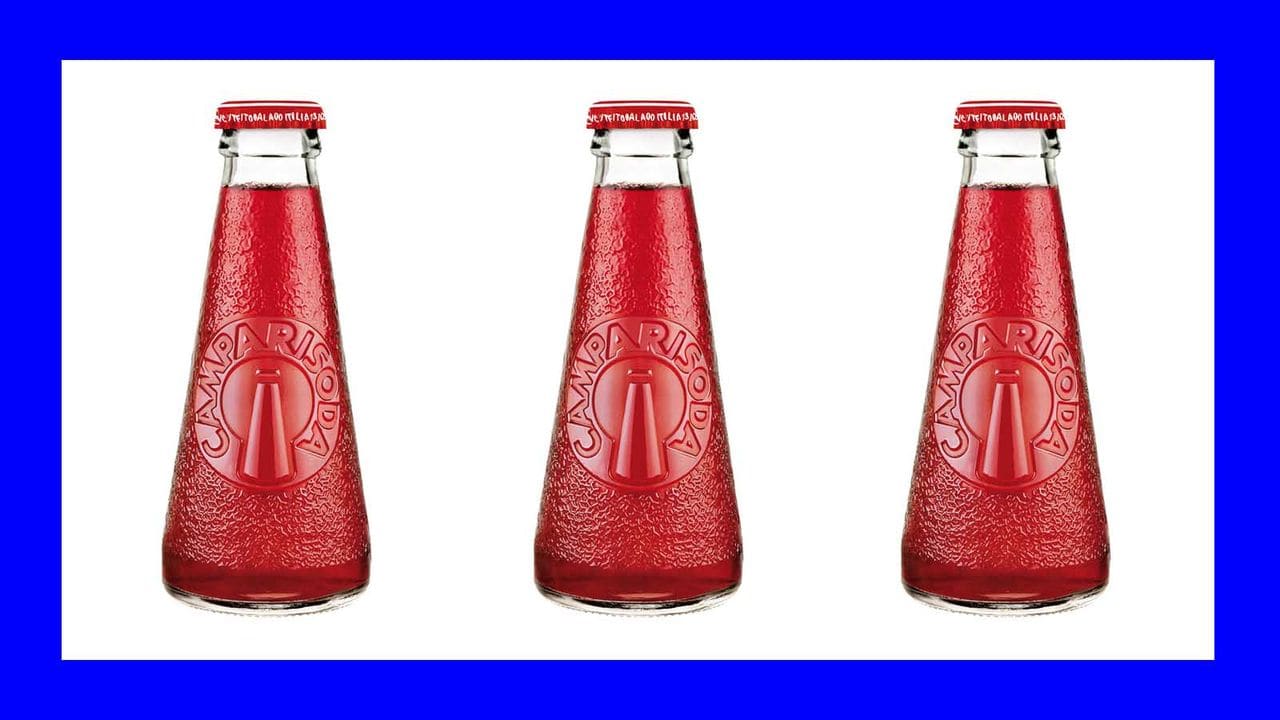
Some designs are recognizable by outline alone. Between June and October, around six in the evening, a particular silhouette appears on Italian café tables with clockwork regularity: a frosted cone of glass, tapering downward, no label, name etched directly into the surface. This is the vessel Fortunato Depero conceived in 1932 for Campari Soda, the first single-serve aperitif in history. His method was disarmingly simple. He inverted a drinking glass and called it done.
The form has remained unchanged for over ninety years. It sits at the intersection of industrial pragmatism and sculptural clarity, a geometry that manages to be both anonymous and instantly identifiable. The bottle announced a conceptual inversion as radical as its physical one: the aperitif ceased to be something a bartender mixed to order and became instead a sealed, pre-measured, ready-to-drink artifact. An exact dose, engineered to stay cold and never lose carbonation.
Origins in Novara, Empire in Milan
The liquid inside predates the bottle by decades. Gaspare Campari, tenth child of a Lombard farming family, finalized his secret formula in Novara in 1860, tinting it with cochineal extract derived from a parasitic insect. His son Davide, raised behind the counter at Caffè Campari in Milan's Galleria Vittorio Emanuele II, transformed a family recipe into a commercial empire. By the early twentieth century, Campari had become synonymous with Italian aperitivo culture, its bittersweet profile inseparable from the ritual of late-afternoon leisure.
When the company sought a container for a portable, single-serve format, they turned not to an industrial designer but to an artist steeped in ideology.
Depero and the Futurist Contradiction
Fortunato Depero occupied the inner circle of Filippo Tommaso Marinetti's Futurist movement, a loose constellation of artists, poets, and provocateurs who championed speed, mechanization, and rupture with the past. Depero believed advertising ranked among the most vital of the arts. His graphic work for Campari, executed throughout the 1920s and early 1930s, deployed bold typography, dynamic diagonals, and saturated color fields. The bottle design followed the same principles: reduction, clarity, industrial reproducibility.
Yet Futurism carried darker freight. The movement celebrated not only machines but also violence, nationalism, and war. It allied itself with Mussolini's regime. In 1943, Depero published A Passo Romano, a collection of openly fascist verse that he later attempted to suppress. The ideological entanglements were neither incidental nor easily disentangled.
The Campari Soda bottle, then, became an ironic monument. Futurism waged a public crusade against pasta, denouncing it as a "passéist food" that "weighs you down, brutalises, deludes you as to its nutritional value." The movement valorized speed and strength; it had no patience for lingering. Yet the object Depero designed now serves as the centerpiece of one of Italy's least hurried rituals: the aperitivo hour, a practice defined by its refusal to rush, by the pleasure of watching ice melt and conversation drift.
Migration of Meaning
What does it mean when an object outlives the ideology that birthed it? Design does not follow linear trajectories. Forms are conceived within specific cultural and political contexts, but they migrate, adapt, and accumulate new meanings. The Campari Soda bottle was born to embody militant, nationalist modernity. Today it is purchased in corner groceries, carried to beaches, set on balcony tables. Same cone, same red, opposite meanings.
This is not unique to Campari. The history of design is littered with such reversals. The Bauhaus aesthetic, forged in Weimar Germany as a utopian project of social transformation, became the visual language of corporate lobbies. Brutalist housing, intended to democratize architecture, is now either demolished or gentrified. Objects survive their authors' intentions.
Samuel Butler's 1863 pamphlet Darwin among the Machines proposed that artificial objects evolve much like biological organisms: through iteration, mutation, and selection pressures that cannot be anticipated. Engineers call this non-linear response. Forms persist, contexts shift, and success is impossible to predict in advance. One generation after another, everything can turn upside down.
The Aperitivo as Counter-Futurism
At World Archi Design, we have long been interested in how objects mediate between ideology and daily life. The Campari Soda bottle is a case study in that tension. It was designed to be modern, efficient, portable, a product of the machine age. And it is all those things. But it has also become inseparable from a ritual that privileges slowness, sociability, and the suspension of productivity.
The aperitivo hour resists the logic of speed. It occupies the liminal space between work and dinner, a threshold where time expands rather than contracts. The bottle sits on a metal table, refracting late sunlight, its contents diluted by melting ice. This is not the Futurist dream of a world in perpetual acceleration. It is, instead, a stubbornly idle present: red, cold, and resolutely unhurried.
Design Without Determinism
The Campari Soda bottle reminds us that design is not destiny. We can trace the formal decisions - Depero's choice to invert the glass, to etch rather than label, to maintain a consistent silhouette across decades - but we cannot control how those decisions will be read, used, or reinterpreted. The bottle's meaning has been rewritten by the millions of hands that have held it, by the tables it has graced, by the conversations it has accompanied.
This is the lesson embedded in the frosted cone: that objects are never finished, that they continue to evolve in the hands of users, and that the most durable designs are often those flexible enough to accommodate meanings their creators never imagined. The avant-garde wanted to conquer the future. It ended up bottling the present.
Coda: The Ordinary Canon
Italy's design canon is well-rehearsed: the Bialetti moka pot, the Vespa, the Arco floor lamp. These objects have been cataloged, celebrated, and enshrined in museum collections. But the Campari Soda bottle belongs to a different register. It is less glamorous, more ubiquitous, the kind of object Italians handle daily without registering that someone, somewhere, made deliberate choices about its form.
This is the ordinary canon, the one that shapes daily life more profoundly than any showpiece ever could. It includes the mosquito coil, the motorway toll transponder, the humble condom. Objects so embedded in routine that they become invisible. Yet they are no less designed, no less thoughtful, and often no less revealing of the culture that produced them.
When the day ends and the bottle sits empty on the table, it holds more than residual liquid. It holds a century of reversals, adaptations, and unintended uses. An artifact of Futurism that now serves as a monument to the pleasure of doing nothing at all.
Save this story. A free account keeps your reading list and the 07:00 email in one place.
CREATE FREE ACCOUNT →SIGN IN