
The Paradox at the Kitchen Sink
Every generation believes it stands on the threshold of a domestic revolution. We've grown accustomed to rendering the future in glossy vignettes - robot assistants, voice-activated everything, entire homes orchestrated by invisible intelligence. Yet the promises made in 1950 bear an uncanny resemblance to those circulating today: more leisure, less drudgery, technology as emancipator. The Los Angeles County Museum of Art's new exhibition, Home of the Future, 1925-1985: Designing Domestic Utopias, asks why these visions recur with such regularity, and why so few have materialised in the way their architects intended.
Spanning six decades of speculative domesticity, the show - and its accompanying publication edited by Wendy Kaplan, head of LACMA's Decorative Arts and Design department - gathers renderings, prototypes, advertisements, and ephemera that once depicted an imminent utopia. Designed by Lorraine Wild and Xiaoqing Wang of Green Dragon Office, the volume presents this material not as nostalgic kitsch but as a serious inquiry into how we imagine home, labour, and freedom.
Machine Dreams and Material Culture
The exhibition opens in the mid-1920s, a moment when electrification was remaking the American household. Labour-saving devices proliferated: refrigerators, vacuum cleaners, washing machines. Manufacturers framed these appliances not merely as conveniences but as instruments of social transformation. The promise was explicit - technology would free women from domestic servitude, allowing time for education, civic participation, creative pursuits.
Yet as historians have long noted, the reality proved more complicated. New machines generated new standards of cleanliness, new rituals of maintenance. The home became a site of intensified consumption rather than liberation. This tension animates much of the material LACMA has assembled. A 1959 photograph by Bob Lerner, for instance, depicts Anne Anderson standing in RCA's 1956 Whirlpool Miracle Kitchen - a gleaming tableau of push-button efficiency that nonetheless required a human operator to navigate its complexity.
The Monsanto House of the Future, designed by Kyu Lee of Hamilton & Goody Architects and presented in 1956, exemplifies the era's faith in synthetic materials and modular construction. Built entirely of fibreglass-reinforced plastic, the house featured cantilevered wings and an open plan that anticipated later experiments in prefabrication. More than eight million visitors toured the structure during its decade-long residency at Disneyland, yet the house never entered mass production. The vision was seductive; the economics were not.
Aerospace Fantasies and Suburban Realities
By the late 1940s and 1950s, domestic futurism had absorbed the visual language of aerospace. Streamlined forms, rocket fins, bubble canopies - these motifs migrated from aviation into furniture, appliances, even children's toys. Alexis V. Lapteff's 1947 illustration Family Departing Visit with Grandparents in their Commuter Helicopter captures this fantasy at its most literal: the suburban home as helipad, the family sedan replaced by personal rotorcraft.
Ralph Bartholomew Jr.'s 1960 rendering, included in the exhibition, imagines interiors as command centres - sleek control panels, wall-mounted screens, furniture that doubles as communication nodes. The aesthetic borrows heavily from midcentury modernism, but the underlying programme is one of total automation. Push a button, and the house responds. Speak a command, and the environment adjusts. These were not idle daydreams; corporations invested heavily in research and development, convinced that the market would follow.
Yet the flying car, like the robot butler, remains a punchline. The technologies required - vertical take-off and landing, autonomous navigation, affordable propulsion - proved far more elusive than postwar optimism allowed. What did arrive, however, were suburban tract homes, mass-produced appliances, and a culture of consumption that reshaped the American landscape. The future came, but it looked different from the brochures.
Counterculture and the Ecological Turn
The exhibition's fourth section marks a tonal shift. By the late 1960s, the shiny promises of earlier decades had begun to ring hollow. Rampant consumption, environmental degradation, and social inequality prompted a reassessment of what "progress" meant. The counterculture movement proposed alternatives: communal living, appropriate technology, off-grid autonomy.
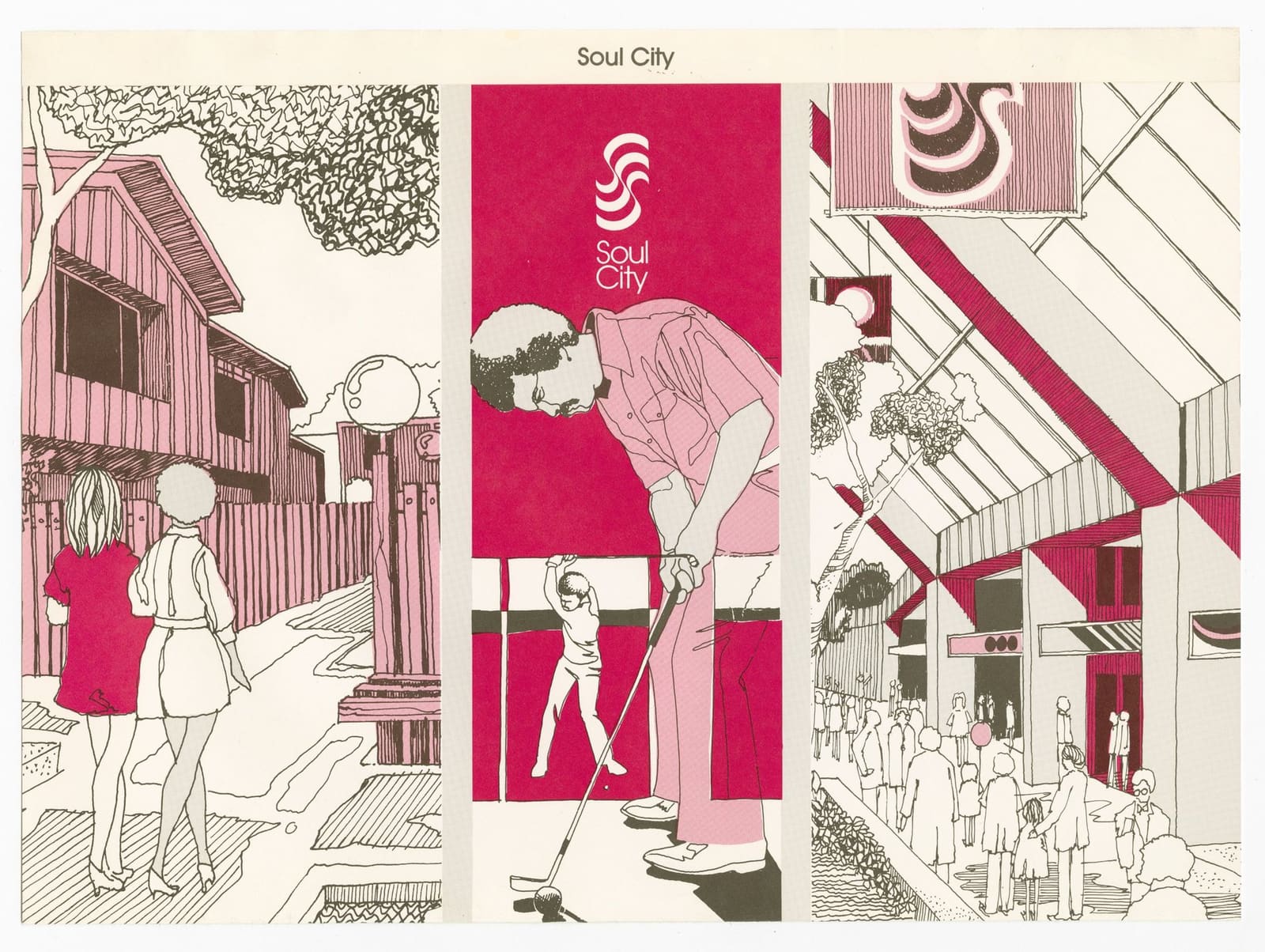
Curtis Schreier's 1974 poster for Space Is the Place, featuring Sun Ra and the Intergalactic Myth-Science Solar Arkestra, suggests one response - a fusion of Afrofuturism, cosmic mythology, and radical politics. Rather than accept the technocratic visions of corporate futurism, artists and activists reimagined the future on their own terms. Floyd McKissick's Soul City, a planned community in North Carolina, attempted to build an economically self-sufficient Black utopia. A brochure from around 1976, included in the LACMA volume, outlines the project's ambitious scope: housing, industry, education, all designed to counter systemic disinvestment.
These visions were no less utopian than those of the 1950s, but they emerged from different premises. Technology was not inherently liberating; it could be deployed in service of justice or exploitation. The home was not a static container but a site of political struggle. The future, in other words, was not inevitable - it had to be built, contested, won.
The Digital Domestic and Its Discontents
At World Archi Design, we've noted how contemporary discourse around smart homes, voice assistants, and ambient computing echoes the rhetoric of earlier eras. The language has changed - algorithms replace push-buttons, machine learning replaces automation - but the underlying promise remains: technology will simplify, liberate, enhance. Yet the criticisms levelled by the counterculture in the 1970s feel newly urgent. Who controls these systems? Whose labour do they displace? What new forms of dependence do they create?
The exhibition closes in 1985, just as personal computing begins its ascent. The date is significant. By the mid-1980s, the microprocessor had entered the home, but the internet had not yet reshaped domestic life. LACMA's temporal boundary allows us to see the prehistory of our own moment - the hopes, failures, and unintended consequences that prefigure today's debates.
Kaplan's editorial framing resists nostalgia. The book does not present these artefacts as quaint relics but as evidence of a recurring pattern: optimism, investment, disillusionment, critique. Each generation inherits the debris of the last and constructs its own vision from the wreckage. The robotic vacuum cleaner, for instance, has finally arrived - though it is less sentient companion than glorified appliance, prone to getting stuck under furniture and requiring regular human intervention.
Lessons from the Archive
What can architects and designers learn from this archive? First, that technological determinism is a poor guide. The assumption that innovation will naturally produce social good has been repeatedly disproven. The Miracle Kitchen did not liberate; the commuter helicopter never took off. Second, that materiality matters. The Monsanto House's fibreglass shell was eventually demolished with difficulty - the material proved too durable for easy disassembly, a cautionary tale for those advocating synthetic construction today.
Third, that visions of the future are always inflected by the politics of the present. The postwar suburban ideal assumed a nuclear family, a single breadwinner, and a rigid division of labour. Countercultural experiments, by contrast, emphasised collectivity, sustainability, and self-determination. Neither vision was neutral; both encoded specific assumptions about gender, race, class, and power.
The exhibition's strength lies in its refusal to resolve these tensions. It does not offer a singular narrative of progress or decline but instead presents a multiplicity of futures, some realised, some abandoned, some still contested. The book's design, with its layered imagery and archival fragments, reinforces this sense of complexity. Readers are invited to dwell in the contradictions rather than seek easy answers.
The Future We Inhabit
The 21st century has produced its own catalogue of domestic utopias: net-zero homes, biophilic interiors, algorithmic environments. We are told that these innovations will address the failures of earlier eras - energy efficiency, wellness, convenience without compromise. Yet as LACMA's exhibition suggests, we should approach such claims with scepticism. The future rarely arrives as advertised.
Perhaps what we need is not another vision of tomorrow but a more honest reckoning with today. The voice-activated home exists, but it is owned by corporations that harvest data and shape behaviour. The labour-saving device exists, but it is often manufactured under conditions of exploitation and designed for obsolescence. The domestic utopia exists, but it is unevenly distributed, accessible only to those with the means to afford it.
The exhibition runs through 14 March 2027 at LACMA's Resnick Pavilion. The book, published by DelMonico Books, retails at 79.95 USD. Both are worth engaging with - not as escapist fantasies but as prompts for critical reflection. If we are to design better homes, we must first understand why so many past attempts have fallen short. The archive, as always, is instructive.
Save this story. A free account keeps your reading list and the 07:00 email in one place.
CREATE FREE ACCOUNT →SIGN IN