
The Threshold as Thesis
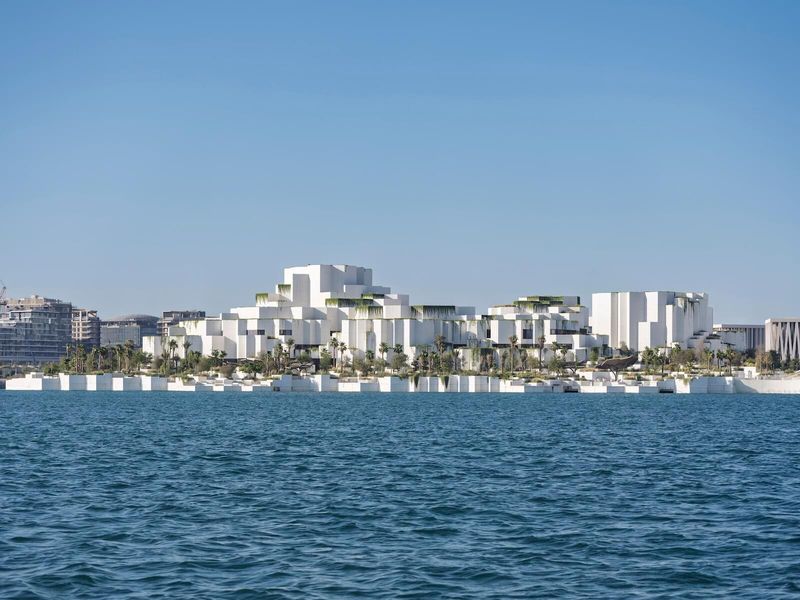
There is a particular eloquence in designing a natural history museum that refuses to behave like a building at all. Mecanoo's recently completed institution on Saadiyat Island operates instead as a constructed terrain, its 35,000 square metres of gallery, laboratory, and public space emerging not as object but as event. The conceptual anchor is the meeting line of water and earth, that shifting, never-static zone where sediment accumulates, tides reconfigure shorelines, and ecosystems negotiate their terms. It is a thesis borrowed from geology itself, and the architecture commits to it without hedging.
At World Archi Design, we've been tracking a quiet but insistent turn in museum design away from the icon and toward the embedded. This project, delivered in 2025 for the Department of Culture and Tourism Abu Dhabi and developed by Miral, represents one of the more rigorous examples of that shift. Where many institutions still announce themselves through sculptural gesture or material spectacle, Mecanoo's approach here is almost anti-monumental. The building does not sit on the site; it folds into it, shaped by a vocabulary of erosion, sedimentation, and time-worn topography.
Massing as Landform
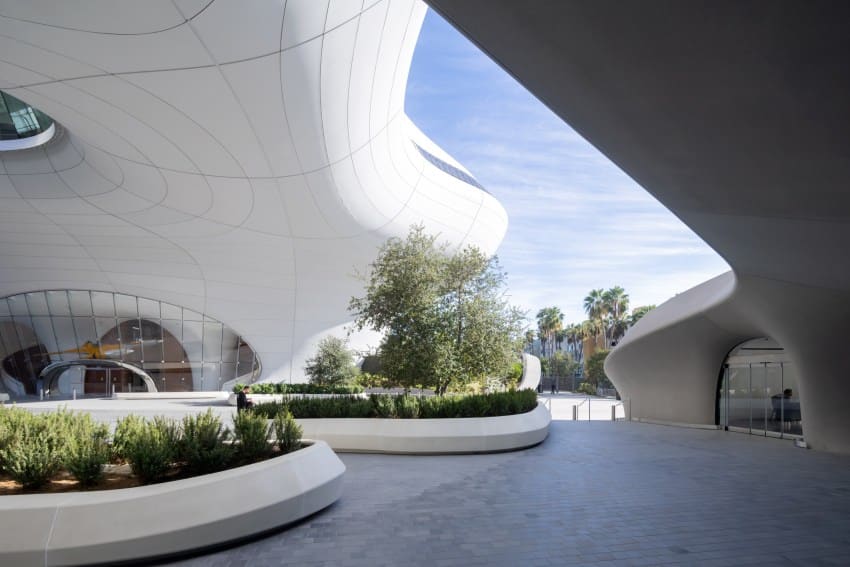
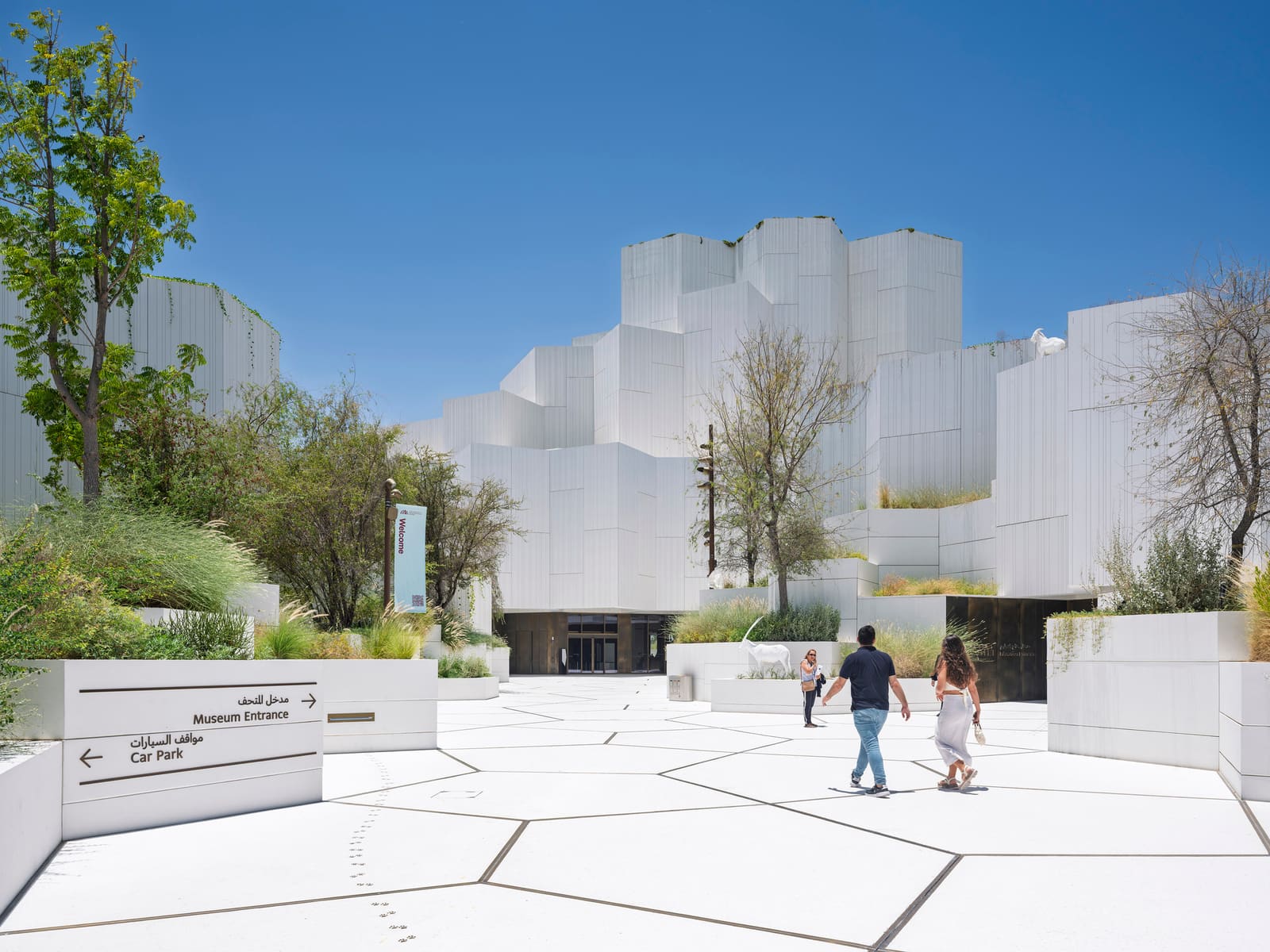
The museum's formal language is drawn directly from the wadis and geological strata of the Arabian Peninsula. Rather than a single volume, the design presents a series of sculpted masses that read as if carved by wind and water over millennia. This is not mimicry but abstraction, the kind of tectonic translation that requires both restraint and confidence. The roofline undulates, the facades recede and advance, and the circulation paths meander in ways that resist the grid logic typical of institutional buildings.
What makes this approach credible is its scale. Spread across an 82,000 square metre site, the museum has room to breathe, to establish its own topography without overwhelming the surrounding plaza, gardens, and waterfront promenade. The landscape architects from Waho worked closely with Mecanoo to ensure that the transition from public realm to exhibition space felt gradual, even inevitable. You do not arrive at a threshold so much as you drift across one.
The massing strategy also addresses the harsh Gulf climate without resorting to the hermetic glass box. By articulating the building as a series of interconnected volumes, Mecanoo creates pockets of shade, channels for air movement, and opportunities for passive cooling. The thick, earth-toned walls evoke the thermal mass of traditional desert construction, while the fenestration is selective, offering views where they matter and enclosure where they protect.
Material and Tectonic Expression
Materiality here is less about finish than about continuity. The exterior surfaces are rendered in tones that shift from ochre to sand to pale limestone, colours lifted from the surrounding desert and coastal geology. The aim is not to camouflage the building but to ground it, to make it legible as part of a longer geological narrative. This is architecture that acknowledges its place in deep time, even as it serves contemporary institutional needs.
Inside, the material palette remains restrained. Concrete, stone, and timber dominate, with detailing that emphasizes weight and permanence. The galleries, designed in collaboration with exhibit specialists Ralph Appelbaum and Barker Langham, are deliberately understated, allowing the collections to take precedence. Display areas are arranged along a spatial sequence that mirrors the museum's conceptual framework: movement, transformation, origin. Visitors are not led through a linear progression so much as invited to explore thresholds, to linger at edges, to consider transitions.
The integration of research and administrative facilities, laboratories, and education centres within the same architectural envelope is handled with unusual dexterity. These are not service spaces tucked into a basement or relegated to a back-of-house annex. They are woven into the fabric of the museum, visible and accessible, reinforcing the idea that natural history is not a static archive but an ongoing investigation.
Precedent and Position
Mecanoo's work here invites comparison with other recent museum projects that prioritize landscape integration over formal autonomy. Renzo Piano's Stavros Niarchos Foundation Cultural Center in Athens, with its artificial hill and planted roof, comes to mind, as does Diller Scofidio + Renfro's U.S. Olympic and Paralympic Museum in Colorado Springs, which similarly uses topographic metaphor to structure experience. But the Abu Dhabi project distinguishes itself through its refusal of spectacle. There is no soaring cantilever, no shimmering facade. The drama is quieter, more patient.
This restraint is strategic. In a cultural district that already includes Jean Nouvel's Louvre Abu Dhabi, the Natural History Museum needed to establish its own identity without competing for visual dominance. Mecanoo's solution was to go low, to go horizontal, to make the building feel less like a destination and more like a continuation of the island's emerging public realm. The result is an architecture that invites occupation rather than demanding admiration.
The design also reflects a broader evolution in how institutions think about sustainability. Rather than layering green technologies onto a conventional building, Mecanoo embeds environmental performance into the parti itself. The massing reduces solar gain, the orientation captures prevailing breezes, and the landscape design manages stormwater and provides habitat. These are not add-ons; they are intrinsic to the project's logic.
Experience and Interpretation
Visitor experience begins not at the entrance but at the edge of the site, where the museum first becomes visible as a low, undulating presence against the horizon. The approach is choreographed to slow perception, to encourage a gradual shift from the tempo of the city to the slower rhythms of geological time. The plaza and gardens, designed to accommodate both informal gathering and programmed events, function as a kind of threshold space, neither fully urban nor fully natural.
Once inside, the spatial sequence is non-hierarchical. Galleries open onto one another without rigid demarcation, and circulation paths allow for multiple readings of the collection. The education centre and multipurpose spaces are positioned to encourage cross-programming, enabling the museum to function as a research hub, a community resource, and a cultural venue simultaneously.
The interplay between interior and exterior is carefully calibrated. Large openings frame views of the waterfront and adjacent landscape, collapsing the distinction between display and context. At moments, the architecture withdraws entirely, ceding attention to the collections and the ideas they embody. This is not modesty for its own sake but a deliberate editorial choice, one that reflects a mature understanding of what a natural history museum can be.
A Museum That Waits
What lingers after visiting Mecanoo's Natural History Museum is not a single image or iconic gesture but a cumulative sense of place. The building does not announce itself; it unfolds. It does not compete with its contents; it amplifies them. And it does not impose a fixed reading; it offers a framework within which multiple narratives can coexist.
This is architecture that understands patience, that recognizes the value of restraint, and that trusts the intelligence of its audience. In a region where ambition often defaults to scale and spectacle, the Natural History Museum Abu Dhabi proposes a different kind of ambition: the ambition to listen, to observe, to let the site and the program guide the form. It is a lesson in how architecture can serve without dominating, how it can shape experience without dictating it, and how it can honor the past while remaining fully engaged with the present.
Save this story. A free account keeps your reading list and the 07:00 email in one place.
CREATE FREE ACCOUNT →SIGN IN