
The Architecture That Refuses to Stay in the Background
Some buildings photograph so well they risk overshadowing whatever unfolds inside them. The Sheats-Goldstein Residence in Beverly Crest operates differently: its cantilevered geometries and raw material palette don't compete for attention so much as they establish a visual argument that everything placed within its frame must answer.
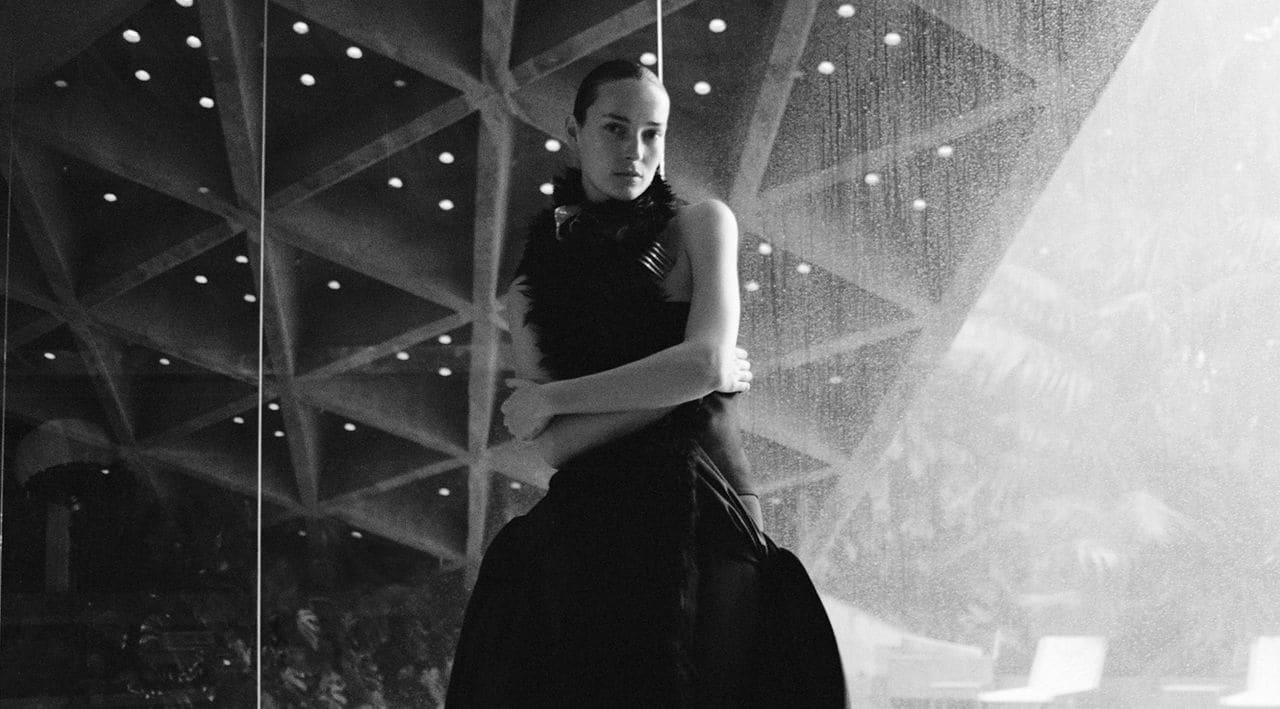
Completed in 1962, the house exemplifies the tectonic confidence that defined John Lautner's practice. The roof - a sculptural plane that blurs the threshold between shelter and exposure - doesn't simply cover space; it choreographs movement through it. This quality has made the residence a recurring character in cinema, music, and editorial work, most recently serving as the setting for a Pre-Fall 2026 fashion feature photographed by David William Baum.
At World Archi Design, we've been tracking how fashion photography increasingly seeks out architectural environments that offer more than backdrop neutrality. The Sheats-Goldstein commission represents a particular species of this relationship: one where the building's formal language becomes part of the editorial thesis.
A Vocabulary of Angles and Drape
The garments selected for the shoot - drawn from Celine, Prada, The Row, JW Anderson, Dior, Gucci, Chloé, Chanel, and Alaïa - read as deliberate counterpoints to Lautner's hard-edged massing. Where the architecture asserts itself through concrete, glass, and steel, the clothing introduces soft volumes, draped silhouettes, and textile pliability.
This juxtaposition operates on multiple registers. Sculptural pieces from The Row and Fforme echo the residence's geometric rigor while maintaining a sense of bodily movement that architecture, by definition, cannot achieve. A Prada faille dress introduces surface texture that catches light differently than polished concrete but shares its commitment to material honesty. An Alaïa tension top responds to the building's structural expression with its own display of second-skin precision.
The styling avoids literal mimicry - there are no sharp-shouldered blazers attempting to mirror cantilevered planes - in favor of exploring how two distinct formal systems can occupy the same visual field without collapsing into metaphor. The result feels less like fashion borrowing from architecture and more like parallel investigations into how volume, line, and negative space construct meaning.
Lautner's Cinematic Instinct
What makes the Sheats-Goldstein Residence such a compelling photographic environment extends beyond its formal drama. Lautner designed the house with an acute understanding of spatial sequence and reveal. The entry compresses visitors through a narrow corridor before releasing them into a double-height living space that opens directly to canyon views - a move that Michael Govan, CEO of the Los Angeles County Museum of Art, described as having an intensity of choreography rarely achieved in residential work.
LACMA received the property as a gift in 2016 from James Goldstein, the businessman who acquired it in 1972 and spent decades refining both the house and its surrounding landscape. Goldstein's stewardship included commissioning Conner + Perry Architects to design the Goldstein Entertainment Complex, a subterranean addition beneath a new tennis court that houses a nightclub, offices, and spa facilities.
The extension, completed more recently, translates Lautner's material vocabulary - raw concrete, expansive glass, stainless steel detailing - into a contemporary program without resorting to pastiche. Kristopher Conner characterizes the work as an evolution rather than imitation of the original visual language, a distinction that matters in adaptive interventions within landmark properties.
When the Weather Writes Its Own Script
The shoot unfolded during a rare Los Angeles rainstorm, an atmospheric condition that reframed the project's initial concept. Fashion photography at modernist landmarks typically relies on Southern California's dependable sunlight to amplify material contrasts and sharpen shadow lines. Rain introduces diffusion, mutes color saturation, and shifts the emotional register from aspirational clarity to something more introspective.
Rather than postponing, the production embraced the weather as a collaborator. Water on glass and concrete surfaces created reflective planes that multiplied the geometric patterns already embedded in Lautner's design. The muted palette allowed textile textures to assert themselves more forcefully against the architecture's monochrome backdrop. Atmospheric haze softened the canyon views that typically dominate the residence's visual identity, redirecting attention inward to the interplay between body, garment, and built form.
This adaptive response reveals a broader shift in how architectural photography - fashion or otherwise - approaches its subjects. The pursuit of ideal conditions increasingly gives way to documentation that acknowledges contingency, imperfection, and the unpredictable variables that shape how we actually experience space.
Precedents in Fashion-Architecture Dialogue
The practice of staging fashion within architecturally significant environments has deep roots, though its motivations have evolved. Mid-century editorial work often positioned modernist buildings as symbols of affluence and sophistication - backdrops that conferred status through association. Contemporary approaches tend toward more critical engagements, using architecture as a formal counterpart rather than merely a luxurious setting.
Helmut Newton's work in the 1970s and 1980s frequently deployed modernist interiors to create tension between the human figure and its geometric surroundings. More recently, photographers have sought out Brutalist structures, industrial ruins, and unfinished construction sites - environments that challenge rather than flatter the clothing they frame.
The Sheats-Goldstein shoot aligns with this latter tendency while avoiding its more confrontational gestures. The residence offers sufficient visual strength to hold its own against high-fashion styling without overwhelming it, creating a productive balance that allows both architecture and garment to remain legible as distinct formal systems.
Material Conversations
One of the more subtle achievements of the project lies in how it foregrounds material specificity. Lautner's use of board-formed concrete - a technique that preserves wood grain patterns in the cured surface - creates a tactile richness that fashion photography rarely engages with directly. By allowing the architecture's material character to remain visible rather than abstracting it through extreme cropping or shallow depth of field, the images establish a dialogue between fabric and finish, drape and structure, transparency and mass.
A Gucci viscose jersey dress reads differently when positioned against raw concrete than it would against white seamless paper or a neutral studio wall. The concrete's texture provides a contrasting datum that emphasizes the garment's fluidity. Similarly, leather pieces from Chloé gain additional presence when juxtaposed with glass expanses that reflect rather than absorb their surface character.
This attention to material relationality suggests that the most productive fashion-architecture collaborations emerge not from stylistic similarity but from deliberate contrast - pairings that make each element's inherent qualities more perceptible through proximity to their opposite.
Legacy and Repetition
The Sheats-Goldstein Residence's recurrent appearance in visual media raises questions about how repeated documentation affects a building's cultural meaning. Familiarity can dull perceptual acuity; we begin to see the image of the place rather than the place itself. Yet the house's formal clarity seems to resist this flattening. Each new photographic interpretation - whether cinematic, editorial, or documentary - finds fresh angles within Lautner's disciplined geometries.
This resilience likely stems from the architecture's refusal to offer a single optimal viewpoint. The cantilevered roof reads differently from every position. The relationship between interior and exterior shifts with the time of day, weather conditions, and seasonal vegetation changes. Such spatial complexity provides enough visual variability to support repeated engagement without exhausting its formal possibilities.
For fashion photography specifically, the residence functions less as a recognizable location than as a spatial condition - a set of formal relationships that can be activated differently depending on what enters the frame. The Pre-Fall 2026 shoot demonstrates this potential by treating the architecture as an active participant in constructing the image rather than a passive container for it.
What the Lens Reveals
Looking across the resulting photographs, what emerges most clearly is a shared investment in the relationship between body and boundary. Fashion and architecture both negotiate how form contains, reveals, conceals, and articulates the human figure. Lautner's expansive glass walls and open floor plans dissolve traditional barriers between inside and outside, public and private. The selected garments perform parallel operations, using transparency, drape, and strategic structure to redefine the body's outline.
This thematic consonance suggests why certain architectural environments prove particularly generative for fashion photography. The most compelling pairings occur when building and garment operate in the same conceptual territory - not matching in style or era, but engaged with overlapping questions about form, material, and spatial experience.
The Sheats-Goldstein commission succeeds because it recognizes this deeper affinity and builds its visual strategy around it, creating images that function simultaneously as fashion editorial, architectural documentation, and meditation on how we construct and inhabit space.
Save this story. A free account keeps your reading list and the 07:00 email in one place.
CREATE FREE ACCOUNT →SIGN IN