
The Downtown Defector
For years, the trajectory seemed clear: fashion designers who valued light and openness gravitated south, away from the Upper East Side's formality. Adam Lippes had followed that path faithfully, moving through a penthouse on lower Fifth Avenue, a Brooklyn Heights apartment, and a duplex overlooking Washington Square Park. Each space featured the same design vocabulary: abundant sunlight, soft palettes, floral textiles, a curated blend of antique and vintage furnishings. Then the pandemic upended everything.
During those months when the city felt unmoored, Lippes questioned whether his business would survive. He decamped to the Berkshires farm he still owns, then stayed at the Four Seasons when work resumed. A temporary arrangement in an uptown apartment shifted something fundamental. The Upper East Side, long dismissed as staid, revealed unexpected appeal. When a duplex became available in an 1886 mansion across from the Central Park Zoo, Lippes took what he calls "a big bite."
The Coal Baron's Legacy
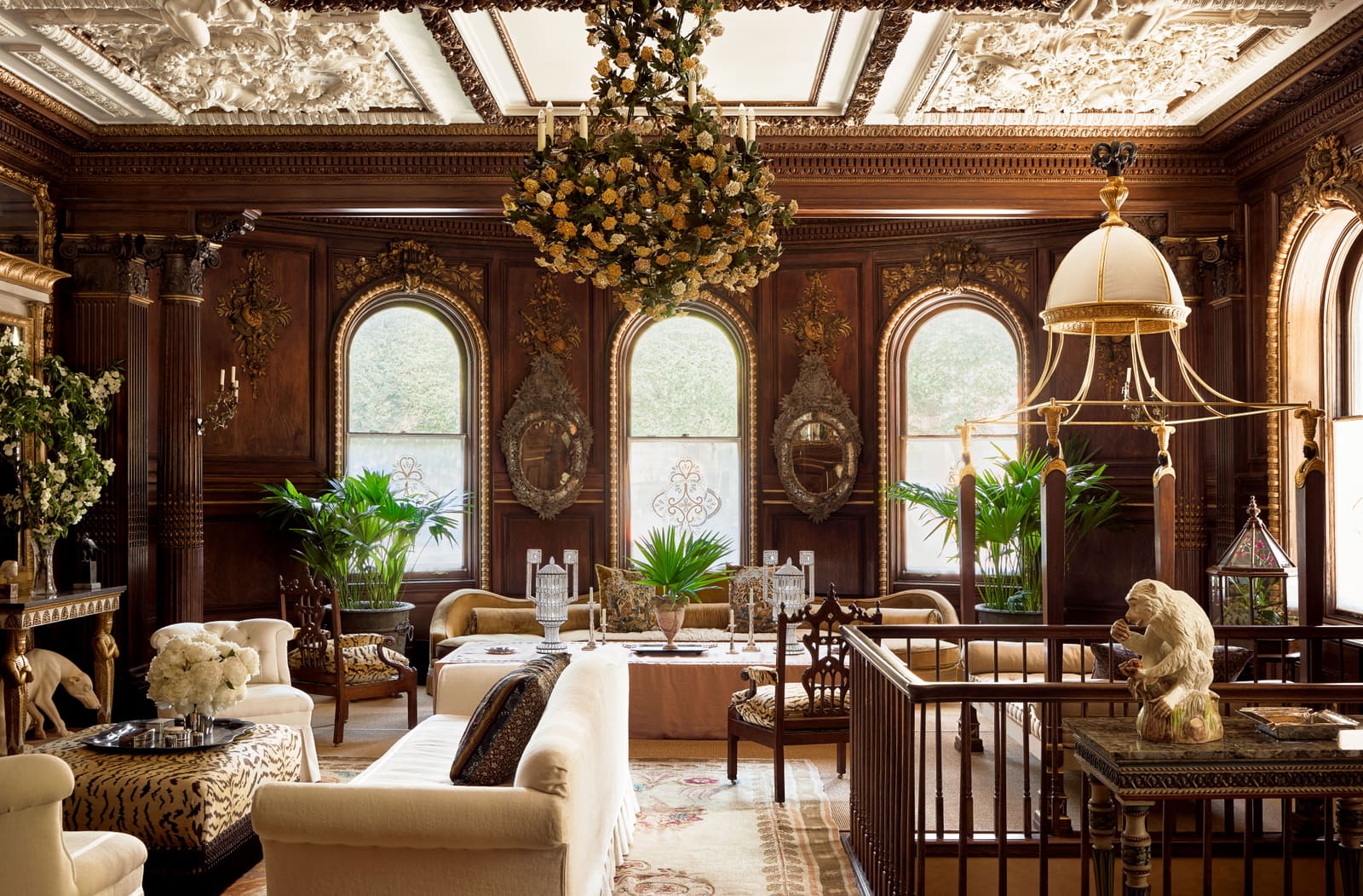
The building was commissioned by a coal magnate during the apex of Gilded Age excess, its interiors designed to signal arrival among New York's industrial aristocracy. Walking into the main room today remains a visceral experience: richly carved and gilded wood paneling climbs toward an ornate ceiling, tall arched windows frame the park, and a marble-clad fireplace anchors the space. The room speaks a language of wealth that predates stock tickers and hedge funds, rooted instead in railroad fortunes and mineral extraction.
But the apartment had sat vacant for over a decade. Mechanicals needed replacement, a kitchen had to be carved from a former pantry, and the lower level required complete reconfiguration. Lippes hesitated. His partner, Alexander Farnsworth, did not. Visiting on a February night with the building wrapped in scaffolding, Farnsworth immediately grasped the potential. The question became not whether to proceed, but how to inhabit such a space without being consumed by it.
The Provenance Trap
Lippes's initial instinct leaned toward symmetry: grand architecture demands grand furniture. He began acquiring pieces from dealers and auction houses internationally, filling the apartment until it resembled a showroom. The strategy backfired. "I realized I was going about it all wrong," he recalls. The room's architectural weight required counterbalance, not reinforcement.
He considered radical intervention, even contemplating painting over the brown wood paneling. Stephen Sills's work for Aerin Lauder in Palm Beach offered one precedent; François-Joseph Graf's Parisian interiors suggested another. Lippes came close to enlisting a decorator of that caliber. Instead, he reversed course entirely, reaching out to Pilar Solchaga, who had transitioned from fit modeling into interior design. Together they developed an approach that neither deferred to the architecture nor fought against it.
Comfort as Counterpoint
The final scheme embraces contradiction. Low-slung seating wrapped in white slipcovers grounds the living room, their casual fabrication deliberately informal against the gilded paneling. An oversized ottoman upholstered in Scalamandré animal-print velvet anchors the space with unabashed texture. A curvy sofa dressed in Dedar velvet with Samuel & Sons trim follows the gentle arc of a windowed wall, beneath sheer panels embroidered by the same Indian atelier Lippes uses for his dress collection. Mirrors inset into the existing paneling multiply light, softening the room's inherent gravitas.
Certain acquisitions from the early buying spree survived the edit. A neo-Egyptian bed by Jonathan Sainsbury, purchased before the design direction clarified, now stands against a 17th-century Brussels tapestry. The late-19th-century chandelier found in Paris stretches six feet tall, its porcelain flowers cascading, yet the room's volume absorbs even that scale. An 18th-century side table by Jean-Henri Riesener holds its own beside contemporary arrangements. The room reads as layered rather than curated, accumulated rather than designed.
Downstairs: Immersive Retreats
The lower level operates under different principles. Where the main floor negotiates between eras, the bedroom level commits fully to envelope and cocoon. The primary suite is drenched in seafoam green, walls and windows and bed swathed in silk moiré by Hurel. The monochromatic palette creates what Lippes describes as profound calm, a feeling of rural remove despite the Fifth Avenue address.
One guest room is tented in custom Taroni silk with a subtle stripe, the fabric draped to obscure architecture entirely. The other guest room leans darker, fitted with an 18th-century Chinese bed and walls covered in Schumacher's Tortoise wallpaper. Scenic wallpapers by Iksel Decorative Arts unify the spaces, their immersive patterns blurring boundaries between surface and depth.
A powder room off the main level demonstrates the apartment's tonal range. A 17th-century sink sourced from The Marble Dog is skirted in Taroni silk; a ship chandelier by Baguès hangs overhead. The small space layers maritime references with textile luxury, compressing the apartment's broader strategy into a single vignette.
Maximalism as Method
Lippes describes his current moment as a "maximalism era," a phrase that captures both the apartment's aesthetic and his expanding business footprint. Retail outlets have opened in Houston, Palm Beach, and Osaka. A tabletop collaboration with Zoë de Givenchy is in production; a jewelry collection is under development. The renovation itself continues, with plans to develop outdoor spaces on the lower level for entertaining.
The apartment reflects a designer confident enough to juxtapose 17th-century tapestry fragments with contemporary slipcovers, to place a Roman marble head atop a 19th-century stand from Jamb near an Empire chest by Jacob Frères. In the entry, a painting by Friedel Dzubas hangs above the chest; elsewhere, works by Alex Katz and Frank Duveneck punctuate rooms already dense with pattern and object.
This approach diverges from the minimalist restraint that has dominated residential design discourse for the past decade. Where many contemporary interiors privilege negative space and material purity, Lippes embraces accumulation. The strategy works because each element earns its place through form, texture, or historical resonance, not merely provenance. A 1950s Cartier clock matters as much for its sculptural presence as its maker. Vintage Bvlgari silver boxes and a coral object from Galerie Wittmann Antiquités in Paris cluster not as status signifiers but as compositional elements.
The Uptown Conversion
What began as a pandemic-driven reassessment has solidified into a geographic and aesthetic reorientation. The designer who once assumed he would remain downtown indefinitely now finds himself embedded in the neighborhood he once avoided. The apartment that initially seemed overwhelming has become a laboratory for testing how historic interiors can support contemporary life without requiring either erasure or museumification.
The tension between the room's Gilded Age bones and its current furnishings never fully resolves, and that irresolution is the point. The space refuses to declare allegiance to a single period or philosophy. It is neither a restoration nor a renovation in the conventional sense, but rather an ongoing negotiation between preservation and intervention, formality and ease. The carved paneling remains; the furniture can be re-slipcovered. The chandelier is permanent; the animal-print ottoman is not.
In this sense, the apartment reflects broader questions facing anyone who inherits historic architecture: how much to honor, how much to ignore, where to draw the line between respect and servitude. Lippes's answer is provisional and personal, rooted in a fashion designer's understanding that style evolves, that rooms like wardrobes can be remixed, that the past need not dictate the present even when it occupies the same four walls.
The outdoor spaces await development. More furniture will arrive, other pieces will rotate out. The apartment remains a work in progress, which may be the most honest relationship one can have with a building that has already survived 140 years of shifting tastes. The coal baron who commissioned it is long gone, his fortune dispersed, his name largely forgotten. The interiors he paid for endure, now inhabited by someone who understands that grandeur, like fashion, is only oppressive when taken too seriously.
Save this story. A free account keeps your reading list and the 07:00 email in one place.
CREATE FREE ACCOUNT →SIGN IN