
Rethinking the Visual Language of Loss
For most of the past century, the funeral industry has operated with a remarkably narrow aesthetic vocabulary. Walk into nearly any memorial showroom and you will encounter the same visual grammar: subdued finishes, standardized shapes, muted tones that communicate solemnity through visual restraint. But what if grief need not look generic? What if the objects we choose to honor the departed could carry the same expressive vitality that defined their lives?
This question animates the work of Urn Studios, a London-based platform founded in 2024 that treats memorial vessels not as somber repositories but as opportunities for creative expression. Having established a foothold in the UK market, the studio has now turned its attention stateside, commissioning seven American artists to reimagine what an urn can be. The resulting collection suggests that there is room within the language of remembrance for color, texture, personality, and even joy.
Seven Voices, One Challenge
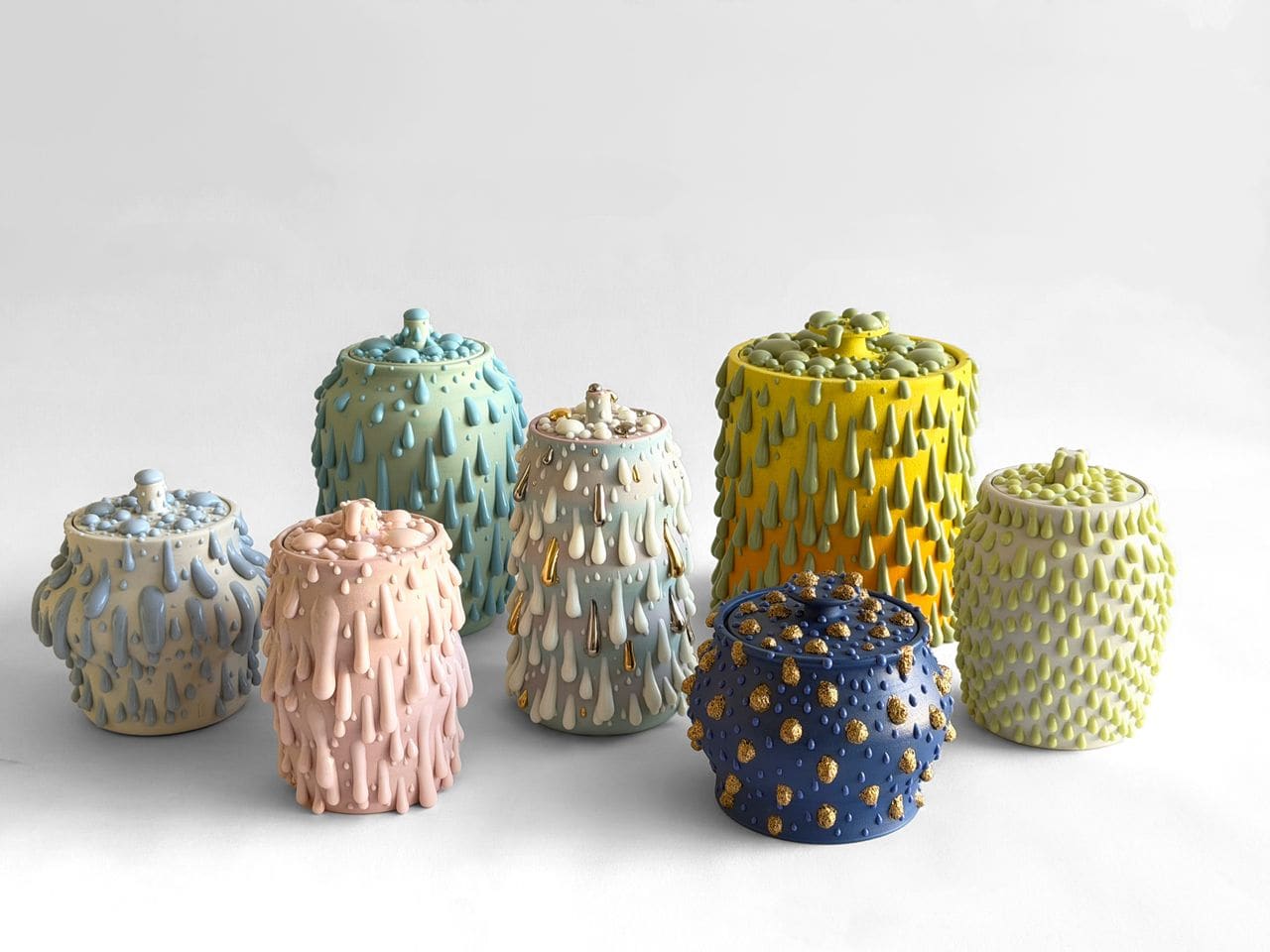
Urn Studios selected its collaborators not for stylistic uniformity but for their distinct material sensibilities and willingness to challenge convention. The roster includes Philip Kupferschmidt, whose California practice produces vessels punctuated by raised droplets and richly layered glazes that invite touch. Brooklyn-based Michelle Wen mines historical ceramic traditions, reinterpreting ancient forms through a contemporary lens. Hui-Yong Kim takes a sculptural, reductive approach, stripping away ornament to reveal essential geometries.
Marianna Jamadi of Kunokaiku designed a minimalist piece that integrates spaces for both candles and flowers, transforming the urn from a static container into a dynamic element of domestic ritual. Abbey Peters, C.C. Boyce, and Jesse Hamerman round out the group, each bringing their own formal preoccupations to the brief. What unites these disparate practices is less a shared aesthetic than a collective willingness to depart from the visual codes that have long dominated memorial design.
The collection intentionally embraces eclecticism. Bold handles jut from surfaces. Silhouettes veer away from the classical urn profile. Irregular textures disrupt smooth finishes. These are not objects designed to disappear into the background of a mantelpiece; they assert presence, character, even personality.
Material Strategies and Formal Risks
At World Archi Design, we have long argued that the most compelling design work emerges when practitioners are willing to question inherited typologies. The Urn Studios commission demonstrates this principle in action. Rather than asking artists to soften their formal languages for a sensitive context, the platform encouraged them to bring their full aesthetic vocabularies to bear.
Kupferschmidt's tactile glazes, for instance, read as descendants of mid-century studio pottery, where surface treatment became a site of expressive possibility. His raised droplets create a haptic quality that invites interaction, a meaningful consideration for an object that may be handled during moments of reflection or ritual. Wen's engagement with historical ceramic traditions operates differently, situating contemporary loss within a longer continuum of material culture. Her work suggests that grief is not a rupture but a thread that connects us across time.
Kim's pared-back sculptural forms offer yet another approach. By reducing the vessel to its essential volumetric presence, he creates objects that resist easy categorization. Are they containers? Sculptures? Monuments? This productive ambiguity allows them to occupy domestic space in ways that conventional urns cannot, functioning equally as artworks and as repositories of memory.
Beyond Visual Restraint
One of the more provocative claims Urn Studios advances is that emotional sensitivity and bold design need not exist in opposition. This runs counter to decades of funeral industry orthodoxy, which has equated visual restraint with respect for the dead. According to Urn Studios, this equation is both culturally constructed and unnecessarily limiting. Boldness, color, and formal exuberance can be just as respectful, just as meaningful, as muted tones and classical proportions.
This argument has precedent in other design contexts. Consider the evolution of children's hospitals, which have increasingly embraced bright colors and playful forms as tools of healing rather than frivolity. Or the shift in healthcare design more broadly, where sterile white environments have given way to biophilic strategies and warm material palettes. In each case, designers have demonstrated that emotional care is compatible with visual vitality.
The question, then, is why memorial design has been so slow to follow suit. Part of the answer lies in industry inertia. Funeral providers have little incentive to expand their offerings when conventional products continue to sell. But part also lies in public awareness. Many people simply do not know that alternatives exist. They default to what is presented because they assume it represents the full range of available options.
Expanding the Spectrum of Choice
By commissioning work from artists outside the traditional funeral supply chain, Urn Studios is attempting to shift both supply and demand. The platform operates on the premise that if people are exposed to a wider range of memorial objects, their understanding of what is appropriate or desirable will expand accordingly. This is not about imposing a new aesthetic orthodoxy but about broadening the field of possibility.
The studio plans to deepen this effort by developing its first in-house collection, which will sit alongside commissioned artist pieces. This dual strategy allows the platform to offer both unique, limited-edition works and more accessible options produced at scale. Together, these collections aim to serve a spectrum of tastes, budgets, and approaches to remembrance.
There is something quietly radical about treating the urn as a site of creative experimentation. Memorial objects have historically been conservative by design, their visual codes calibrated to communicate continuity, tradition, and permanence. By inviting contemporary artists to reimagine these forms, Urn Studios suggests that permanence need not look like stasis. Memory, after all, is not static. It evolves, deepens, and changes texture over time. Perhaps the objects we use to hold it should reflect that dynamism.
Precedents and Parallels
This approach recalls earlier moments when designers challenged the visual norms of emotionally charged contexts. In the 1960s, architects like Aldo van Eyck reimagined orphanages and playgrounds, rejecting institutional austerity in favor of warmth and human scale. More recently, studios like Studio Gang and MASS Design Group have brought rigorous formal thinking to community-focused projects, demonstrating that social sensitivity and architectural ambition can coexist.
Within product design, similar shifts have occurred. The medical device industry, once dominated by utilitarian objects in beige plastic, has increasingly embraced user-centered design that acknowledges aesthetics as part of functionality. Prosthetics, hearing aids, and even insulin pumps have become sites of formal innovation. The message is clear: objects that touch our most vulnerable moments deserve thoughtful design.
Urn Studios extends this logic to memorial objects, arguing that the vessels we use to honor the dead should be as varied, as personal, and as expressive as the lives they commemorate. This is not about novelty for its own sake but about creating space for individual stories within a cultural practice that has long defaulted to uniformity.
The Domestic Life of Memorial Objects
One underexplored dimension of this work is how these objects inhabit domestic space. Traditional urns are often designed to be discreet, tucked away on a shelf or in a cabinet. The Urn Studios collection, by contrast, produces pieces that can function as focal points, objects around which other elements of a room might be organized. Jamadi's candle-and-flower integration is particularly notable in this regard, transforming the urn into a living altar that evolves with the seasons and occasions.
This shift has implications for how we think about the relationship between the living and the dead. Rather than sequestering memorial objects in separate, sanctified spaces, these designs suggest they can be woven into the fabric of everyday life. An urn on a dining room shelf, a cremation vessel on a bedside table, these placements signal that remembrance need not be confined to cemeteries or formal occasions. It can be an ongoing, ambient presence.
Looking Forward
As Urn Studios expands its roster of collaborators and develops its in-house line, the platform faces the challenge of maintaining its curatorial vision while scaling its operations. The risk in any such expansion is dilution, the softening of a sharp idea into something more palatable and less distinct. Yet the studio's commitment to eclecticism may serve as a safeguard. By refusing to settle on a house style, it preserves space for multiple voices and approaches.
The US collection represents a test case for this model. If it succeeds, it will demonstrate that there is market demand for memorial objects that break from convention, that people are willing to choose vessels that reflect personal aesthetics rather than industry defaults. That success would, in turn, create pressure on larger funeral providers to diversify their offerings, potentially shifting the visual landscape of an entire industry.
Whether that shift materializes remains to be seen. But the collection itself stands as proof that the tools already exist. The artists are there. The materials are there. The formal vocabularies are there. What has been missing is not capability but permission, the cultural authorization to treat memorial objects as sites of creative possibility rather than somber obligation. Urn Studios is making the case that such permission has always been ours to grant.
Save this story. A free account keeps your reading list and the 07:00 email in one place.
CREATE FREE ACCOUNT →SIGN IN