
The Negotiation of Space
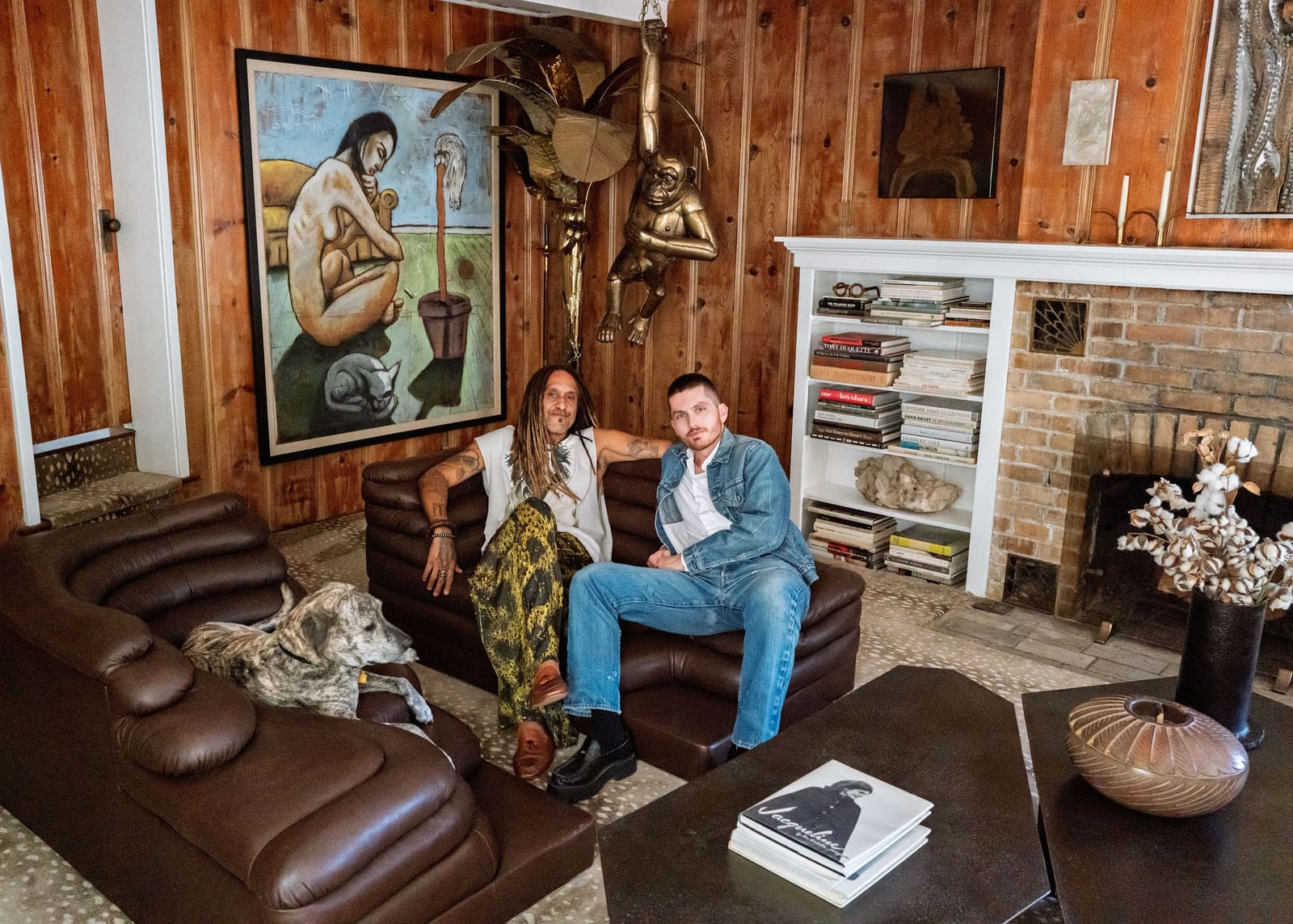
The most revealing artefact in Harrison Soll and Rodney Burns's Laurel Canyon home may not be any single piece of furniture but rather the story behind a single flooring decision. The doe-patterned wall-to-wall carpet that now anchors their living room required multiple dinner conversations before both parties reached consensus. Soll, who gravitates toward spare interiors, installed it without prior approval from Burns, a self-described maximalist. The risk paid off, though it took time. This minor domestic drama encapsulates a broader question: how do two people with fundamentally different visual languages share the same four walls?
The answer, as their 1920s Craftsman demonstrates, lies not in compromise but in establishing zones of influence and learning when to cede territory. The result is a home that oscillates between restraint and exuberance, where a midcentury desk occupies one room and a brass Maison Jansen palm tree commands another.
Material Choices and the Renter's Paradox
Operating within the constraints of a rental agreement sharpens decision-making. Soll secured permission to retile one bathroom and install a new vanity, but most interventions had to be reversible or persuasive enough to win over the landladies. The carpet gambit succeeded on the latter count. The owners approved it after installation, a testament to either the strength of the design or Soll's powers of persuasion.
This dynamic between permanence and impermanence shapes the home's material palette. The living room pairs a reupholstered Joseph D'Urso sofa for Knoll, now clad in leopard fabric, with a leather De Sede Terrazza. Both pieces carry modernist pedigrees but diverge in texture and visual weight. The leopard print, a bold move in a rental context, signals confidence in pattern as a grounding element rather than an accent. The Antilocarpa carpet from Stark reinforces this approach, layering animal motifs in a way that could easily tip into kitsch but instead reads as deliberate.
Zoning by Aesthetic Temperament
Certain rooms function as concessions to Soll's minimalist inclinations. An office features a midcentury desk paired with a 1970s tapestry, the latter providing warmth without clutter. The dining room follows a similar logic: a Sergio Bustamante table and a Chinese Art Deco rug anchor the space, with little else competing for attention. These rooms demonstrate that minimalism, in this context, is not about absence but about clarity of focus.
Elsewhere, Burns's maximalist tendencies hold sway. A trio of fibreglass shell artworks sourced through Kelly Wearstler punctuates one wall, while a manipulated canvas garment bag by Roosevelt "Rip" Woods, the first Black artist to mount a solo exhibition at the Phoenix Art Museum, occupies another. The juxtaposition of high-design sourcing and art-historical significance suggests a collecting strategy rooted in narrative as much as form. A brass Maison Jansen palm tree and a Sergio Bustamante monkey sculpture share a corner, two theatrical gestures that would overwhelm a more austere interior but thrive in a room that welcomes density.
Learning Restraint Through Collaboration
Burns credits Soll with teaching him to pause before acquiring another object, to question whether a piece earns its place or merely fills a gap. This is not the language of conversion, minimalist evangelism winning over a maximalist soul, but rather the outcome of sustained negotiation. Soll's influence manifests not in the elimination of objects but in their curation, a shift from accumulation to selection.
The reverse influence is harder to quantify but equally present. A minimalist living alone might never choose leopard upholstery or doe-patterned carpeting. Soll's willingness to embrace pattern and texture suggests that proximity to a maximalist sensibility can expand, rather than dilute, a restrained aesthetic. The two approaches do not cancel each other out; they establish a productive tension.
Precedents in Domestic Hybridity
The Soll-Burns interior recalls other domestic spaces where opposing design philosophies coexist. Charles and Ray Eames's own home in Pacific Palisades layered folk art, textiles, and found objects within a rigorously modernist steel-frame structure. The collision of systems, rather than their synthesis, generated the spatial interest. Similarly, the Memphis Group's domestic interiors in 1980s Milan embraced contradiction, pairing functionalist furniture with exuberant surface decoration.
What distinguishes the Laurel Canyon Craftsman is its lack of a unifying theoretical framework. Soll and Burns are not advancing a manifesto but negotiating daily life. The home's coherence emerges not from a predetermined style but from the iterative process of living together, object by object, room by room.
The Craftsman as Container
The 1920s Craftsman typology, with its emphasis on natural materials, built-in cabinetry, and human-scaled rooms, provides a forgiving container for this aesthetic experiment. The architecture's inherent warmth and detail absorb both minimalist gestures and maximalist flourishes without protest. A more austere modernist box might resist the layering; a more ornate period interior might compete with it. The Craftsman's vernacular solidity allows the interior to remain the primary event.
This is not to suggest that the architecture recedes entirely. The home's original woodwork and proportions establish a baseline that both designers respect. Their interventions read as inhabitation rather than transformation, a distinction that matters in rental contexts but also in broader discussions of adaptive reuse and domestic stewardship.
What Remains Unresolved
Not every tension in the home has been resolved, nor should it be. The ongoing conversation between minimalism and maximalism is the engine that keeps the interior alive. A space that fully reconciles opposing forces risks becoming static. The Soll-Burns home retains a sense of negotiation in progress, rooms that might shift as tastes evolve or as one partner wins another round of dinner-table debate.
The carpet, after all, was an "ask for forgiveness" move. The next intervention might require advance approval. The balance is not fixed but dynamic, a reflection of two people learning to see through each other's eyes without abandoning their own vision.
Save this story. A free account keeps your reading list and the 07:00 email in one place.
CREATE FREE ACCOUNT →SIGN IN