
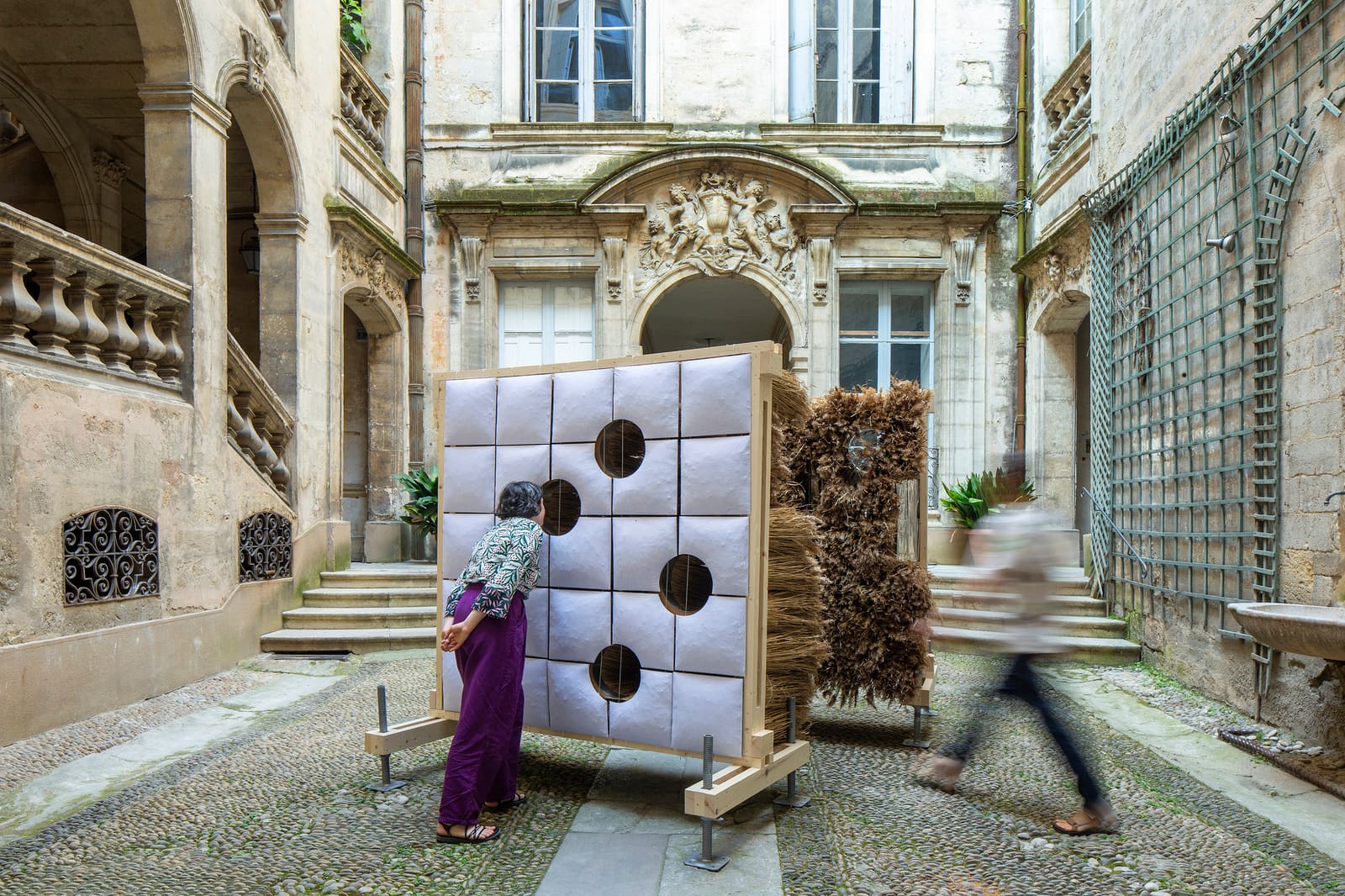
The Overlooked Material
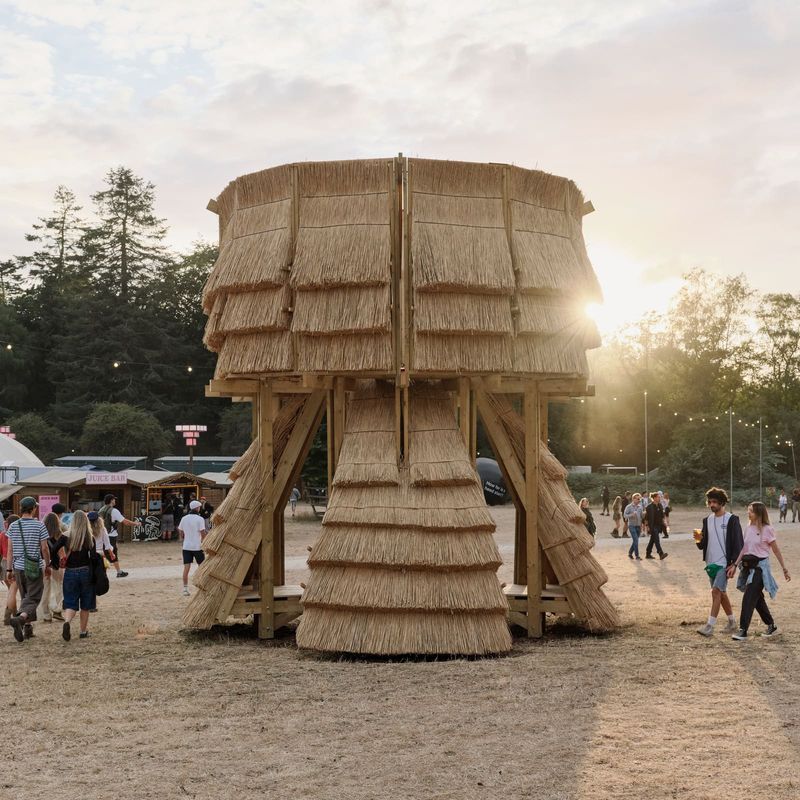
Reed grass occupies an odd position in contemporary construction. Too coarse for interiors, too fragile for structure, too tied to rural tradition for urban contexts - it exists at the periphery of the material palette most architects consider. Yet COAT, the Paris-based practice led by Julia Fraolini and Felix Steinbacher, selected this very material as the sole protagonist for their 2025 contribution to Montpellier's Festival des Architectures Vives.
The installation, realised within a modest ten square metres, asks a question we've been tracking at World Archi Design for some time: when does a material cease to be merely cladding and begin to shape atmosphere itself?
Craft as Spatial Logic
COAT's approach is grounded in what they term "conditions atmosphériques d'espaces" - atmospheric conditions of space. Here, that translates into an understanding of how light, air movement, and texture converge through a single vegetal element. Reed grass, when bundled and oriented with intention, behaves as filter, screen, and luminous medium simultaneously.
The pavilion's form emerges not from imposed geometry but from the inherent properties of the material. Bundled reeds create vertical striations that modulate daylight into soft, oscillating bands. As visitors move through the installation, shifts in density reveal shifting degrees of enclosure - never fully opaque, never entirely transparent. This deliberate ambiguity recalls the fenestration strategies of Kengo Kuma's bamboo projects, though COAT's work is less about framing views than about dissolving the boundary between inside and atmospheric surround.
The construction logic is straightforward. Reeds are harvested locally, bundled into uniform sections, and anchored into a minimal armature. No adhesives, no synthetic binders - only compression and repetition hold the assembly together. This technique draws on vernacular thatching methods common to Mediterranean and northern European building traditions, yet the spatial outcome diverges sharply from the pitched-roof typology those methods typically serve.
Temporality and Material Honesty
Ephemeral installations occupy a curious territory in architectural discourse. Freed from the performance requirements of permanent structures - weatherproofing, code compliance, long-term durability - they permit a kind of material candour rarely feasible in commissioned work. COAT leverages this freedom not to indulge in spectacle but to foreground process and degradation.
Reed grass will dry, bleach, and eventually fragment. The installation's lifespan is measured in weeks, not decades. This temporal constraint becomes a design parameter. The pavilion does not aspire to permanence; it acknowledges its own obsolescence as part of its conceptual structure. In this sense, the work aligns more closely with land art practices - think Andy Goldsworthy's woven willow sculptures - than with conventional pavilion design.
Yet unlike Goldsworthy's work, which often exists in remote landscapes, COAT's installation is urban, embedded within Montpellier's historic fabric. The juxtaposition is deliberate. Visitors encounter a material typically associated with wetlands and agricultural zones within a dense, stone-built courtyard. The cognitive dissonance heightens awareness of the material's origins and its transformation through craft.
Sensory Calibration
One of the pavilion's most effective qualities is its acoustic behaviour. Reed bundles, when arranged in depth, absorb and diffuse sound in ways that hard surfaces cannot. Conversations within the installation take on a muted, intimate quality, as though the space itself is listening. This acoustic softness contrasts sharply with the reverberant stone surrounds of the festival site, creating a pocket of sensory refuge.
Thermal performance, though not quantified, is perceptible. On warm days, the reed assembly provides measurable shade and allows air to pass through, preventing heat buildup. The material's porosity becomes a passive climate-regulating device, a principle familiar to vernacular builders but often forgotten in contemporary practice.
Haptic engagement is equally significant. Visitors are invited to touch the reeds, to feel the variation in diameter and surface texture. This tactile dimension reinforces the material's organic origin and its divergence from industrially processed finishes. In an era where much architecture is designed to be viewed but not handled, COAT's installation reclaims touch as a valid mode of architectural experience.
Precedents and Divergences
COAT's work can be situated within a broader lineage of material-focused temporary installations. Anna Heringer's mud and bamboo structures share a commitment to low-embodied-energy materials and local craft. Diébédo Francis Kéré's Serpentine Pavilion in 2017, with its timber lattice and open-air assembly, similarly explored how modular repetition of natural elements can generate complex spatial effects.
Yet COAT's installation diverges in scale and ambition. Where Kéré's pavilion was a public gathering space, designed for crowds and events, Chaume Sublimé is introspective, almost monastic. It accommodates only a handful of visitors at a time, prioritising intimacy over spectacle. This shift in scale reflects a different set of priorities: not the democratisation of public space but the calibration of individual sensory experience.
The work also resonates with the recent surge in bio-based material experimentation - mycelium panels, hemp composites, algae-based plastics. But COAT's use of reed grass is notable for its simplicity. There is no laboratory phase, no proprietary process, no patent. The material is harvested, bundled, and assembled. This directness is both its strength and its limitation. It cannot be scaled, cannot be industrialised, cannot be replicated without the specific ecological and craft conditions that made it possible in the first place.
The Festival Context
Montpellier's Festival des Architectures Vives has, over its two-decade history, become a testing ground for architectural ideas that resist conventional building typologies. The festival's format - inviting architects to intervene in historic courtyards - encourages site-specific, materially experimental work. COAT's installation fits this brief precisely, yet it also challenges the festival's tendency towards visual spectacle.
Many previous entries have relied on bold colour, dramatic form, or digital fabrication to capture attention. COAT's pavilion is subdued, almost self-effacing. Its impact is cumulative rather than immediate, requiring time and proximity to fully register. This restraint is a deliberate editorial stance, one that privileges atmosphere over image, duration over instant legibility.
What Persists
When the festival concludes, the installation will be disassembled. The reeds will return to the landscape, composted or repurposed. No physical trace will remain. Yet the project's contribution lies not in its material persistence but in its demonstration of how architecture can operate with minimal means and maximal sensory intelligence.
At World Archi Design, we've observed a growing interest in what might be called "post-permanent" architecture - structures designed to exist briefly, to leave no footprint, to resist the extractive logic of conventional construction. COAT's work exemplifies this shift. It does not propose a universal solution or a scalable model. Instead, it offers a localised, temporally bounded experiment in how materials, when handled with precision and respect, can generate experiences that far exceed their humble origins.
The question the installation leaves behind is not whether reed grass can replace steel and concrete, but whether the architectural discipline is willing to value projects that cannot be photographed into immortality, that exist only in memory and sensation. If the answer is yes, then work like COAT's becomes not an exception but a precedent - a reminder that architecture's most enduring contributions are not always the ones that endure.
Save this story. A free account keeps your reading list and the 07:00 email in one place.
CREATE FREE ACCOUNT →SIGN IN