
The Calendar as Conceptual Framework
At World Archi Design, we've been tracking how fairs increasingly function not merely as commercial platforms but as instruments of narrative architecture. The decision to bifurcate a single brand into two seasonal identities reflects something more ambitious than rebranding: it's an attempt to encode tempo and character into the event structure itself. When the September edition introduces a distinct name and thematic direction while the January iteration retains its focus on established craft, the fair is essentially arguing that time of year can carry conceptual weight.
The September 2026 edition, scheduled from 10 to 14 September at Paris Nord Villepinte, introduces a framework centered on rhythm and movement as organizing principles. Rather than positioning this as a break from three decades of programming, the organizers frame it as an evolution that preserves institutional memory while responding to shifts in how the design sector operates. The distinction between the two annual moments becomes taxonomic: January addresses legacy, September addresses emergence.
This structural logic aligns with how design education increasingly differentiates between iterative refinement and speculative exploration. The fair is adopting a pedagogical model, treating its calendar as a syllabus that alternates between consolidation and risk.
Masquespacio and the Question of Ambassadorship
The selection of Masquespacio to shape the September edition's visual and conceptual direction is revealing. The Valencia-based studio, founded by Ana Milena Hernández Palacios and Christophe Penasse, has built a practice around chromatically saturated environments that borrow from Memphis Group aesthetics, postmodern irony, and Mediterranean vernacular. Their work operates at the intersection of interior architecture, product design, and branding, often for hospitality and retail clients seeking experiential differentiation.
What makes their involvement significant is not novelty but continuity. Masquespacio's design language is immediately recognizable, almost to the point of brand consistency across projects. This creates a productive tension: a fair organized around the concept of pulse selects a studio whose work is defined by formal coherence and chromatic signature. The choice suggests that rhythm, in this context, is less about disruption and more about sustained energy, a controlled intensity that can be maintained across diverse applications.
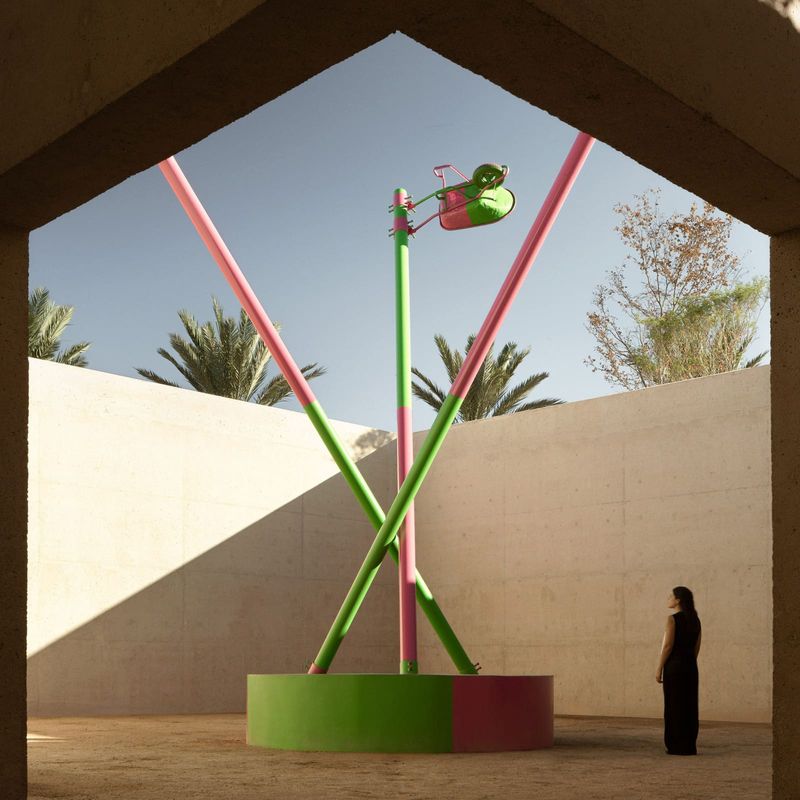
Their installation at Villepinte will likely deploy their characteristic palette of ochre, terracotta, cobalt, and mint alongside geometric forms that reference both industrial production and craft traditions. The question is whether the installation will function as scenography or as a spatial argument about how repetition and variation can coexist within a single aesthetic system.
Design District and the Curation of Emergence
The Design District, positioned within Hall 5A, continues under the direction of Hall Haus, a collective founded by Abdoulaye Niang, Sammy Bernoussi, Teddy Sanches, and Zakari Boukhari. Hall Haus emerged from Paris's evolving design culture, which increasingly foregrounds Afro-diasporic and multicultural perspectives that had been underrepresented in European design discourse. Their curatorial approach emphasizes scenographic cohesion, treating the district not as a series of booths but as a unified spatial narrative.
The Future On Stage program, now in its seventh edition, functions as an accelerator mechanism within the fair structure. Three emerging studios are selected by jury to present work that demonstrates material innovation, environmental responsibility, and what the organizers term "the pursuit of emotion." This last criterion is worth examining. Emotion in design discourse often serves as shorthand for user experience or affective resonance, but it can also signal a move away from purely rational or functionalist evaluation frameworks. The inclusion of emotion as a selection criterion suggests the jury is looking for work that operates on sensory and psychological registers, not just technical or formal ones.
The Rising Talent Awards this year focus on South Africa, specifically Cape Town, Johannesburg, and Durban. South African design has been gaining visibility in European contexts over the past decade, particularly work that engages with indigenous craft traditions, post-apartheid social dynamics, and the material realities of resource scarcity. Studios like Dokter and Misses, Cheick Diallo, and Haldane Martin have demonstrated how regional specificity can inform globally legible design languages. The partnership with Decorex Africa positions the fair as a conduit for cross-continental exchange, though the effectiveness of such programs depends heavily on how follow-up support and market access are structured beyond the fair itself.
Paris Design Week and the Urban Fabric as Exhibition Space
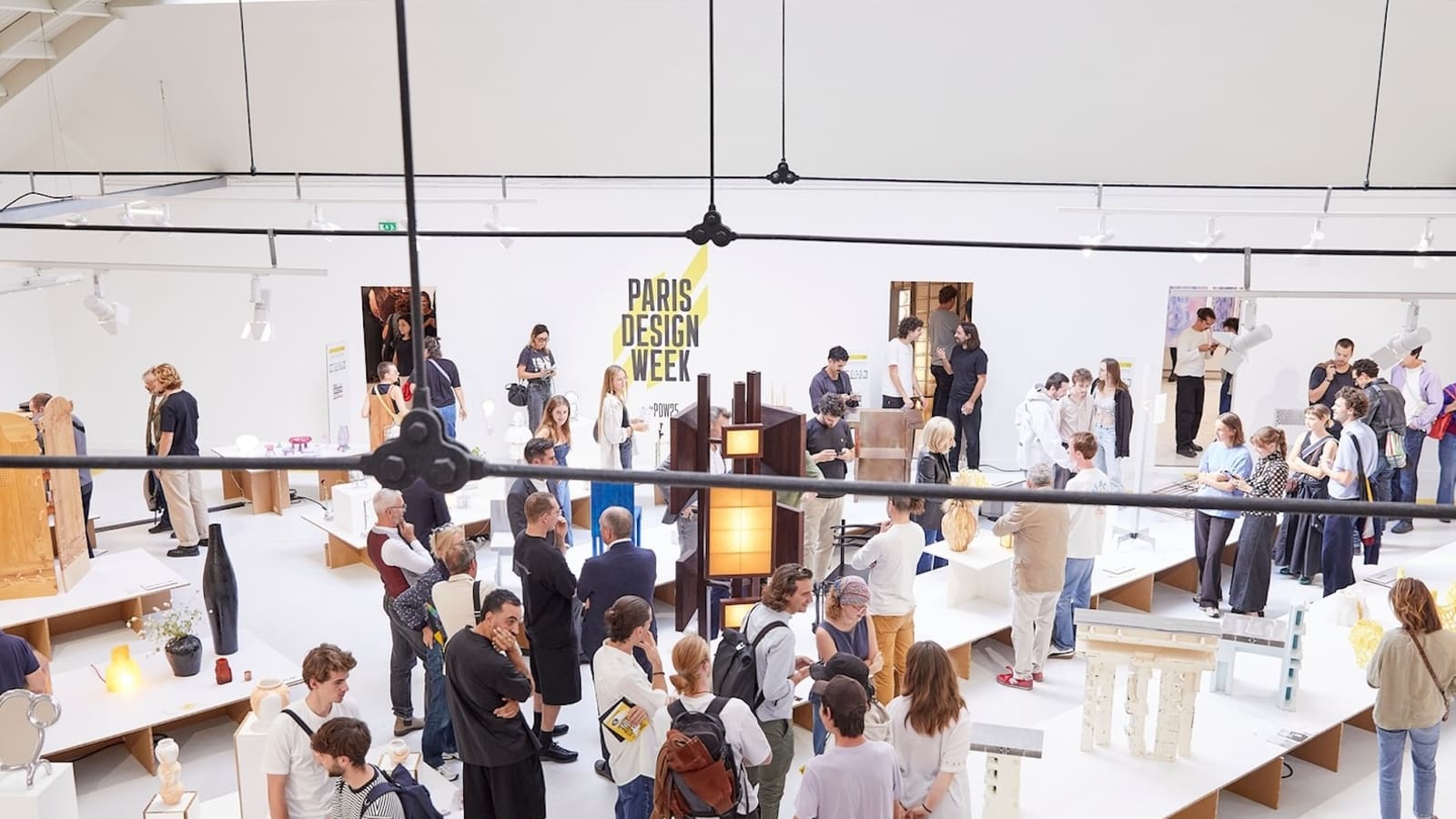
Running concurrently from 10 to 19 September, Paris Design Week transforms the city into a distributed exhibition, activating courtyards, galleries, showrooms, and institutional spaces across multiple arrondissements. The Design Sur Cour program brings installations into historically significant sites including the Grand Palais, Hôtel de Sully, Hôtel de la Marine, Musée Bourdelle, and the French National Archives. This strategy of embedding contemporary design within heritage architecture creates immediate juxtaposition, forcing dialogue between historical materiality and current production.
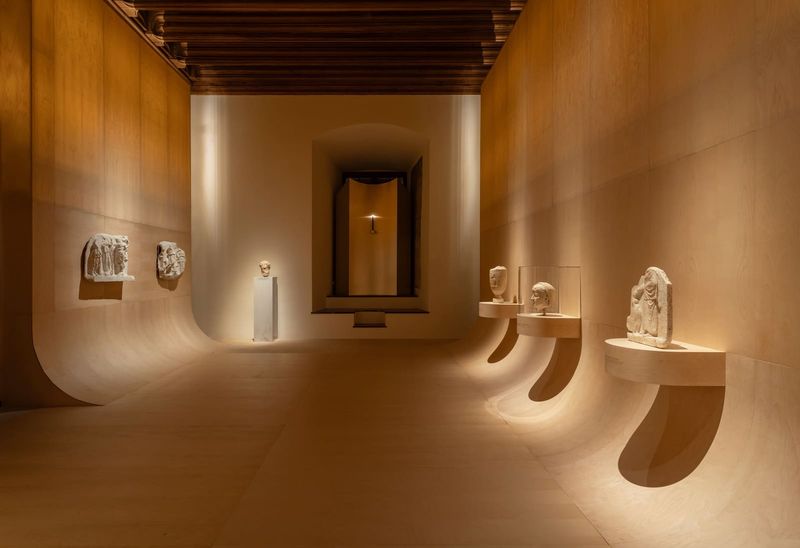
One notable intervention is the Musée Bourdelle installation, which engages directly with the museum's permanent collection of sculpture by Antoine Bourdelle. The project explores light, wood, textiles, glass, and clay as materials that can resonate with early 20th-century figuration. Collaborations with Atelier Toporkoff, Atelier Monier, La Chance, Atelier Tissages de Charlieu, and Fornace Brioni suggest a multi-disciplinary approach that treats craft lineage as active rather than archival.
La Re-prise de la Bastille, developed by Studio 5.5 in collaboration with Refashion, stages a monumental installation at Place de la Bastille using reclaimed textiles. Claire Renard and Jean-Sébastien Blanc, the studio's co-founders, are known for projects that integrate industrial design with social commentary. The installation around the July Column reframes textile waste as both material resource and symbolic gesture, linking revolutionary history with contemporary debates around circular economy and fashion industry accountability. The choice of site is deliberate: Place de la Bastille carries layered associations with popular uprising, political transformation, and collective memory. Using textile waste in this context transforms the column into a site of critique about consumption, labor, and environmental impact.
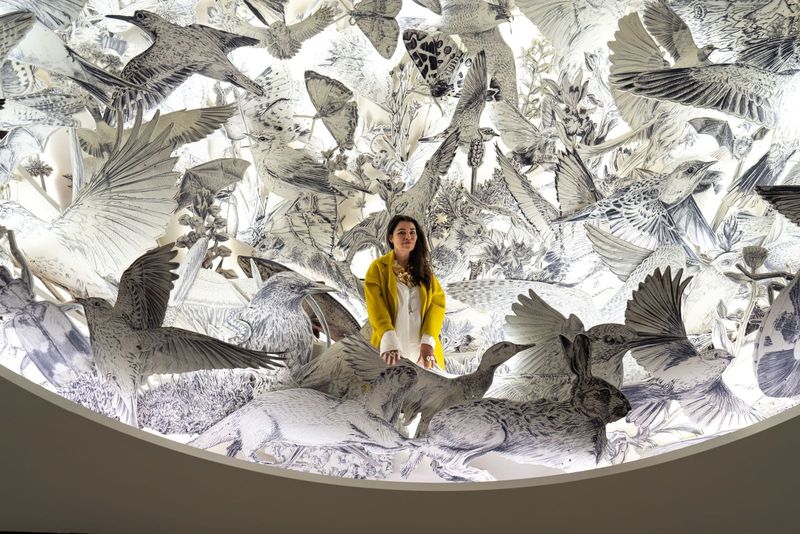
Jeremy Pradier-Jeauneau's La Tempête at the Arc de Triomphe offers a different mode of intervention. Rather than adding objects to the site, the project reimagines the experience of ascending the monument, using immersive techniques to foreground the architecture's spatial and historical dimensions. This approach aligns with trends in experiential design that prioritize phenomenological engagement over object production.
The Factory: A Curatorial Model for Emerging Practice
The Factory, curated by Jean-Baptiste Durand and Simon Géringer, operates across four locations in Le Marais: Espace Commines, 116 rue de Turenne, 16 rue des Minimes, and 10 rue de Turenne. Each site addresses a different stage of design development. Espace Commines and 116 rue de Turenne feature site-specific scenography that integrates emerging work into curated spatial narratives. This model treats the exhibition itself as a design object, where relationships between pieces are as important as individual works.
At 16 rue des Minimes, the focus shifts to production processes, displaying prototypes alongside finished objects. This transparency about iteration and refinement offers insight into how design moves from concept to market, a dimension often obscured in polished fair presentations. The 10 rue de Turenne location hosts the China Creative Pavilion with an exhibition titled BON GOÛT! GOOD TASTE!, exploring intersections between gustatory and aesthetic taste across cultural contexts. The project positions Chinese contemporary design within a framework of sensory experience and gastronomy, challenging Western-centric narratives about design evolution.
The Factory's distributed structure allows for differentiation within a single curatorial vision, a model that acknowledges how emerging designers often operate across multiple scales and contexts simultaneously. By spreading the program across Le Marais, the curators also tap into the neighborhood's density of galleries, boutiques, and cultural institutions, creating opportunities for accidental discovery and cross-pollination.
Rhythm as Organizational Principle
The concept of pulse that structures the September edition is more than metaphor. In architectural and design discourse, rhythm refers to the repetition and variation of elements across time or space. It's a way of organizing complexity without imposing rigid hierarchy. By framing the fair around rhythm and motion, the organizers are proposing that design's value lies not in static perfection but in its capacity to adapt, respond, and evolve.
This approach reflects broader shifts in how the design economy operates. With shorter product cycles, increased emphasis on sustainability and circularity, and growing demand for customization, the industry increasingly values flexibility and responsiveness over monolithic stability. A fair that positions itself as a platform for experimentation and dialogue, rather than a showcase of finished solutions, aligns with these dynamics.
The challenge, of course, is whether the concept of pulse can be sustained beyond a single edition's theme. If rhythm is genuinely central to the fair's identity, it will need to manifest in how programming evolves year to year, how emerging talent is supported beyond initial exposure, and how the fair mediates between commercial imperatives and curatorial ambition. The success of this reframing will be measured not in September 2026 alone but in how the fair's dual structure develops over the next several cycles, and whether the distinction between September and January remains conceptually meaningful or collapses back into logistical convenience.
At a moment when design fairs face pressure from digital platforms, direct-to-consumer models, and questions about their environmental footprint, the decision to invest in conceptual differentiation and urban integration represents a bet that physical gathering still offers something irreplaceable. Whether that bet pays off depends on execution, but the ambition to treat the fair itself as a designed system, with rhythm and renewal as its organizing logic, is a direction worth watching.
Save this story. A free account keeps your reading list and the 07:00 email in one place.
CREATE FREE ACCOUNT →SIGN IN