
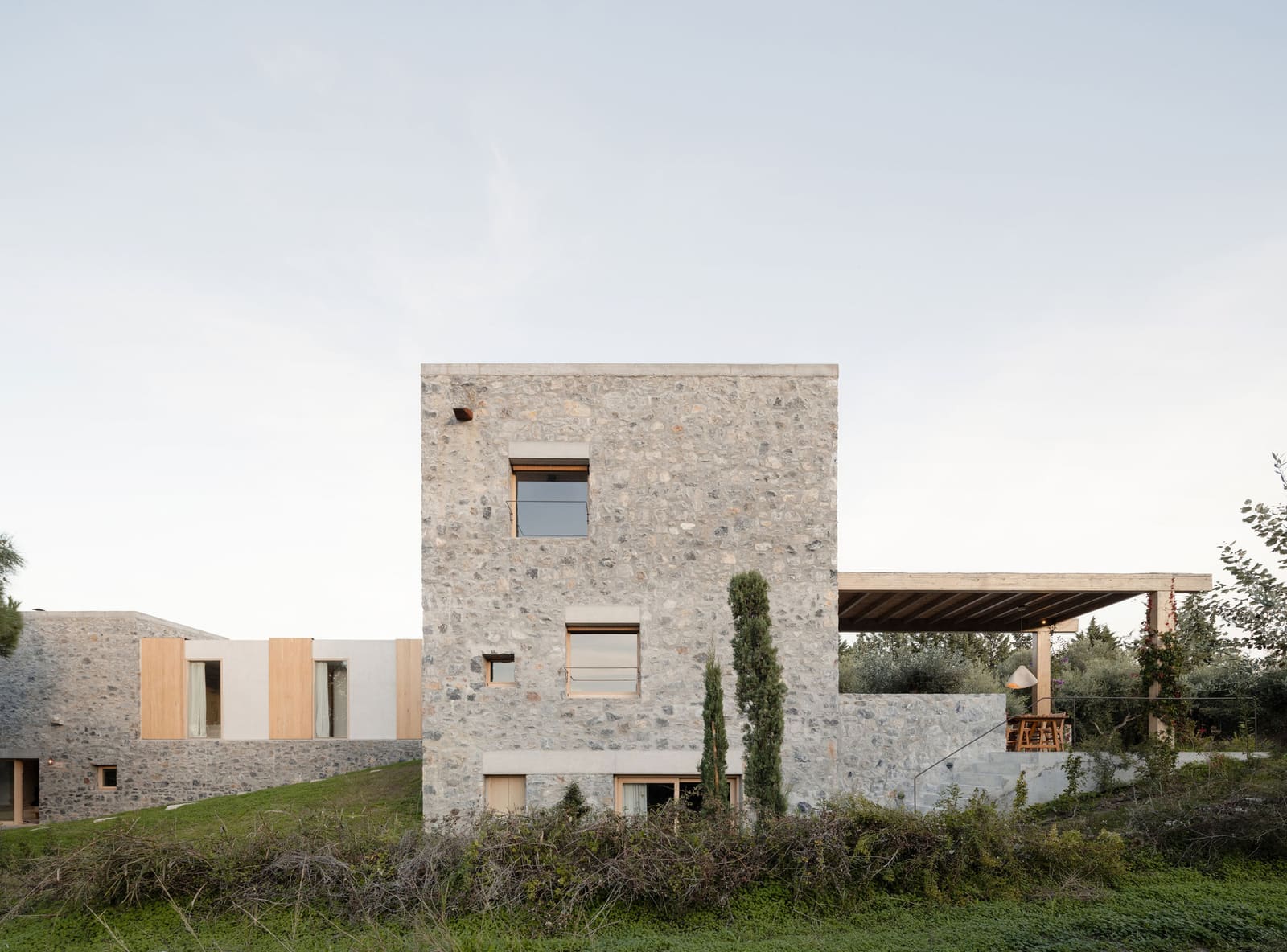
The Vernacular as Starting Point
There is a particular kind of restraint embedded in the rural stone houses of Chalkidiki, a quietness that emerges not from minimalism but from necessity. These structures, built over generations from local materials and shaped by the demands of climate and terrain, carry within them a logic that contemporary architecture often overlooks in its pursuit of novelty. Treelithon, completed in 2025 by Athens-based Not a Number Architects, begins with this vernacular typology and asks a different question: how might we honor that logic without replicating its form?
Ermis Adamantidis and Dominiki Dadatsi, the lead architects behind the project, approached the 200-square-meter retreat as an exercise in spatial negotiation. The site itself presented a compelling set of constraints: a long, narrow plot descending in a gentle gradient, punctuated by mature pines and olive trees that predate any human intervention on the land. Rather than clearing the canopy or imposing a singular geometric gesture, the design threads itself through the existing landscape, allowing the architecture to emerge as a series of calibrated responses to topography, light, and the presence of the trees themselves.
Massing and the Language of Stone
The parti here is deceptively simple: a linear composition that follows the slope, broken into discrete volumes that read as both unified and fragmented. This duality is critical. By articulating the mass as a sequence of stone-clad pavilions rather than a monolithic block, Not a Number Architects creates a rhythm that echoes the traditional settlement patterns of the region, where individual structures cluster organically rather than aligning to a grid.
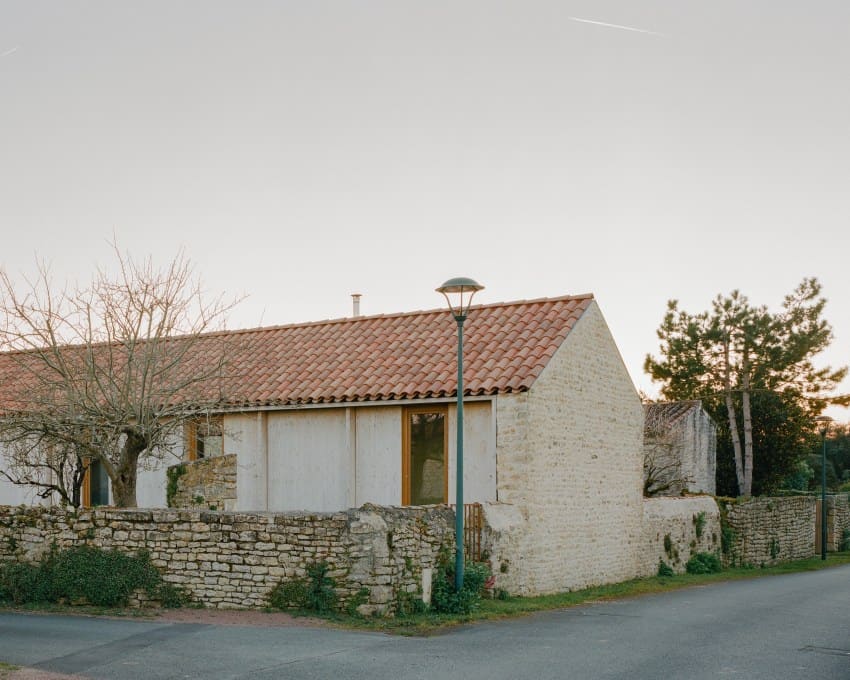
Stone, naturally, is the primary material, sourced locally and employed in a manner that bridges tectonic honesty with contemporary detailing. The walls read as load-bearing, their thickness and texture recalling the masonry traditions of the area, yet the joinery and fenestration reveal a precision that belongs firmly to the present. Windows are cut as sharp voids, their frames recessed to emphasize the depth of the wall, creating a play of shadow that shifts throughout the day. This is not pastiche; it is a selective engagement with precedent, one that understands the difference between mimicry and continuation.
Spatial Sequence and the Descent
Movement through Treelithon is shaped by the topography. The entrance sits at the higher elevation, where the land is most compressed between trees. From here, the interior unfolds as a gradual descent, each room stepping down in response to the slope. This sequential logic, familiar to anyone who has studied the hill towns of the Mediterranean, creates a sense of procession without formality. You are always aware of where you have been and where you are going, yet the transitions feel organic rather than choreographed.
The living spaces occupy the central volume, where ceiling heights expand and the relationship to the canopy becomes most intimate. Here, large openings frame views of the surrounding pines and olives, transforming the trees into compositional elements rather than mere context. The effect is biophilic in the truest sense: not a superficial application of greenery, but a fundamental reorganization of the interior around the presence of the landscape.
Material Continuity and Thermal Strategy
Beyond its aesthetic role, the stone mass serves a pragmatic function rooted in the climate of Halkidiki. The region experiences hot, dry summers and mild, wet winters, a pattern that demands thermal mass and careful solar orientation. The thick stone walls act as a buffer, absorbing heat during the day and releasing it slowly at night, a passive strategy that reduces reliance on mechanical systems. This is adaptive design in the sense that it adapts not to a stylistic trend but to the environmental realities of the site.
Timber appears as a secondary material, most notably in the ceiling planes and in the detailing of interior partitions. The choice is both practical and symbolic: oak and pine, locally available, bring warmth to the interiors and establish a material dialogue between the built and the natural. The grain of the wood, left visible, contrasts with the rough texture of the stone, creating a haptic richness that invites touch as much as sight.
Precedent and Divergence
It is worth situating Treelithon within a broader conversation about contemporary Greek architecture. In recent years, practices such as K-Studio and Mold Architects have explored similar terrain, reinterpreting vernacular typologies through the lens of modernist clarity and environmental responsiveness. What distinguishes Not a Number Architects' approach is its emphasis on fragmentation over consolidation. Where others might have pursued a single, continuous volume, Adamantidis and Dadatsi break the mass into parts, allowing the landscape to infiltrate the composition rather than holding it at bay.
This strategy recalls, in some respects, the work of Portuguese architect Eduardo Souto de Moura, particularly his early houses in the north of Portugal, where stone walls and timber roofs engage the topography through a series of terraced platforms. The difference lies in scale and density: Treelithon is more compact, more tightly woven into its canopy, and therefore more reliant on the interplay between interior and immediate exterior.
The Question of Context
One of the recurring challenges in designing countryside retreats is the tension between retreat and engagement. A house in the landscape can either withdraw, asserting its autonomy through formal contrast, or it can embed itself, seeking continuity with its surroundings. Treelithon opts for the latter, but with a critical caveat: it does not disappear. The stone volumes are assertive, their geometry clear, their presence unmistakable. Yet they belong. This balance, between visibility and integration, is difficult to achieve and rarer still to sustain across the full arc of a project.
The siting strategy, developed in collaboration with general contractor KOMET ATE, preserved every significant tree on the plot. This decision, seemingly straightforward, has profound implications for the spatial experience. The trees are not ornamental; they are structural. They define clearings, frame views, and modulate light. In this sense, the architecture is incomplete without them, a condition that few contemporary projects are willing to embrace.
What Comes Next
At World Archi Design, we have been tracking a shift in how architects approach vernacular traditions. The old binary, preservation versus innovation, no longer holds. Projects like Treelithon suggest a third path: one that treats the vernacular not as a museum artifact but as a living language, capable of evolving in response to new needs and new technologies. The question is not whether to reference the past, but how to do so with integrity and invention.
Treelithon does not resolve every tension inherent in this approach. There are moments where the detailing feels almost too refined, where the hand of the architect is perhaps too visible. Yet these are minor inflections within a larger argument that is both coherent and compelling. What Not a Number Architects has achieved here is a retreat that feels rooted, that belongs to its place not through mimicry but through a deeper engagement with the forces, material and cultural, that have shaped that place over time.
The project stands as a reminder that the vernacular is not a style but a method, one that begins with observation and ends with specificity. In an era of global templates and algorithmic optimization, that specificity, that insistence on the particular, is itself a form of resistance.
Save this story. A free account keeps your reading list and the 07:00 email in one place.
CREATE FREE ACCOUNT →SIGN IN