
The Peculiar Challenge of Sculpting the Unknown
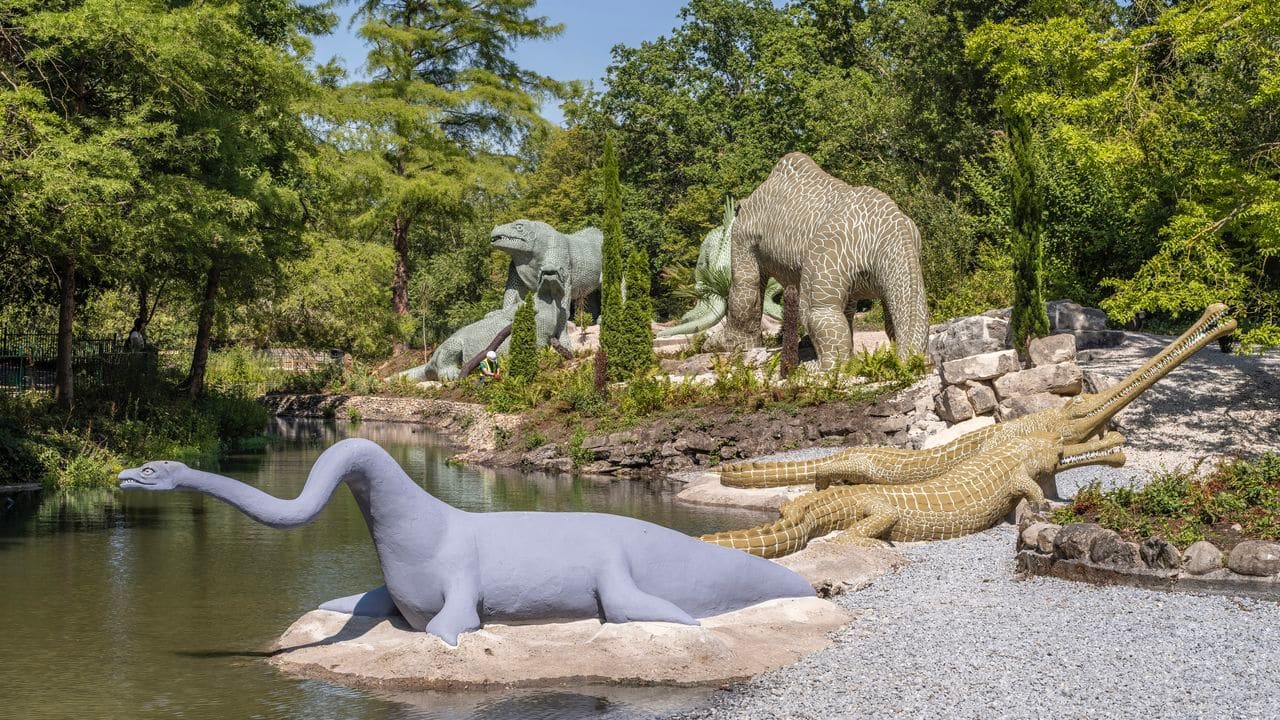
There is something deeply instructive about standing before a creature modeled with complete confidence but wholly inaccurate anatomy. The dinosaur sculptures at Crystal Palace Park, first unveiled between 1852 and 1854, represent a moment when scientific ambition outpaced scientific knowledge by several decades. Artist Benjamin Waterhouse Hawkins and paleontologist Sir Richard Owen constructed life-sized models of prehistoric animals at a time when "dinosaur" was still a novel term, coined by Owen himself barely a decade earlier. The discipline had fragments, conjecture, and Victorian certainty. What it lacked was a complete skeleton.
This month, following an extensive conservation program, these sculptures have reopened to the public as part of a broader regeneration of the Grade II* listed park. Bromley Council and Crystal Palace Park Trust led the effort, which addresses not only the sculptural court itself but also the surrounding landscape, water systems, and infrastructure that together form one of London's most idiosyncratic heritage sites.
Anatomy of a Restoration
The Geological Court, which houses the sculptures, holds Grade I listed status, the highest tier of protection in England's heritage system. Conservation specialists approached the work with methods that blend historical craft and contemporary technology. Paint analysis identified original pigments, material testing informed compatible repair compounds, and 3D printing allowed precise reconstruction of missing or eroded details. Crucially, the team prioritized the preservation of original materials wherever feasible, a decision that respects both the physical integrity of the sculptures and their status as documents of mid-19th-century making.
The intervention was significant enough to remove the sculptures from Historic England's Heritage At Risk Register, a catalog of endangered sites that require urgent attention. For structures exposed to the elements for more than 170 years, that outcome reflects not just repair but a fundamental stabilization of their long-term viability.
We have covered numerous adaptive reuse and conservation projects at World Archi Design, but few involve artifacts this conceptually odd. These are not ruins of a lost civilization or fragments of a demolished monument. They are deliberate fictions, built with the tools of empirical science, that became historically valuable precisely because they were wrong.
Landscape as Pedagogical Infrastructure
The park itself was conceived as an extension of the Crystal Palace, the cast-iron and glass pavilion designed by Sir Joseph Paxton for the 1851 Great Exhibition in Hyde Park. When the structure was relocated to Sydenham the following year, the surrounding grounds were developed as a public amenity that combined recreation, horticulture, and education. The dinosaurs were part of that educational brief, a three-dimensional textbook in an era before mass media or natural history museums as we understand them today.
Restoration work addressed the park's historic topography and sightlines, reinstating the spatial relationships that Paxton and his collaborators originally intended. The Grand Centre Walk, the park's formal spine, has been reconstructed. The Italian Terrace, a Grade II listed feature, underwent stonework repairs that stabilize its structure and clarify its architectural language. A bust of Paxton, previously displaced, has returned to its original location, a gesture that re-centers the park's authorship.
The Upper Lake, integral to the park's hydrology and aesthetic, was desilted and fitted with a recirculation system that revives its cascades. More than 7,500 tonnes of excavated soil were retained on-site and redistributed, a practical decision that also reduces the carbon cost of disposal and importation. Sediment removed from the lake was repurposed into approximately 500 square meters of habitat shelving, creating niches for aquatic and marginal species.
Ecological Retrofit Within a Heritage Framework
Contemporary landscape architecture increasingly demands that historic sites accommodate ecological function alongside heritage value. At Crystal Palace Park, that negotiation took the form of rain gardens and swales designed to manage stormwater runoff, a necessity in an urban park subject to intensifying rainfall patterns. Around 58,000 square meters of wildflower meadow and 64,000 perennial plantings now populate areas that were once celebrated for their horticultural displays. These interventions echo the park's original ambition while responding to present-day environmental imperatives.
The tension between preservation and adaptation is not new, but it becomes particularly acute in projects where the heritage asset is also a public amenity. Paxton's parks were democratic spaces, open to a broad public at a time when such access was far from guaranteed. Maintaining that accessibility required upgrades throughout the site, ensuring compliance with contemporary standards for mobility and wayfinding.
New Structures, Historic Grammar
Two new additions punctuate the restored landscape. The Penge Gate entrance has been redesigned with a modular vocabulary that references the Crystal Palace's prefabricated structural system, a nod to the building's role in the history of industrialized construction. Nearby, a timber Visitor Centre by Tate + Co provides orientation and amenities without competing visually with the historic core. Both structures demonstrate how new architecture can operate within a heritage context when it speaks the same formal language, even at a different scale.
A dinosaur-themed play area offers a more literal engagement with the site's prehistory, translating the Geological Court's didactic intent into contemporary recreational infrastructure. The installation acknowledges that pedagogy has evolved, but the desire to make learning tactile and immersive remains constant.
Precedent and Persistence
Few 19th-century public works combine ambition, error, and durability quite like these sculptures. They belong to a lineage of speculative reconstruction that includes Viollet-le-Duc's restorations of French medieval monuments and the plaster casts that populated early museum collections. All share a willingness to fill gaps in the historical record with educated guesswork, and all have since been revised or critiqued by subsequent scholarship.
Yet the sculptures endure not despite their inaccuracies but because of them. They are evidence of how knowledge is constructed, revised, and occasionally overturned. Owen and Hawkins worked with the information available to them, and the result is a snapshot of scientific understanding at a particular moment. The iguanodon, famously modeled with a horn on its nose rather than as a thumb spike, is wrong in ways that are now instructive. It teaches us as much about the history of science as it does about the creatures it purports to represent.
At World Archi Design, we have long argued that the value of built heritage lies not only in aesthetic or technical achievement but also in its capacity to document how societies understand themselves and their world. Crystal Palace Park's dinosaurs are monuments to Victorian confidence, but they are also reminders of the provisional nature of all knowledge. They stand as a counterpoint to the certainty that often accompanies new construction, a useful humility for a discipline that shapes the physical world with incomplete information and evolving values.
The Long View
The restoration secures the park's future for at least another generation, but heritage conservation is never truly complete. Materials degrade, climates shift, and public expectations evolve. What this project demonstrates is that thoughtful intervention can extend the life of a site without erasing the traces of its history. The dinosaurs remain anatomically incorrect, the landscape retains its Victorian structure, and new elements are legible as additions rather than falsifications.
This approach aligns with contemporary conservation philosophy, which privileges honesty over seamless replication. It allows the park to function as both a recreational amenity and a historical document, a place where multiple temporalities coexist without conflict. The result is not a restoration in the sense of returning to an original state, but rather a careful calibration of past ambition and present need, a model that other heritage sites might study as they navigate similar challenges.
Save this story. A free account keeps your reading list and the 07:00 email in one place.
CREATE FREE ACCOUNT →SIGN IN